Spain: What It's Famous For, Iconic Landmarks, Regions, History and the Meaning of the Spanish Flag

Spain is a country of sunshine and siestas, of flamenco, tapas and late-night dinners, but also of snowy mountains, green Atlantic coasts, volcanic islands and some of the most remarkable buildings in Europe. Romans, Visigoths, Muslims and Christians all left their mark here, and from Spain explorers set out to cross the oceans, spreading the Spanish language around the world. In this guide we explore what Spain is famous for, its most distinctive landmarks, the most popular regions and what each one offers, a timeline of Spanish history, and the meaning behind the red and yellow of the Spanish flag.
Spain at a glance
- Official name: the Kingdom of Spain (Reino de España)
- Capital: Madrid, also the largest city; other major cities include Barcelona, Valencia, Seville, Zaragoza, Málaga and Bilbao
- Population: around 49 million
- Area: about 506,000 km², the second-largest country in the European Union after France
- Languages: Spanish (Castilian) is official throughout the country; Catalan, Galician and Basque are co-official in their own regions, alongside Valencian, a form of Catalan, and Aranese in a small corner of Catalonia
- Currency: the euro (€), which replaced the Spanish peseta in 2002
- Regions: 17 autonomous communities and two autonomous cities, Ceuta and Melilla, on the North African coast
- Government: a parliamentary monarchy; King Felipe VI has been head of state since 2014, and the president of the government, usually called the prime minister in English, leads the government
- National symbols: the red and yellow flag, the coat of arms with the Pillars of Hercules and the motto Plus Ultra ("further beyond"), and the national anthem, the Marcha Real, one of the few national anthems in the world with no official lyrics
- National day: the Fiesta Nacional de España, 12 October, the anniversary of Christopher Columbus's arrival in the Americas in 1492
- Highest mountain: Mount Teide (3,715 m) on Tenerife in the Canary Islands; the highest on the mainland is Mulhacén (3,479 m) in the Sierra Nevada
- Longest river: the Tagus (Tajo), about 1,000 km long, which flows through Spain and Portugal to the Atlantic at Lisbon; the longest river entirely within Spain is the Ebro
- Standout facts: Spain is one of the most visited countries in the world, welcoming tens of millions of international visitors every year, and it has around 50 UNESCO World Heritage Sites, among the most of any country
What is Spain famous for?
Tapas and Spanish food
Spanish food is made for sharing. Tapas, small plates eaten with a drink, range from olives and patatas bravas to garlic prawns and croquettes, and in the Basque Country they become pintxos, often served on bread. Paella comes from Valencia, where it was traditionally cooked with rabbit, chicken and beans, and the tortilla de patatas, a thick potato omelette, is eaten everywhere. Spain is famous for cured ham, especially jamón ibérico, for chilled gazpacho soup in summer and for churros dipped in thick hot chocolate. It is also by far the world's largest producer of olive oil.
Wine, sherry and cava
Spain has more land under vines than any other country. Its best-known wines include the reds of Rioja and Ribera del Duero, the crisp whites of Rías Baixas in Galicia, and cava, a sparkling wine made mainly in Catalonia. In Andalusia, the town of Jerez de la Frontera gave its name to sherry, a fortified wine aged in a system of stacked barrels. On hot summer evenings, many Spaniards prefer a cold beer or a tinto de verano, red wine mixed with lemonade.
Flamenco
Born among the Roma, or gitano, communities of Andalusia and shaped by many influences, flamenco combines song, guitar, dance and rhythmic hand-clapping, and it is recognised by UNESCO as part of the world's intangible cultural heritage. Its passionate singing, called cante, and dramatic footwork can be seen in small bars, called tablaos, in Seville, Granada, Jerez and Madrid. Spain is also home to the classical guitar, and composers such as Isaac Albéniz, Manuel de Falla and Joaquín Rodrigo drew on Spanish folk music.
Art and artists
Spain has produced some of the greatest painters in history. Diego Velázquez, painter to the court of King Philip IV, created Las Meninas, and Francisco de Goya recorded both royal portraits and the horrors of war. El Greco, born in Crete, did his greatest work in Toledo. In the 20th century, Pablo Picasso, born in Málaga, co-founded Cubism, while Salvador Dalí and Joan Miró became giants of Surrealism and modern art. Madrid's Prado Museum is one of the world's finest art galleries, and Picasso's Guernica hangs in the nearby Reina Sofía.
Gaudí and architecture
Spanish architecture spans Roman aqueducts, Moorish palaces, Gothic cathedrals and daring modern buildings. Its most famous architect is Antoni Gaudí, the leading figure of Catalan modernisme, whose curving, colourful buildings in Barcelona, including the Sagrada Família, Casa Batlló, Casa Milà and Park Güell, form part of a UNESCO World Heritage Site. More recently, Frank Gehry's Guggenheim Museum in Bilbao and Santiago Calatrava's City of Arts and Sciences in Valencia have become landmarks in their own right.
Festivals
Spain loves a fiesta. In Pamplona, the San Fermín festival in July is famous for the early-morning running of the bulls, made known worldwide by Ernest Hemingway. In March, Valencia's Las Fallas fills the streets with giant satirical figures that are burned on the final night, and in August the town of Buñol holds La Tomatina, a huge tomato fight. Holy Week, or Semana Santa, brings solemn processions to cities across the country, especially in Andalusia, and Seville's April Fair is a week of flamenco dresses, horses and dancing.
Football and sport
Spain is one of the world's great football nations. Real Madrid has won the European Cup and Champions League more times than any other club, and FC Barcelona is famous for its stylish play and youth academy. The men's national team won the World Cup in 2010 and has won the European Championship a record four times (1964, 2008, 2012 and 2024), and the women's team became world champions in 2023. In tennis, Rafael Nadal won the French Open a record 14 times, and Carlos Alcaraz has followed him as a Grand Slam champion and world number one.
Literature and the Spanish language
Spanish is spoken as a first language by around 500 million people, more than any language except Mandarin Chinese, thanks largely to the spread of Spanish across the Americas. Its greatest classic is Miguel de Cervantes's Don Quixote, published in two parts in 1605 and 1615 and often called the first modern novel. Other giants of Spanish literature include the playwright Lope de Vega and the poet and dramatist Federico García Lorca, who was killed at the start of the Civil War in 1936.
Spain's most distinctive landmarks
The Alhambra, Granada
Set on a hill above Granada with the snowy Sierra Nevada behind it, the Alhambra is one of the most beautiful palace complexes in the world. Most of what visitors see today was built in the 13th and 14th centuries by the Nasrid dynasty, the last Muslim rulers in the Iberian Peninsula. Behind its plain red walls lie courtyards, fountains and halls covered in delicate carved plaster, tiles and inscriptions, including the famous Court of the Lions. In 1492 the last Nasrid sultan, Muhammad XII, known as Boabdil, handed Granada to the Catholic Monarchs, Ferdinand and Isabella. With the gardens of the Generalife and the old Albaicín quarter opposite, the Alhambra is a UNESCO World Heritage Site, and tickets often sell out weeks in advance.
The Sagrada Família, Barcelona
Barcelona's most famous building was begun in 1882, and a year later the young Antoni Gaudí took charge of the project, devoting the rest of his life to it. When he died in 1926, after being struck by a tram, only a small part was finished. Work has continued ever since, funded largely by donations and visitors' tickets, and in 2010 Pope Benedict XVI consecrated it as a basilica. Its towers are covered in sculpture inspired by nature and the Bible, and the forest-like columns and stained glass inside fill the nave with coloured light. In February 2026 the cross was completed on the central Tower of Jesus Christ, making the Sagrada Família, at about 172.5 m, the tallest church in the world, although work on other parts of the basilica is still continuing.
Park Güell, Barcelona

On a hillside above Barcelona, Park Güell was commissioned by Gaudí's patron Eusebi Güell in the early 1900s as a garden estate for wealthy families. The housing project failed, but the park became a public space, and today it is one of the city's most popular sights. Its highlights include two gingerbread-like gatehouses, a staircase guarded by a mosaic lizard, often called "the dragon", and a great terrace edged by a long serpentine bench covered in trencadís, a mosaic of broken tiles and pottery. The house where Gaudí lived for nearly twenty years is now a museum inside the park.
The Mosque-Cathedral of Córdoba

When Córdoba was the capital of al-Andalus, it was one of the largest and most sophisticated cities in Europe, and its great mosque was its pride. Begun in 785 under Abd al-Rahman I and enlarged several times over the next two centuries, the Mezquita is famous for its seemingly endless forest of columns, many of them reused from Roman and Visigothic buildings, topped by red and white striped arches. After the Christian conquest of Córdoba in 1236 it became a cathedral, and in the 16th century a Renaissance nave was built right in its centre. It is the heart of Córdoba's historic centre, a UNESCO World Heritage Site.
The Guggenheim Museum, Bilbao

Designed by the Canadian-American architect Frank Gehry and opened in 1997, the Guggenheim Museum transformed Bilbao, a struggling industrial port, into a cultural destination, an effect so famous it is now known around the world as the "Bilbao effect". Its swirling curves are clad in thin sheets of titanium that shimmer in changing light. Outside, Jeff Koons's Puppy, a giant dog covered in flowering plants, guards the entrance, while Louise Bourgeois's enormous spider, Maman, stands beside the river.
Plaza de España, Seville

Built for the Ibero-American Exposition of 1929 and designed by the architect Aníbal González, Seville's Plaza de España is a vast semicircle of brick, marble and painted ceramic tiles. Along its walls, a series of tiled alcoves represents the provinces of Spain, each with a map and a scene from its history, and a canal crossed by four bridges follows the curve of the building. The square sits on the edge of María Luisa Park and has appeared in several films, including Star Wars: Episode II – Attack of the Clones.
Santiago de Compostela Cathedral, Galicia

For more than a thousand years, pilgrims have walked across Europe to Santiago de Compostela, where tradition holds that the remains of St James the Apostle are buried. The cathedral was begun in the Romanesque style in the late 11th century, and its spectacular baroque Obradoiro façade was added in the 18th century. During some services, a giant incense burner, the Botafumeiro, is swung in great arcs across the church by a team of men pulling on ropes. Today hundreds of thousands of people a year complete the Camino de Santiago, the Way of St James, on foot or by bicycle.
The Royal Palace of Madrid

The Royal Palace was built in the 18th century on the site of an old fortress, the Alcázar, which burned down on Christmas Eve 1734. With more than 3,000 rooms, it is one of the largest royal palaces in Europe. It remains the official residence of the King of Spain, although the royal family actually lives in the smaller Zarzuela Palace outside the city, and the palace is used for state ceremonies. Visitors can tour its lavish throne room, the royal armoury and a collection of Stradivarius instruments, and next door rises the Almudena Cathedral.
The Aqueduct of Segovia, Castile and León

Built by the Romans, probably around the end of the 1st or beginning of the 2nd century AD, the Aqueduct of Segovia is one of the best-preserved Roman structures anywhere. Its granite blocks were laid without mortar, held together by their own weight, and its two tiers of arches stride across the Plaza del Azoguejo at a height of about 28 m. The aqueduct carried water to the city until modern times. Together with Segovia's Gothic cathedral and the fairy-tale Alcázar castle, it forms part of a UNESCO World Heritage Site.
The most popular regions in Spain and what they offer
Spain is made up of 17 autonomous communities, each with its own parliament, traditions and, in several cases, its own language. Here are the highlights.
Andalusia

Spain's most populous region is, for many, the essence of the country: the home of flamenco, sherry, bullfighting traditions, whitewashed villages and the great monuments of al-Andalus. Seville has a vast Gothic cathedral with its Giralda bell tower, once a minaret, and the royal palace of the Real Alcázar. Granada has the Alhambra, Córdoba its Mezquita, and Málaga, Picasso's birthplace, is the gateway to the beaches of the Costa del Sol. In the mountains, the town of Ronda is split by a deep gorge spanned by the Puente Nuevo, completed in the late 18th century.
Madrid
Spain's capital, at the very centre of the country, is famous for its art, its parks and its energy. The Prado, the Reina Sofía and the Thyssen-Bornemisza museums form the "Golden Triangle of Art" along the Paseo del Prado, which, with the Retiro Park, is a UNESCO World Heritage Site. Madrid also has the arcaded Plaza Mayor, the bustling Puerta del Sol, from where distances on Spain's main roads are measured, and the Santiago Bernabéu, home of Real Madrid. Its tapas bars and late-night streets rarely sleep, and Toledo, Segovia and the royal monastery of El Escorial are easy day trips.
Catalonia
In the north-east, Catalonia has its own language, Catalan, and a strong identity of its own. Barcelona, Spain's second-largest city, combines Gaudí's masterpieces with the medieval lanes of the Gothic Quarter, the bustling La Rambla, the Boqueria food market and city beaches. Inland, the monastery of Montserrat sits among extraordinary jagged peaks, and the medieval city of Girona has a well-preserved Jewish quarter. Along the coast, the coves of the Costa Brava lead to Figueres, home of the Dalí Theatre-Museum. Catalonia is also famous for its castells, human towers built at festivals, recognised by UNESCO.
Valencian Community

Valencia, Spain's third-largest city, is the home of paella and of the Las Fallas festival. Its futuristic City of Arts and Sciences, designed largely by the Valencian architect Santiago Calatrava, includes a science museum, an opera house, a planetarium and one of Europe's largest aquariums, set along the old bed of the River Turia, which was turned into a long green park after a devastating flood in 1957. The old town has a Gothic cathedral and the UNESCO-listed Silk Exchange, and to the south, the Costa Blanca offers the beaches of Alicante and Benidorm.
The Basque Country

On the Bay of Biscay, the Basque Country, or Euskadi, has green hills, a rugged coast and a language, Basque (Euskara), that is not related to any other living language. San Sebastián, curving around the elegant Bay of La Concha, is one of Europe's great food cities, famous for its pintxos bars and its many Michelin-starred restaurants. Bilbao has the Guggenheim and a charming old quarter, and on the coast the hermitage of San Juan de Gaztelugatxe, reached by a winding stone stairway, became famous as a filming location for Game of Thrones.
Galicia
In the far north-west, Galicia is a green, rainy land of misty hills, granite villages and deep coastal inlets called rías. Its capital, Santiago de Compostela, is the destination of the Camino de Santiago. Galicia has its own language, Galician, closely related to Portuguese, and a Celtic heritage that lives on in its bagpipe music. It is also famous for its seafood, especially octopus, scallops and mussels. In A Coruña, the Tower of Hercules is a Roman lighthouse that still guides ships today and is a UNESCO World Heritage Site.
The Balearic Islands

In the Mediterranean, the Balearic Islands of Mallorca, Menorca, Ibiza and Formentera are among Europe's favourite holiday destinations. Mallorca's capital, Palma, is dominated by its great Gothic cathedral, La Seu, whose interior was partly reworked by Gaudí in the early 20th century, and the island's Serra de Tramuntana mountains are a UNESCO World Heritage cultural landscape. Ibiza is known worldwide for its clubs as well as its quiet coves and old town, Menorca is a UNESCO biosphere reserve dotted with prehistoric stone monuments, and Formentera has some of the clearest waters in the Mediterranean.
The Canary Islands

Far out in the Atlantic, off the coast of north-west Africa, the volcanic Canary Islands enjoy mild weather all year round. On Tenerife, Mount Teide is the highest peak in Spain and the centrepiece of a national park that is a UNESCO World Heritage Site, while Gran Canaria has sweeping sand dunes at Maspalomas. Lanzarote's black volcanic landscapes were shaped into art by the local artist César Manrique, and on La Palma a volcanic eruption in 2021 lasted for nearly three months, burying more than a thousand buildings under lava. The islands' clear skies also make them home to some of the world's leading astronomical observatories.
Castile and León

Spain's largest region by area is the historic heartland of Castile, a land of high plains, castles and cathedrals. Salamanca is famous for its golden sandstone buildings, its university, founded in 1218 and the oldest in Spain still operating, and its grand 18th-century Plaza Mayor. Segovia has its aqueduct and Alcázar, Ávila is surrounded by medieval walls with dozens of towers, and the Gothic cathedrals of Burgos and León are among the finest in Spain. Near Burgos, the caves of Atapuerca have yielded some of the oldest human remains in Western Europe.
Castilla-La Mancha

South of Madrid, Toledo stands on a rocky hill almost encircled by the River Tagus. Known as the "City of Three Cultures", it was for centuries a meeting place of Christians, Muslims and Jews, and its streets hold a Gothic cathedral, synagogues, a former mosque and the paintings of El Greco, who lived here for nearly forty years. Further south, the plains of La Mancha, with their white windmills on the ridges at Consuegra and Campo de Criptana, are the landscape of Don Quixote. The region is also known for Manchego cheese, saffron and the "hanging houses" of Cuenca, built on the edge of a cliff.
Asturias and Cantabria

Along the north coast, "Green Spain" offers a cooler, wetter landscape of mountains, meadows and dramatic beaches. The limestone peaks of the Picos de Europa, shared by Asturias, Cantabria and Castile and León, became Spain's first national park in 1918. In Asturias, the shrine of Covadonga marks the site of a battle traditionally seen as the start of the Christian Reconquista, and cider is poured from a great height to give it sparkle. In Cantabria, the cave of Altamira contains some of the most famous prehistoric paintings in the world, and visitors can see a faithful replica in the museum next to it.
A timeline of Spanish history
- Over a million years ago: Early humans live at Atapuerca, near Burgos, among the oldest known human sites in Western Europe.
- c. 36,000–13,000 years ago: Prehistoric artists paint and engrave the walls of the cave of Altamira in Cantabria.
- c. 1100 BC: The Phoenicians found Gadir, today's Cádiz, according to tradition, making it one of the oldest cities in Western Europe.
- 218 BC: Roman troops land in Iberia during the Second Punic War, beginning the Roman conquest of Hispania.
- 19 BC: Rome completes its conquest of the peninsula under the emperor Augustus.
- 5th–6th centuries: The Visigoths establish a kingdom in Hispania, later with its capital at Toledo.
- 711: Muslim forces cross from North Africa and conquer most of the Iberian Peninsula within a few years.
- c. 722: The Battle of Covadonga, traditionally seen as the beginning of the Christian Reconquista.
- 929: Abd al-Rahman III proclaims the Caliphate of Córdoba.
- 1085: Alfonso VI of Castile captures Toledo.
- 1212: Christian kingdoms defeat the Almohads at the Battle of Las Navas de Tolosa.
- 13th–14th centuries: The Nasrid rulers of Granada build the Alhambra.
- 1469: Isabella of Castile marries Ferdinand of Aragon, uniting the two leading Spanish crowns.
- 1492: Granada surrenders to the Catholic Monarchs, Jews who refuse to convert are expelled, and Columbus reaches the Americas on 12 October.
- 1521: Hernán Cortés and his Indigenous allies capture the Aztec capital, Tenochtitlan.
- 1530s: Francisco Pizarro conquers the Inca Empire.
- 1556: Philip II becomes king of a vast empire; in 1561 he makes Madrid the capital.
- 1588: The Spanish Armada fails in its attempt to invade England.
- 1605: The first part of Cervantes's Don Quixote is published.
- 1609: The expulsion of the Moriscos, descendants of Spain's Muslims, begins.
- 1701–1714: The War of the Spanish Succession brings the Bourbon dynasty to the throne.
- 1785: King Charles III chooses a red and yellow ensign for Spain's navy.
- 1808–1814: Spain fights the Peninsular War against Napoleon's occupation, starting with the Madrid uprising of 2 May 1808.
- 1812: The liberal Constitution of Cádiz is proclaimed.
- 1810s–1820s: Most of Spain's colonies in the Americas win their independence.
- 1898: Spain loses Cuba, Puerto Rico and the Philippines after the Spanish-American War.
- 1931: The Second Republic is proclaimed, and its new constitution gives women the vote.
- 1936–1939: The Spanish Civil War.
- 1937: The bombing of the Basque town of Guernica inspires Picasso's famous painting.
- 1939–1975: General Francisco Franco rules Spain as a dictator.
- 1975: Franco dies and Juan Carlos I becomes king, opening the way to democracy.
- 1978: Spaniards approve a democratic constitution in a referendum.
- 1981: An attempted military coup fails on 23 February.
- 1986: Spain joins the European Economic Community, today's European Union.
- 1992: Barcelona hosts the Summer Olympics and Seville hosts the Expo.
- 2002: Euro notes and coins replace the peseta.
- 2004: Bombings on Madrid commuter trains on 11 March kill 193 people.
- 2005: Spain becomes one of the first countries in the world to legalise same-sex marriage.
- 2010: Spain wins the men's football World Cup for the first time.
- 2014: King Juan Carlos I abdicates, and his son becomes King Felipe VI.
- 2017: An independence referendum in Catalonia, ruled unconstitutional by Spain's courts, leads to a constitutional crisis and a period of direct rule of the region from Madrid.
- 2023: Spain wins the women's football World Cup.
- 2024: Spain wins a record fourth European Championship, and catastrophic flash floods kill more than 220 people in the Valencia region.
- 2025: A nationwide power blackout on 28 April leaves most of Spain and Portugal without electricity for several hours.
- 2026: The cross is completed on the Sagrada Família's central tower, in the centenary year of Gaudí's death.
The Spanish flag: its history and meaning
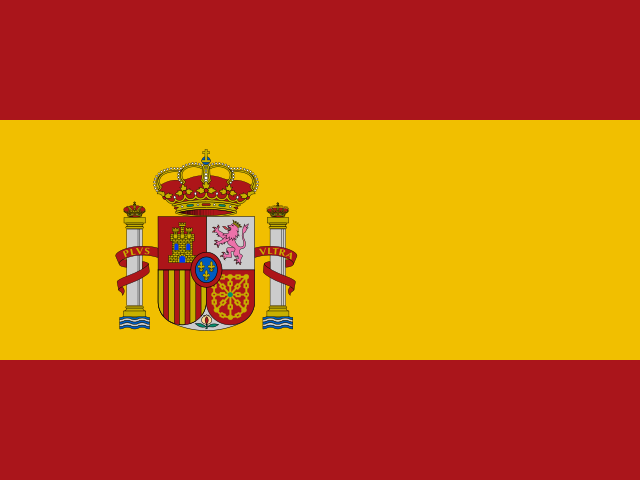
The Spanish flag has three horizontal stripes, red, yellow and red, with the central yellow stripe twice the height of each red one. On official flags, the coat of arms of Spain sits on the yellow stripe, nearer the flagpole. Its nickname is la Rojigualda, from rojo (red) and gualda, an old word for a golden yellow.
What the colours and symbols mean
- There is no official meaning for the colours. Red and yellow are historically linked to the old kingdoms of Spain: the red and gold stripes of the Crown of Aragon, and the gold castle on red of Castile.
- "Blood and gold" is a popular poetic reading of the colours, but it is a later interpretation rather than their origin.
- The coat of arms combines the symbols of the historic kingdoms: a castle for Castile, a lion for León, red and gold stripes for Aragon, chains for Navarre and a pomegranate for Granada, with the fleurs-de-lis of the Bourbon dynasty in the centre.
- The Pillars of Hercules on either side represent the Strait of Gibraltar, wrapped in a banner reading Plus Ultra, "further beyond", a motto adopted by Charles I that came to symbolise Spain's voyages beyond the known world.
Where the flag came from
Until the late 18th century, Spain's ships flew mainly white flags bearing the royal arms, which were easily confused at sea with the flags of other kingdoms ruled by the Bourbon family. In 1785, King Charles III held a competition and chose a red and yellow design for the navy, so that Spanish ships could be recognised from far away. The colours spread to army units and fortresses, and in 1843 Queen Isabella II made the red and yellow flag the national flag of Spain.
The flag has changed only at moments of great upheaval. The Second Republic, from 1931 to 1939, used a flag of red, yellow and purple stripes. Franco's regime restored red and yellow, adding a coat of arms with a black eagle. The current coat of arms was adopted in 1981, and the flag is set out in Article 4 of the 1978 constitution.
Flag facts most people get wrong
- The stripes are not equal. The yellow stripe is twice as tall as each red stripe, giving proportions of 1:2:1.
- The coat of arms is not centred. On the official flag, the arms sit on the yellow stripe closer to the flagpole.
- The plain version is allowed. Private citizens may fly the red and yellow flag without the coat of arms, while official buildings use the version with it.
- It is not the Catalan flag. Catalonia's flag, the Senyera, has four red stripes on a gold background, inherited from the old Crown of Aragon.
The Spanish people: many regions, one shared love of life
Spaniards often feel a strong attachment to their region, and in several of them, especially Catalonia, the Basque Country and Galicia, a distinct language and culture are central to people's sense of who they are. The 1978 constitution recognises these "nationalities and regions" and gives the autonomous communities wide powers, and debates about the balance between regional self-government and the Spanish state remain an important part of political life. From Andalusian flamenco to Galician bagpipes and Basque pelota, Spain's regional traditions are a major source of its richness.
Social life is one of the great pleasures of Spain. Families often gather for long weekend lunches, friends meet on terraces and in tapas bars, and squares are full of children playing late into the evening. Spaniards enjoy one of the highest life expectancies in the world, often linked to the Mediterranean diet, an active outdoor lifestyle and close family ties. In recent decades Spain has also become a country of immigration, with millions of residents born abroad, many of them from Latin America, Morocco and Romania.
Spain's influence reaches far beyond its borders. The Spanish language, Catholic traditions, architecture and festivals spread across Latin America, the Philippines and beyond, and many Spaniards emigrated in the 19th and 20th centuries to Argentina, Cuba, Mexico, Venezuela and other countries. Today the bonds between Spain and the Spanish-speaking world remain deep, celebrated each 12 October on Spain's national day.
Frequently asked questions about Spain
What is Spain most famous for?
Spain is famous for the Alhambra, the Sagrada Família and the works of Gaudí; for tapas, paella, jamón and olive oil; for flamenco, festivals such as San Fermín and Las Fallas; for painters such as Velázquez, Goya, Picasso and Dalí; for football clubs such as Real Madrid and FC Barcelona; and for its beaches and islands, from the Costa del Sol to Mallorca and the Canary Islands.
What do the colours of the Spanish flag mean?
The red and yellow colours have no official meaning, but they come from the historic colours of the Crown of Aragon and the Kingdom of Castile. They were chosen by King Charles III in 1785 for the navy, so that Spanish ships could be recognised at sea, and became the national flag in 1843. The popular phrase "blood and gold" is a later poetic interpretation.
What is the capital of Spain?
Madrid is the capital and largest city of Spain. It has been the capital almost continuously since King Philip II moved his court there in 1561, chosen partly because of its central position in the Iberian Peninsula.
How many autonomous communities does Spain have?
Spain has 17 autonomous communities: Andalusia, Aragon, Asturias, the Balearic Islands, the Basque Country, the Canary Islands, Cantabria, Castile and León, Castilla-La Mancha, Catalonia, Extremadura, Galicia, La Rioja, Madrid, Murcia, Navarre and the Valencian Community. There are also two autonomous cities, Ceuta and Melilla, in North Africa.
What languages are spoken in Spain?
Spanish, also called Castilian, is the official language of the whole country. Catalan (known as Valencian in the Valencian Community), Galician and Basque are co-official in their regions, and Aranese, a form of Occitan, is co-official in Catalonia. Many Spaniards are bilingual.
Own a square of the Spanish flag
On 195 Flags, the flag of Spain is being rebuilt one square at a time by people in Spain and around the world. Claim your square for $1.99 and seal a message and a photo inside it: a time capsule for your future self and the generations who come after you. And when the Spanish flag is completely filled, one square owner wins $40,000.
Claim your square of the Spanish flag →
Photo credits
- Alhambra and Sierra Nevada, Granada (cover): Adam Jones, Ph.D., CC BY-SA 3.0, via Wikimedia Commons
- Mosaic bench, Park Güell: Danbu14, CC BY-SA 3.0, via Wikimedia Commons
- Arches of the Mosque-Cathedral of Córdoba: Sharon Mollerus from Minneapolis, United States, CC BY 2.0, via Wikimedia Commons
- Guggenheim Museum Bilbao: kallerna, CC BY-SA 4.0, via Wikimedia Commons
- Plaza de España, Seville: Alvesgaspar, CC BY-SA 4.0, via Wikimedia Commons
- Santiago de Compostela Cathedral: Luis Miguel Bugallo Sánchez, CC BY-SA 3.0, via Wikimedia Commons
- Royal Palace of Madrid: kallerna, CC BY-SA 4.0, via Wikimedia Commons
- Aqueduct of Segovia: Benjamin Smith, CC BY-SA 4.0, via Wikimedia Commons
- Puente Nuevo, Ronda: Wolfgang Moroder, CC BY-SA 3.0, via Wikimedia Commons
- City of Arts and Sciences, Valencia: Sunnya343, CC BY-SA 4.0, via Wikimedia Commons
- Bay of La Concha, San Sebastián: Kent Wang, CC BY-SA 4.0, via Wikimedia Commons
- Palma Cathedral, Mallorca: Arieleisenhammer, CC BY-SA 4.0, via Wikimedia Commons
- Mount Teide, Tenerife: Ingo Mehling, CC BY-SA 4.0, via Wikimedia Commons
- Plaza Mayor, Salamanca: Anual, CC BY-SA 4.0, via Wikimedia Commons
- Toledo skyline: Diliff, CC BY 2.5, via Wikimedia Commons
- Picos de Europa, Asturias: Bikerhiker75, CC BY-SA 4.0, via Wikimedia Commons
The Spanish flag image is from 195flags.com.


