Brazil: What It's Famous For, Iconic Landmarks, States, History and the Meaning of the Brazilian Flag

Brazil is a country on a giant scale: the largest nation in South America, home to most of the Amazon rainforest, thousands of kilometres of Atlantic beaches and some of the world's biggest and most exuberant cities. It is the land of samba and Carnival, of five football World Cups, of Christ the Redeemer and Iguaçu Falls, and of a people whose Indigenous, African, European and Asian roots have created one of the most diverse cultures on Earth. In this guide we explore what Brazil is famous for, its most distinctive landmarks, the most popular states and what each one offers, a timeline of Brazilian history, and the meaning behind the green, yellow and blue of the Brazilian flag, with its starry sky and motto Ordem e Progresso.
Brazil at a glance
- Official name: the Federative Republic of Brazil (República Federativa do Brasil)
- Capital: Brasília, a planned city inaugurated in 1960; the largest city is São Paulo, followed by Rio de Janeiro, and other major cities include Salvador, Fortaleza, Belo Horizonte, Manaus and Curitiba
- Population: around 210 million, the largest in Latin America
- Area: about 8.5 million km², the fifth-largest country in the world; Brazil borders every South American country except Chile and Ecuador
- Language: Portuguese, making Brazil by far the largest Portuguese-speaking country in the world; Brazilian Sign Language (Libras) is also legally recognised, and more than 250 Indigenous languages are still spoken
- Currency: the Brazilian real (BRL), introduced in 1994
- Administrative divisions: 26 states and the Federal District, where Brasília is located, grouped into five large regions: the North, Northeast, Centre-West, Southeast and South
- Government: a federal presidential republic; the president is both head of state and head of government and is elected for a four-year term
- National symbols: the constitution names four: the flag, the coat of arms, the national seal and the national anthem; the motto Ordem e Progresso ("Order and Progress") appears on the flag
- National day: Independence Day, 7 September, marking the declaration of independence from Portugal in 1822
- Highest mountain: Pico da Neblina (about 2,995 m), on the border with Venezuela in the Amazon rainforest
- Longest river: the Amazon, one of the two longest rivers in the world and by far the largest by volume of water, which rises in the Peruvian Andes and flows across northern Brazil to the Atlantic; the longest river entirely within Brazil is the São Francisco
- Standout facts: around 60% of the Amazon rainforest lies in Brazil, which is one of the most biodiverse countries on the planet, and Brazil has won the men's football World Cup more times than any other nation
What is Brazil famous for?
Carnival
Brazil's Carnival, held in the days before Lent, is one of the biggest parties on Earth. In Rio de Janeiro, the great samba schools compete in the Sambadrome, a parade avenue designed by Oscar Niemeyer, with thousands of dancers, drummers and dazzling floats, while hundreds of free street parties, called blocos, fill the city. In Salvador, crowds follow trios elétricos, lorries carrying bands and huge sound systems, through the streets, and in Recife and Olinda people dance the fast, acrobatic frevo, recognised by UNESCO, among giant puppets.
Football
Football is close to a national religion in Brazil. The men's team, the Seleção, has won the World Cup five times, in 1958, 1962, 1970, 1994 and 2002, more than any other country, and is the only team to have played at every World Cup. Brazil has produced legends such as Pelé, Garrincha, Zico, Ronaldo, Ronaldinho and Neymar, and Marta, six times named the world's best female player. Brazil hosted the World Cup in 1950 and 2014, and is due to host the Women's World Cup in 2027, the first to be held in South America. Rio's Maracanã stadium is one of the most famous football grounds in the world.
Samba, bossa nova and Brazilian music
Brazilian music is as varied as the country. Samba, with its roots in Afro-Brazilian communities of Bahia and Rio de Janeiro, is the heartbeat of Carnival. In the late 1950s, musicians such as João Gilberto, Antônio Carlos Jobim and the poet Vinicius de Moraes created bossa nova, a gentle, jazz-influenced style that went around the world with songs such as "The Girl from Ipanema". The 1960s brought the bold Tropicália movement of Caetano Veloso and Gilberto Gil, and today Brazilians also love sertanejo, a country-style music, the accordion-led forró of the Northeast and funk carioca from Rio.
Brazilian food and drink
Brazil's national dish is often said to be feijoada, a rich stew of black beans and pork, traditionally served on Saturdays with rice, farofa (toasted cassava flour), greens and orange slices. Brazilians are famous for their barbecue, churrasco, served in churrascarias where waiters carve skewers of meat at the table. Other favourites include pão de queijo, cheese bread from Minas Gerais, moqueca, a fish stew made with coconut milk and palm oil in Bahia, acarajé, black-eyed-pea fritters, the chocolate sweets called brigadeiros, and açaí, a dark purple berry from the Amazon. The national cocktail, the caipirinha, is made with cachaça, a spirit distilled from sugar cane, and Brazil has been the world's largest coffee producer for well over a century.
The Amazon and Brazil's nature
The Amazon rainforest is the largest tropical rainforest on Earth, and around 60% of it lies in Brazil. It is home to a staggering variety of life, from jaguars, giant otters and pink river dolphins to tens of thousands of plant species, and it plays a vital role in the world's climate. Brazil's other great natural regions include the Pantanal, one of the largest tropical wetlands in the world, the Cerrado, a vast tropical savanna, and the Atlantic Forest, which once covered much of the coast and still shelters many species found nowhere else. Protecting these ecosystems is one of the country's biggest challenges.
Beaches and beach culture
With around 7,500 km of coastline, Brazil has beaches for every taste, from the urban sands of Copacabana and Ipanema to the dunes and lagoons of the Northeast and the islands of the South. Beach life is central to culture in coastal cities: people meet friends, play futevôlei (footvolley) and beach football, drink coconut water and eat grilled cheese on sticks sold by passing vendors. The famous small swimsuits and flip-flops are part of the national style too.
Capoeira
Capoeira is a uniquely Brazilian blend of martial art, dance, music and acrobatics, developed among enslaved Africans and their descendants. Two players face each other inside a circle, the roda, moving to the rhythm of the berimbau, a single-stringed bow, along with drums and singing. Once persecuted, it is now practised around the world, and the capoeira circle is recognised by UNESCO as part of humanity's intangible cultural heritage.
Architecture and design
Brazil is famous for its bold modernist architecture. Oscar Niemeyer, one of the most influential architects of the 20th century, designed the flowing curves of Brasília's government buildings and cathedral, the Pampulha complex in Belo Horizonte and many other works. The landscape architect Roberto Burle Marx created gardens and public spaces across the country, including the reworking and extension of Copacabana's famous wave-patterned promenade in the 1970s, inspired by Portuguese pavements.
Motor racing, aviation and invention
Brazil has a proud motor-racing history: Emerson Fittipaldi, Nelson Piquet and Ayrton Senna were all Formula One world champions, and Senna, who died in a crash in 1994, remains a national hero. Brazilians also celebrate Alberto Santos-Dumont, an aviation pioneer who flew his 14-bis aeroplane in Paris in 1906 and whom many Brazilians regard as the true father of flight. In the arts, Brazilian literature includes Machado de Assis, Jorge Amado and Clarice Lispector, and in 2025 the film I'm Still Here (Ainda Estou Aqui) won Brazil's first Oscar for Best International Feature Film.
Brazil's most distinctive landmarks
Christ the Redeemer, Rio de Janeiro
With its arms spread wide above the city, Christ the Redeemer (Cristo Redentor) has become a symbol of Rio de Janeiro and of Brazil itself. It stands on the summit of Corcovado, a granite peak about 700 m high in the Tijuca National Park, one of the largest urban forests in the world. The statue was designed by the Brazilian engineer Heitor da Silva Costa and sculpted by the French sculptor Paul Landowski, with the face made by the Romanian sculptor Gheorghe Leonida. Built of reinforced concrete covered in thousands of small soapstone tiles, it is about 30 m tall, standing on an 8 m pedestal, and its arms stretch about 28 m. It was inaugurated in 1931 and named one of the "New Seven Wonders of the World" in a popular vote in 2007. Visitors reach the top by a cog railway through the forest or by road.
Sugarloaf Mountain, Rio de Janeiro

Rising about 396 m straight out of the water at the mouth of Guanabara Bay, Sugarloaf Mountain (Pão de Açúcar) is Rio's other great icon. A cable car, first opened in 1912 and among the earliest in the world, carries visitors in two stages, via the smaller Morro da Urca, to the summit. From the top, the views take in Copacabana beach, the bay, the city and Christ the Redeemer on Corcovado, especially at sunset. Rio's dramatic setting between the mountains and the sea is a UNESCO World Heritage Site.
Iguaçu Falls, Paraná

On the border between Brazil and Argentina, the Iguaçu River tumbles over a horseshoe-shaped cliff almost 3 km wide in a series of around 275 waterfalls. The most spectacular is the Devil's Throat (Garganta do Diabo), where much of the river pours into a narrow chasm. Argentina has most of the falls, while the Brazilian side offers the best panoramic views and a walkway that leads out over the water into the spray. The national parks on both sides are UNESCO World Heritage Sites, home to toucans, coatis and clouds of butterflies, and nearby is the Itaipu Dam, shared with Paraguay, one of the largest hydroelectric power plants in the world.
Copacabana and Ipanema, Rio de Janeiro

Copacabana's curving beach, about 4 km long, is one of the most famous stretches of sand in the world, backed by the Avenida Atlântica and its black and white wave-patterned promenade. Every New Year's Eve, crowds often estimated in the millions gather here, many dressed in white, for fireworks, and many throw flowers into the sea for Iemanjá, the Afro-Brazilian goddess of the sea. Free concerts on the beach, including those by the Rolling Stones in 2006, Madonna in 2024 and Lady Gaga in 2025, have drawn crowds reported to be among the largest in music history. Next door, Ipanema, made world-famous by bossa nova, is known for its stylish beach life and its sunsets behind the twin peaks of Dois Irmãos.
The Selarón Steps, Rio de Janeiro

Linking the bohemian neighbourhoods of Lapa and Santa Teresa, the Escadaria Selarón is a staircase of around 215 steps covered in thousands of colourful tiles. It was the life's work of the Chilean-born artist Jorge Selarón, who began decorating the steps outside his home around 1990 as a tribute to the Brazilian people. Many of the tiles were sent to him by visitors from around the world, and the green, yellow and blue of the Brazilian flag feature prominently along the walls. Selarón died in 2013, but his steps remain one of the most photographed places in Rio.
Brasília's modernist cathedral and government buildings

Built from scratch on the high plateau of central Brazil, Brasília was planned by the urban planner Lúcio Costa with its main buildings designed by Oscar Niemeyer, and was inaugurated as the capital in 1960. Seen from above, its central plan is often compared to an aeroplane or a bird. Its most famous buildings stand along the Esplanade of the Ministries: the National Congress, with its twin towers and two bowl-shaped chambers, the Planalto Palace and the Metropolitan Cathedral, whose sixteen curving concrete columns rise like hands reaching towards the sky. Brasília is a UNESCO World Heritage Site, one of the few modern cities to be recognised in this way.
The Meeting of the Waters, Amazonas

Just downstream from Manaus, in the heart of the Amazon, the dark, tea-coloured Rio Negro meets the sandy, pale brown Solimões, as the upper Amazon is known in Brazil. Because the two rivers differ in temperature, speed and the amount of sediment they carry, their waters flow side by side for several kilometres before they finally mix, forming a sharp line that can be seen clearly from a boat. From here onwards, Brazilians call the combined river the Amazonas. Boat trips from Manaus visit the meeting point, and many continue to see giant water lilies and pink river dolphins.
The Amazon Theatre, Manaus

Few buildings tell the story of the Amazon rubber boom like the Teatro Amazonas. Opened in 1896, when Manaus had grown rich on rubber, the opera house was built with materials shipped from Europe, including Italian marble and Venetian glass chandeliers. Its dome is covered in tens of thousands of glazed tiles, brought from France, in the green, yellow and blue of the Brazilian flag. After the rubber boom collapsed, the theatre fell into neglect, but it has been restored and today hosts the annual Amazonas Opera Festival.
Pelourinho, Salvador

The old upper town of Salvador, Brazil's first capital, is known as the Pelourinho, after the pillory that once stood in its main square. Its steep cobbled streets are lined with pastel-coloured colonial houses and baroque churches, including the Church of São Francisco, whose interior is covered in gilded carving. Salvador was one of the main ports of the transatlantic slave trade, and its African heritage shapes the city's music, food, religion and festivals. The historic centre is a UNESCO World Heritage Site, and the drumming group Olodum became internationally famous when Michael Jackson filmed a music video here in 1996.
The most popular states in Brazil and what they offer
Brazil is a federation of 26 states and the Federal District, spread across five regions with very different landscapes and cultures. Here are some of the highlights.
Rio de Janeiro
The state of Rio de Janeiro is home to the city that many people picture when they think of Brazil, the Cidade Maravilhosa, or "Marvellous City", with its beaches, mountains, Carnival and samba. Beyond the city, the colonial town of Paraty, with its whitewashed houses and cobbled streets, and the car-free island of Ilha Grande are UNESCO-listed for their culture and nature. In the mountains, Petrópolis was the summer retreat of Brazil's emperors, and to the east, the resort of Búzios has dozens of beaches.
São Paulo

São Paulo is Brazil's economic powerhouse and one of the largest cities in the world, with more than 20 million people in its metropolitan area. It is a city of skyscrapers, museums, nightlife and food from every corner of the globe, shaped by waves of Italian, Portuguese, Japanese, Lebanese and other immigrants; it is home to the largest Japanese community outside Japan, centred on the Liberdade district. On Avenida Paulista, the São Paulo Museum of Art (MASP), designed by Lina Bo Bardi and held up by two great red frames, houses one of the finest art collections in Latin America. Ibirapuera Park has buildings by Niemeyer, and the state's coast has fine beaches around Ubatuba and Ilhabela.
Bahia

Bahia is often described as the heartland of Afro-Brazilian culture. Its capital, Salvador, is famous for the Pelourinho, Carnival, capoeira, the Candomblé religion and its spicy cooking. The coast was where Pedro Álvares Cabral first landed in 1500, near Porto Seguro, and it is lined with beaches and islands, such as Morro de São Paulo and the Bay of All Saints. Inland, Chapada Diamantina National Park is a land of table mountains, caves, waterfalls and natural swimming pools, once the scene of a diamond rush in the 19th century.
Amazonas and Pará
The vast states of Amazonas and Pará cover much of the Brazilian Amazon. Manaus, a city of more than 2 million people in the middle of the rainforest, is the gateway to jungle lodges, river cruises and the Meeting of the Waters. Near the mouth of the Amazon, Belém is known for the Ver-o-Peso market, its Amazonian food and the Círio de Nazaré, one of the largest religious processions in the world, held every October. In November 2025, Belém hosted COP30, the United Nations climate conference.
Minas Gerais

Inland from Rio, Minas Gerais, "General Mines", grew rich in the 18th century from one of the world's great gold rushes. Its colonial towns, including Ouro Preto, Mariana, Tiradentes and Congonhas, are filled with baroque churches decorated with the sculptures of Aleijadinho, Brazil's most celebrated colonial artist, whose work includes the Church of São Francisco de Assis in Ouro Preto. Minas is also famous for its home cooking, pão de queijo and cachaça, and near the capital, Belo Horizonte, the vast Inhotim park combines contemporary art with botanical gardens.
The Pantanal: Mato Grosso and Mato Grosso do Sul

Shared by the states of Mato Grosso and Mato Grosso do Sul, the Pantanal is one of the largest tropical wetlands in the world, flooding each rainy season and drying out into grasslands and lagoons. It is one of the best places in the Americas to see wildlife, including jaguars, capybaras, caimans, giant anteaters, hyacinth macaws and the jabiru stork, symbol of the region. Part of the Pantanal is a UNESCO World Heritage Site. In Mato Grosso do Sul, the town of Bonito is famous for snorkelling in crystal-clear rivers full of fish.
Pernambuco

In the Northeast, Pernambuco combines history, culture and beaches. Its capital, Recife, is crossed by rivers and bridges and was for a time the centre of Dutch Brazil in the 17th century, and next door the hilltop town of Olinda, with its colonial churches and colourful houses, is a UNESCO World Heritage Site famous for its street Carnival. To the south are the natural pools of Porto de Galinhas, and far out in the Atlantic, the archipelago of Fernando de Noronha, a protected marine park, has some of the most beautiful beaches in Brazil and is famous for spinner dolphins and sea turtles.
Maranhão

On the northern coast, Maranhão is home to one of Brazil's most surprising landscapes: Lençóis Maranhenses National Park, where white sand dunes stretch inland from the sea. During the rainy season, water collects between the dunes to form thousands of blue and green lagoons, usually at their fullest from around June to September. The park was added to UNESCO's World Heritage List in 2024. The state capital, São Luís, founded by the French in 1612, has a UNESCO-listed historic centre of buildings decorated with Portuguese tiles, and is known for the Bumba Meu Boi festival.
Santa Catarina and the South

Brazil's southern states, Paraná, Santa Catarina and Rio Grande do Sul, have a cooler climate and strong European influences. Florianópolis, the capital of Santa Catarina, lies mostly on an island with dozens of beaches, lagoons and surf spots, and the city of Blumenau holds one of the largest Oktoberfests outside Germany. Curitiba, the capital of Paraná, is known for its urban planning and pioneering bus system, and Rio Grande do Sul is the land of the gaúchos, cowboys of the southern plains, of churrasco and chimarrão, a bitter herbal tea, and of the vineyards of the Serra Gaúcha.
The Federal District
The Federal District is home to Brasília, the capital since 1960. Beyond its famous government buildings, the city has the TV Tower with views over the whole plan, Lake Paranoá, created when the city was built, the JK Bridge with its three steel arches, and the colourful Dom Bosco Sanctuary, lit by deep blue stained glass. Brasília's spacious superblocks of apartments, each with its own green spaces and schools, were an experiment in modern living that is still studied by architects and planners.
A timeline of Brazilian history
- By at least 11,000 years ago: People live in what is now Brazil; the skull known as "Luzia", found in Minas Gerais, is among the oldest human remains in the Americas.
- c. 400–1400: The Marajoara culture flourishes on Marajó Island at the mouth of the Amazon, known for its elaborate painted pottery.
- 1494: The Treaty of Tordesillas divides the lands newly encountered by Europeans between Spain and Portugal.
- 1500: Pedro Álvares Cabral lands on the coast of Bahia on 22 April and claims the land for Portugal.
- Early 16th century: The trade in brazilwood, a tree that yielded a red dye, gives the country its name.
- 1532: São Vicente is founded, the first permanent Portuguese settlement.
- 1549: Salvador is founded as the capital of Portuguese America, and the first Jesuits arrive.
- 1554: Jesuit missionaries found the settlement that becomes São Paulo.
- 1565: Rio de Janeiro is founded.
- 16th–19th centuries: Around 4 to 5 million enslaved Africans are brought to Brazil, more than to any other country in the Americas, to work on sugar plantations, in mines and in cities.
- 1630–1654: The Dutch control much of north-eastern Brazil, ruling from Recife.
- 1690s: Gold is discovered in Minas Gerais, starting a gold rush.
- 1695: Zumbi, leader of the Palmares quilombo, a large community of people who had escaped slavery, is killed on 20 November; the date is now Black Consciousness Day.
- 1763: The colonial capital moves from Salvador to Rio de Janeiro.
- 1792: Tiradentes, a leader of the Minas Gerais independence plot, is executed.
- 1808: The Portuguese royal family and court arrive in Rio de Janeiro, escaping Napoleon's invasion of Portugal.
- 1815: Brazil is raised to a kingdom, united with Portugal and the Algarves.
- 1822: Prince Pedro declares independence on 7 September and becomes Emperor Pedro I.
- 1831: Pedro I abdicates in favour of his five-year-old son, the future Pedro II.
- 1864–1870: Brazil, Argentina and Uruguay fight Paraguay in the War of the Triple Alliance.
- 1888: Princess Isabel signs the Golden Law on 13 May, abolishing slavery; Brazil is the last country in the Americas to do so.
- 1889: The monarchy is overthrown and a republic is proclaimed on 15 November; the current flag is adopted four days later.
- 1930: Getúlio Vargas takes power, and goes on to dominate Brazilian politics until 1945 and again in the early 1950s.
- 1932: Women win the right to vote.
- 1944–1945: The Brazilian Expeditionary Force fights alongside the Allies in Italy during the Second World War.
- 1950: Brazil hosts the World Cup, losing the decisive match to Uruguay at the Maracanã.
- 1958: Brazil wins its first World Cup, with a 17-year-old Pelé, and bossa nova is born.
- 1960: Brasília is inaugurated as the new capital on 21 April.
- 1964: A military coup begins more than two decades of military rule.
- 1985: Civilian rule returns.
- 1988: A new democratic constitution is adopted on 5 October.
- 1994: The real is introduced, Ayrton Senna dies at Imola, and Brazil wins its fourth World Cup.
- 2002: Brazil wins a record fifth World Cup.
- 2014: Brazil hosts the men's football World Cup for the second time.
- 2016: Rio de Janeiro hosts the first Olympic Games in South America, and President Dilma Rousseff is removed from office after impeachment proceedings in Congress.
- 2022: Brazil marks 200 years of independence; Pelé dies on 29 December.
- 2023: On 8 January, rioters storm the Congress, the Supreme Court and the presidential palace in Brasília, a week after the new government takes office.
- 2024: Catastrophic floods hit Rio Grande do Sul, and Lençóis Maranhenses becomes a UNESCO World Heritage Site.
- 2025: Belém hosts the COP30 climate conference, and I'm Still Here wins Brazil's first Oscar for Best International Feature Film.
- 2026: Brazilians vote in general elections in October.
The Brazilian flag: its history and meaning
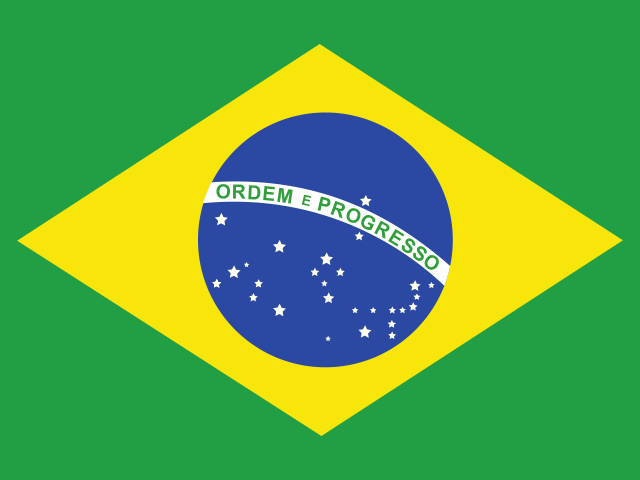
The Brazilian flag is a green field with a large yellow rhombus, or diamond, in the centre. Inside it sits a blue globe showing the night sky, scattered with 27 white stars and crossed by a curved white band bearing the national motto, Ordem e Progresso, "Order and Progress", in green letters. It is one of the few national flags to include a written motto and a map of the stars.
What the colours and symbols mean
- Green and yellow were first chosen for the flag of the Empire of Brazil in 1822. They are traditionally linked to the royal houses of Emperor Pedro I, the House of Braganza (green), and of his wife, Empress Maria Leopoldina, the House of Habsburg (yellow).
- Forests and gold is a popular later interpretation, in which green represents Brazil's forests and yellow its gold and mineral wealth. It is widely taught, but it is not the original meaning.
- The blue globe shows the sky over Rio de Janeiro on the morning of 15 November 1889, the day the republic was proclaimed, including the Southern Cross.
- The 27 stars represent the 26 states and the Federal District. The single star above the band, Spica, represents the state of Pará.
- Ordem e Progresso comes from the philosophy of positivism, founded by the French thinker Auguste Comte, which was influential among the founders of the republic.
Where the flag came from
When Brazil became independent in 1822, the French artist Jean-Baptiste Debret helped design the imperial flag: a green field with a yellow diamond bearing the emperor's coat of arms. After the monarchy was overthrown in 1889, a brief flag inspired by the United States' stars and stripes was used for a few days, before the current design was adopted on 19 November 1889. Devised by Raimundo Teixeira Mendes and Miguel Lemos with the astronomer Manuel Pereira Reis, and drawn by the painter Décio Villares, it kept the imperial colours and replaced the crown and arms with the starry sky and motto. The number of stars has been updated as new states were created, most recently in 1992. Brazil celebrates Flag Day on 19 November.
Flag facts most people get wrong
- The stars are not random. Each one is a real star placed as it appeared over Rio on 15 November 1889, and each is assigned to a particular state.
- The sky is shown as if seen from outside. The constellations appear in mirror image, as though viewed from beyond the celestial sphere looking back towards Earth.
- Yellow does not officially mean gold. The colours come from Brazil's imperial dynasties; the "forests and gold" meaning was added later.
- The motto is a shortened quotation. Comte's original motto included love as well as order and progress, and there have been occasional proposals to add the word Amor to the flag.
- The stars have changed. The flag of 1889 had 21 stars; as new states were created, more were added, reaching 27 in 1992.
The Brazilian people: diverse, creative and warm-hearted
Brazilians are one of the most diverse peoples in the world. Their ancestry combines the Indigenous peoples who lived here for thousands of years, the Portuguese colonists, the millions of Africans brought by force during the slave trade, and later immigrants from Italy, Germany, Spain, Japan, Lebanon, Syria and many other countries. In the 2022 census, the largest group of Brazilians described themselves as pardo, of mixed ancestry, followed by white and Black Brazilians, and more than 1.6 million people identified as Indigenous, belonging to more than 300 different peoples. Debates about racial equality and the legacy of slavery are an important part of national life.
Many visitors are struck by Brazilians' warmth, optimism and love of music, dancing and conversation. Family and friendship are central, weekends often revolve around long lunches, barbecues and the beach, and football results can dominate the national mood. Brazil has the largest Catholic population in the world, alongside fast-growing evangelical Protestant churches and Afro-Brazilian religions such as Candomblé and Umbanda. The Portuguese word saudade, a deep longing for someone or something absent, is often said to capture something of the Brazilian soul.
Brazilian culture travels far beyond its borders. Large Brazilian communities live in the United States, Portugal, Japan and across Europe, and Brazilian music, capoeira, jiu-jitsu, food and football have fans all over the world. At home, Brazil's regions, from the gaúcho South to the Afro-Brazilian Northeast and the Amazonian North, each add their own flavour to a country that is united by a common language and a shared love of celebration.
Frequently asked questions about Brazil
What is Brazil most famous for?
Brazil is famous for Christ the Redeemer, Sugarloaf Mountain and the beaches of Copacabana and Ipanema in Rio de Janeiro; for Carnival, samba and bossa nova; for winning five football World Cups and for players such as Pelé; for the Amazon rainforest and Iguaçu Falls; and for food and drink such as feijoada, churrasco, açaí, coffee and the caipirinha.
What do the colours of the Brazilian flag mean?
The green and yellow were chosen in 1822 for the flag of the Empire of Brazil and are linked to the royal houses of Emperor Pedro I (Braganza, green) and Empress Maria Leopoldina (Habsburg, yellow). Today they are popularly said to represent Brazil's forests and its gold. The blue globe shows the sky over Rio de Janeiro on 15 November 1889, and its 27 stars stand for the states and the Federal District.
What is the capital of Brazil?
Brasília has been the capital of Brazil since 21 April 1960. It was built in the interior to encourage the development of the centre of the country, replacing Rio de Janeiro, which had been the capital since 1763.
What language do Brazilians speak?
Brazilians speak Portuguese, not Spanish, because Brazil was a Portuguese colony. Brazilian Portuguese has its own accent, vocabulary and spelling, and many words come from Indigenous Tupi and from African languages.
How many states does Brazil have?
Brazil has 26 states and one Federal District, which contains the capital, Brasília. The largest state by area is Amazonas, and the most populous is São Paulo.
What does "Ordem e Progresso" mean?
Ordem e Progresso means "Order and Progress". The motto, written across the blue globe on the flag, was inspired by the positivist philosophy of Auguste Comte, which influenced many of the founders of the Brazilian republic in 1889.
Own a square of the Brazilian flag
On 195 Flags, the flag of Brazil is being rebuilt one square at a time by people in Brazil and around the world. Claim your square for $1.99 and seal a message and a photo inside it: a time capsule for your future self and the generations who come after you. And when the Brazilian flag is completely filled, one square owner wins $40,000.
Claim your square of the Brazilian flag →
Photo credits
- Christ the Redeemer, Rio de Janeiro (cover): Mucio Scorzelli, CC BY-SA 4.0, via Wikimedia Commons
- Sugarloaf Mountain, Rio de Janeiro: Wilfredor, CC0, via Wikimedia Commons
- Devil's Throat, Iguaçu Falls: Josep M. Gracia, CC BY-SA 4.0, via Wikimedia Commons
- Copacabana promenade, Rio de Janeiro: Wilfredor, CC0, via Wikimedia Commons
- Selarón Steps, Rio de Janeiro: Donatas Dabravolskas, CC BY-SA 4.0, via Wikimedia Commons
- Cathedral of Brasília: Arian Zwegers from Brussels, Belgium, CC BY 2.0, via Wikimedia Commons
- Meeting of the Waters, Manaus: Ana Claudia Jatahy (MTUR), CC0, via Wikimedia Commons
- Amazon Theatre, Manaus: Karine Hermes, CC BY-SA 4.0, via Wikimedia Commons
- Largo do Pelourinho, Salvador: Paul R. Burley, CC BY-SA 4.0, via Wikimedia Commons
- São Paulo Museum of Art (MASP): Wilfredor, CC0, via Wikimedia Commons
- Chapada Diamantina National Park, Bahia: Aq.nicolas, CC BY-SA 4.0, via Wikimedia Commons
- Church of São Francisco de Assis, Ouro Preto: Alvesgaspar, CC BY-SA 3.0, via Wikimedia Commons
- Pantanal, Mato Grosso: Filipefrazao, CC BY-SA 3.0, via Wikimedia Commons
- Colonial church, Olinda: Wilfredor, CC0, via Wikimedia Commons
- Lençóis Maranhenses National Park: Joao lara mesquita, CC BY-SA 4.0, via Wikimedia Commons
- Praia Brava, Florianópolis: Mariordo (Mario Roberto Durán Ortiz), CC BY-SA 4.0, via Wikimedia Commons
The Brazilian flag image is from 195flags.com.


