Mexico: What It's Famous For, Iconic Landmarks, States, History and the Meaning of the Mexican Flag

Mexico is a country of ancient pyramids and colonial cathedrals, of rainforests, deserts, volcanoes and two long coastlines, and of a food culture so rich that UNESCO recognises it as part of the world's heritage. Great civilisations such as the Olmecs, the Maya, the Zapotecs and the Aztecs rose here long before Europeans arrived, and their legacy still shapes the language, food, art and faith of modern Mexico. In this guide we explore what Mexico is famous for, its most distinctive landmarks, the most popular states and what each one offers, a timeline of Mexican history, and the meaning behind the green, white and red of the Mexican flag, with its famous eagle and serpent.
Mexico at a glance
- Official name: the United Mexican States (Estados Unidos Mexicanos)
- Capital: Mexico City, also the largest city; other major cities include Guadalajara, Monterrey, Puebla, Tijuana, León and Mérida
- Population: around 130 million, the largest Spanish-speaking population of any country in the world
- Area: about 1.96 million km², roughly eight times the size of the United Kingdom
- Languages: Spanish is spoken by the great majority and is the main language of government, but Mexico has no single official language in law: Spanish and 68 Indigenous languages, including Nahuatl, Yucatec Maya, Mixtec and Zapotec, are all recognised as national languages
- Currency: the Mexican peso (MXN)
- Administrative divisions: 31 states plus Mexico City, which together make up the 32 federal entities
- Government: a federal presidential republic; the president is both head of state and head of government and serves a single six-year term
- National symbols: the green, white and red flag, the coat of arms showing an eagle on a cactus devouring a snake, the national anthem, and the golden eagle
- National day: Independence Day, 16 September, which recalls the call to revolt made by the priest Miguel Hidalgo in 1810; celebrations begin on the night of the 15th with the Grito, the "cry" of independence
- Highest mountain: Pico de Orizaba, also called Citlaltépetl, a dormant volcano of about 5,600 m on the border of Puebla and Veracruz, the highest peak in Mexico and the third-highest in North America
- Longest river: the Río Bravo del Norte, known in the United States as the Rio Grande, which forms much of the border between the two countries; the longest river system lying entirely within Mexico is the Lerma–Santiago
- Standout facts: Mexico has more UNESCO World Heritage Sites than any other country in the Americas, and it is one of a small group of "megadiverse" countries that are home to a large share of the world's plant and animal species
What is Mexico famous for?
Mexican food
In 2010 traditional Mexican cuisine became one of the first cuisines to be recognised by UNESCO as part of the world's intangible cultural heritage. At its heart is maize, which was domesticated from a wild grass in southern Mexico thousands of years ago and is still ground into dough for tortillas, tamales and countless street snacks. Mexico gave the world chillies, tomatoes, avocados, vanilla and chocolate, which the Maya and Aztecs drank as a bitter, spiced drink. Favourite dishes include tacos al pastor, mole, a rich sauce that can contain dozens of ingredients, pozole, a hearty hominy stew, and chiles en nogada, a dish whose green, white and red colours match the national flag.
Tequila and mezcal
Mexico's most famous drink, tequila, is distilled from the blue agave plant and takes its name from the town of Tequila in Jalisco. By law it can only be made in Jalisco and in designated parts of four other states. Its smokier cousin, mezcal, can be made from many kinds of agave whose hearts are often roasted in underground pits, and much of it comes from Oaxaca. Mexico is also famous for its beers, for horchata, a sweet rice drink, and for agua fresca, made with fresh fruit.
Day of the Dead
On 1 and 2 November, families across Mexico celebrate Día de Muertos, the Day of the Dead, when it is believed the souls of loved ones return for a visit. Homes and cemeteries are decorated with ofrendas, altars covered in marigolds, candles, photographs, sugar skulls, pan de muerto and the favourite food and drink of the departed. Far from being a sad occasion, it is a joyful and colourful celebration of memory, and UNESCO lists the Indigenous festivity dedicated to the dead as part of the world's intangible heritage. The elegant skeleton figure La Catrina, created by the engraver José Guadalupe Posada in the early 20th century, has become one of its best-known images.
Mariachi and music
Few sounds are as recognisably Mexican as mariachi: groups of violins, trumpets and guitars, including the deep-voiced guitarrón, with musicians dressed in the silver-studded charro suit. Mariachi grew up in western Mexico, especially Jalisco, and was added to UNESCO's intangible heritage list in 2011. Mexico's musical life also includes the harp-led son jarocho of Veracruz, the accordion-driven norteño music of the north, banda, ranchera songs and a lively pop and rock scene.
Art and muralism
After the Revolution of 1910, Mexican artists set out to tell the nation's story on the walls of public buildings. The great muralists Diego Rivera, José Clemente Orozco and David Alfaro Siqueiros painted vast scenes of Indigenous history, labour and revolution that can still be seen in Mexico City's National Palace, the Palace of Fine Arts and many other buildings. Frida Kahlo, famous for her vivid self-portraits, has become one of the most recognisable artists in the world, and her Blue House in Coyoacán is now a museum. Mexico's folk arts are just as celebrated, from Talavera pottery and Oaxacan woodcarvings to embroidered textiles.
Ancient civilisations
Mexico was one of the cradles of civilisation in the Americas. The Olmecs of the Gulf Coast carved giant stone heads around 3,000 years ago, the city of Teotihuacan was among the largest in the world in the early centuries AD, and the Maya built cities of stone across the south and the Yucatán Peninsula, developing a sophisticated writing system, astronomy and calendar. The Aztecs, or Mexica, ruled a powerful empire from their island capital, Tenochtitlan, until the Spanish conquest in 1521. Tens of thousands of archaeological sites have been recorded across the country.
Football and lucha libre
Football is Mexico's most popular sport, and the national team has played at most World Cups since the first in 1930. Mexico hosted the tournament in 1970 and 1986, and in 2026 it co-hosted the World Cup with the United States and Canada, making it the first country to host the men's tournament three times. Mexico City's Estadio Azteca staged the opening match in all three. Mexico also loves lucha libre, a theatrical style of wrestling in which masked heroes and villains fly around the ring, as well as baseball, boxing and charrería, a traditional equestrian sport.
Inventions and ideas
Mexican science has made some notable contributions to the modern world. In 1951 the chemist Luis Miramontes, working in Mexico City, helped to synthesise norethisterone, one of the first compounds used in the oral contraceptive pill. In 1940 the engineer Guillermo González Camarena patented an early colour television system. In literature, the poet and essayist Octavio Paz won the Nobel Prize in Literature in 1990, and writers such as Juan Rulfo and Carlos Fuentes are read around the world.
Nature and wildlife
Mexico stretches from deserts in the north to tropical rainforests in the south. Every autumn, millions of monarch butterflies travel thousands of kilometres from Canada and the United States to spend the winter in the fir forests of Michoacán and the State of Mexico, where they cover whole trees. The Yucatán Peninsula is dotted with cenotes, natural sinkholes filled with clear water, and off its coast lies part of the Mesoamerican Barrier Reef. Grey whales give birth in the lagoons of Baja California, and the axolotl, a salamander found in the wild only in the waters around Mexico City, has become a national favourite.
Mexico's most distinctive landmarks
Chichén Itzá, Yucatán
Rising from a flat grassy plaza in the Yucatán Peninsula, the stepped pyramid known as El Castillo, or the Temple of Kukulcán, is the most famous image of ancient Mexico. Chichén Itzá was one of the greatest Maya cities, flourishing especially between about the 9th and 12th centuries, and it also shows strong links with central Mexico. The pyramid is a giant calendar in stone: its four staircases and top platform together add up to 365 steps, one for each day of the year. Around the spring and autumn equinoxes, the afternoon sun casts a pattern of light and shadow on the northern staircase that looks like a serpent sliding down to the carved snake heads at its base. The site also includes a huge ball court and a sacred cenote. Chichén Itzá is a UNESCO World Heritage Site and was named one of the "New Seven Wonders of the World" in a popular vote in 2007.
Teotihuacan, State of Mexico

About 50 km north-east of Mexico City lie the ruins of Teotihuacan, which at its height, in roughly the first six centuries AD, was one of the largest cities in the world, home to perhaps 100,000 people or more. Its builders remain something of a mystery, and the name we use today was given by the Aztecs, who found the city in ruins centuries later and called it "the place where the gods were created". A broad avenue, the Avenue of the Dead, runs past the enormous Pyramid of the Sun, one of the largest pyramids in the Americas, to the Pyramid of the Moon. The Temple of the Feathered Serpent is decorated with carved serpent heads. Climbing the pyramids has been restricted in recent years, but the views from the avenue are still breathtaking.
The Palace of Fine Arts, Mexico City

With its white marble walls and glowing tiled domes, the Palacio de Bellas Artes is Mexico City's grandest cultural building. Construction began in 1904 to designs by the Italian architect Adamo Boari, but it was interrupted by the Revolution and the building was finally completed in 1934. The exterior is in the ornate Art Nouveau style, while the interior is mostly Art Deco. Inside are some of the most important murals by Rivera, Orozco and Siqueiros, and the main theatre has a remarkable glass stage curtain made by Tiffany Studios of New York, showing the volcanoes that overlook the Valley of Mexico. The palace hosts opera, concerts and exhibitions, and the Ballet Folklórico de México regularly performs there.
The Zócalo and Metropolitan Cathedral, Mexico City

The Zócalo, officially the Plaza de la Constitución, is one of the largest public squares in the world and the political and spiritual heart of Mexico. It stands on the site of the centre of the Aztec capital, Tenochtitlan. On one side rises the Metropolitan Cathedral, built over nearly three centuries from 1573 to 1813, which mixes Renaissance, baroque and neoclassical styles and is one of the largest cathedrals in the Americas. Opposite is the National Palace, whose staircase and walls are covered by Diego Rivera's murals of Mexican history. Just beside the cathedral are the excavated remains of the Templo Mayor, the Aztecs' great temple, rediscovered in 1978 when electricity workers uncovered a huge carved stone disc. A giant national flag flies over the square.
Palenque, Chiapas

Surrounded by thick rainforest in the foothills of Chiapas, Palenque is one of the most beautiful of all Maya cities. Its most celebrated ruler, K'inich Janaab' Pakal, reigned for nearly 70 years in the 7th century, and his tomb was found in 1952 deep inside the Temple of the Inscriptions, where he lay beneath a magnificently carved stone lid and wore a mask of jade. The temple's long hieroglyphic inscriptions have helped scholars to understand the history of the city's kings. With its palace and watchtower, its temples and the sounds of howler monkeys in the trees, Palenque is a UNESCO World Heritage Site.
Tulum, Quintana Roo

Few archaeological sites have a setting like Tulum. Perched on limestone cliffs above the turquoise Caribbean, this walled Maya town flourished in the centuries before the Spanish arrived and was one of the last Maya cities to be inhabited. Its main temple, known as El Castillo, may have served as a beacon for canoes trading along the coast, and the little Temple of the God of the Wind stands on a headland above a cove. Below the ruins are white sandy beaches, and the modern town of Tulum, with its hotels, cenotes and nature reserves, has become one of the most popular destinations on the Riviera Maya.
Monte Albán, Oaxaca

High on a mountaintop that its builders levelled by hand, Monte Albán looks down over the three arms of the Oaxaca Valley. Founded around 500 BC, it became the capital of the Zapotec people and remained an important city for more than a thousand years. Its great plaza is lined with pyramids, temples, a ball court and an observatory, and some of its oldest carvings, the so-called Danzantes, show human figures whose meaning is still debated. Monte Albán and the nearby colonial city of Oaxaca together form a UNESCO World Heritage Site.
The Copper Canyon, Chihuahua

In the Sierra Madre Occidental of northern Mexico, the Barrancas del Cobre, or Copper Canyon, are a vast network of canyons carved by six rivers, often said to be larger in area than Arizona's Grand Canyon, with some sections deeper too. The region is home to the Rarámuri, or Tarahumara, people, famous for their long-distance running. One of the best ways to see the canyons is from the Chihuahua–Pacific Railway, known as El Chepe, which climbs from the Pacific coast through tunnels and over bridges to the high plateau, and from the cable car and viewpoints at Divisadero.
The agave landscape of Tequila, Jalisco

Around the town of Tequila, west of Guadalajara, the slopes of the Tequila volcano are covered in neat rows of spiky blue-green agave. This is where tequila was born, and the area's fields, old haciendas and distilleries have been a UNESCO World Heritage Site since 2006. Each agave takes several years to mature before jimadores cut away its leaves to harvest the heart, called the piña, which is then cooked, crushed and fermented. Visitors can tour distilleries in Tequila itself, one of Mexico's Pueblos Mágicos, or "Magic Towns".
The most popular states in Mexico and what they offer
Mexico is a federation of 31 states and Mexico City, each with its own landscapes, food and traditions. Here are some of the highlights.
Mexico City

Built on the ruins of Tenochtitlan in a high valley surrounded by mountains, Mexico City is one of the largest metropolitan areas in the world. Its historic centre is packed with palaces, churches and museums, and Chapultepec Park holds a castle and the National Museum of Anthropology, home to the famous Aztec Sun Stone. The leafy neighbourhoods of Coyoacán, Roma and Condesa are known for their cafés and markets, and the Basilica of Our Lady of Guadalupe is one of the most visited Catholic shrines in the world. In the south, the canals of Xochimilco, the last remains of the Aztecs' chinampas, or floating gardens, are explored on colourful boats called trajineras, often accompanied by mariachis.
Yucatán and Quintana Roo

The flat limestone Yucatán Peninsula combines Maya heritage with some of the most beautiful beaches in the Caribbean. In Quintana Roo, Cancún grew from a small fishing area into a major resort from the 1970s, and the coast to the south, the Riviera Maya, includes Playa del Carmen, the diving island of Cozumel and Tulum. The state of Yucatán has the elegant colonial capital Mérida, the yellow-painted town of Izamal, the ruins of Chichén Itzá and Uxmal, and hundreds of cenotes for swimming. The region's cooking, with dishes such as cochinita pibil, slow-roasted pork marinated in citrus and achiote, has its own Maya character.
Oaxaca
In the south, Oaxaca is one of Mexico's most culturally diverse states, with many Indigenous peoples, including Zapotecs and Mixtecs, and a strong tradition of crafts, markets and festivals. Its capital, Oaxaca de Juárez, is a UNESCO-listed colonial city of green stone buildings, famous for the gilded interior of the Church of Santo Domingo. Oaxaca is often called the "land of the seven moles", and it is the heartland of mezcal. Every July the Guelaguetza festival brings together dance and music from communities across the state. Beyond the city lie the ruins of Monte Albán and Mitla, the mineral "petrified waterfalls" of Hierve el Agua and the Pacific surf beaches of Puerto Escondido.
Jalisco

Jalisco is the home of many of the things the world thinks of as typically Mexican: mariachi, tequila, charrería and the wide-brimmed sombrero. Its capital, Guadalajara, Mexico's second-largest city, has a cathedral with distinctive yellow-tiled spires and the Hospicio Cabañas, a former orphanage decorated with powerful murals by José Clemente Orozco and now a UNESCO World Heritage Site. On the Pacific coast, Puerto Vallarta is a popular beach resort, and inland lie the agave fields of Tequila and the shores of Lake Chapala, Mexico's largest freshwater lake.
Guanajuato

In the central highlands, the state of Guanajuato grew rich from silver mining during the colonial era. Its capital, also called Guanajuato, squeezes into a narrow ravine, with brightly painted houses climbing the hillsides, winding alleys such as the famous Callejón del Beso, the "Alley of the Kiss", and roads that run through tunnels beneath the city. It hosts the Festival Internacional Cervantino, one of the largest arts festivals in Latin America, and was the birthplace of Diego Rivera. The state also played a key role in the independence movement: Miguel Hidalgo issued his call to revolt in the town of Dolores in 1810.
San Miguel de Allende

Also in Guanajuato state, San Miguel de Allende is one of Mexico's most admired colonial towns, with cobbled streets, ochre and terracotta houses and the extraordinary Parroquia de San Miguel Arcángel, whose pink neo-Gothic towers were added in the late 19th century by a local stonemason, said to have been inspired by postcards of European churches. The town is named after Ignacio Allende, a hero of independence who was born here. Its art schools, galleries and mild climate have long attracted artists and international residents, and together with the nearby Sanctuary of Atotonilco it is a UNESCO World Heritage Site.
Puebla

Founded by the Spanish in 1531, the city of Puebla has a UNESCO-listed historic centre of baroque churches and buildings faced with colourful Talavera tiles, a craft that is still practised in local workshops. Its cathedral has some of the tallest bell towers in Mexico, and the Rosary Chapel in the Church of Santo Domingo is covered in gilded decoration. Puebla is famous for mole poblano, a dark sauce made with chillies, spices and chocolate, and for the Battle of Puebla on 5 May 1862, the origin of Cinco de Mayo. Nearby, in Cholula, a church sits on top of the Great Pyramid of Cholula, often described as the largest pyramid in the world by volume, now covered by a grassy hill, while the volcano Popocatépetl smokes on the horizon.
Chiapas

Mexico's southernmost state borders Guatemala and is one of its greenest, with cloud forests, waterfalls and rainforest. In the highlands, the colonial town of San Cristóbal de las Casas is surrounded by Indigenous Tsotsil and Tseltal Maya communities, whose markets and handwoven textiles are celebrated. The dramatic Sumidero Canyon, with cliffs rising around 1,000 m above the Grijalva River, can be explored by boat, and the turquoise waterfalls of Agua Azul and the ruins of Palenque, Yaxchilán and Bonampak lie in the jungle to the north and east.
Baja California and Baja California Sur
Stretching for more than 1,000 km between the Pacific Ocean and the Gulf of California, also called the Sea of Cortez, the Baja California Peninsula is a land of deserts, cacti and empty beaches. At its southern tip, Los Cabos is famous for the rock arch of El Arco and its resorts, while the islands and protected areas of the Gulf of California are a UNESCO World Heritage Site rich in marine life. From about January to March, grey whales gather to give birth in lagoons on the Pacific coast, such as San Ignacio. In the north, near Ensenada, the Valle de Guadalupe is Mexico's best-known wine region.
Michoacán
West of Mexico City, Michoacán is a state of lakes, volcanoes and Purépecha culture. Its capital, Morelia, has a UNESCO-listed historic centre built of pink stone and a long colonial aqueduct. Around Lake Pátzcuaro, the island of Janitzio and nearby towns hold some of Mexico's most famous Day of the Dead vigils. In the highlands on the border with the State of Mexico, the Monarch Butterfly Biosphere Reserve shelters millions of butterflies each winter, and the volcano of Paricutín, which was born in a cornfield in 1943, is one of the youngest volcanoes in the world.
A timeline of Mexican history
- By at least 13,000 years ago: Hunter-gatherers live in what is now Mexico.
- c. 9,000 years ago: Maize is domesticated from a wild grass, teosinte, in the Balsas River valley of southern Mexico.
- c. 1200–400 BC: The Olmec civilisation flourishes on the Gulf Coast, carving colossal stone heads.
- c. 500 BC: The Zapotecs found Monte Albán in the Oaxaca Valley.
- 1st–6th centuries AD: Teotihuacan grows into one of the largest cities in the world.
- c. 250–900: The Classic period of Maya civilisation, with great cities such as Palenque and Calakmul.
- 615–683: K'inich Janaab' Pakal rules Palenque.
- c. 900–1200: The Toltecs dominate central Mexico from Tula, and Chichén Itzá is at its height.
- 1325: According to tradition, the Mexica found Tenochtitlan on an island in Lake Texcoco.
- 1428: The Aztec Triple Alliance is formed, the beginning of the Aztec Empire.
- 1519: Hernán Cortés lands on the Gulf Coast and marches inland to Tenochtitlan, where he meets Moctezuma II.
- 1521: Tenochtitlan falls on 13 August to the Spanish and their Indigenous allies after a long siege.
- 1531: According to tradition, the Virgin of Guadalupe appears to Juan Diego at Tepeyac.
- 1535: The Viceroyalty of New Spain is established, with Mexico City as its capital.
- 1551: The Royal and Pontifical University of Mexico is founded, one of the earliest universities in the Americas.
- 1810: Miguel Hidalgo calls for revolt in Dolores on 16 September, starting the War of Independence.
- 1821: Mexico achieves independence from Spain.
- 1822–1823: Agustín de Iturbide rules briefly as Emperor of Mexico.
- 1824: Mexico becomes a federal republic under its first constitution.
- 1836: Texas declares independence from Mexico.
- 1846–1848: The Mexican–American War ends with the Treaty of Guadalupe Hidalgo, under which Mexico cedes around half of its territory to the United States.
- 1857: A liberal constitution is adopted, followed by the Reform War between liberals and conservatives.
- 1862: Mexican forces defeat a French army at the Battle of Puebla on 5 May.
- 1864–1867: Maximilian of Habsburg rules as emperor with French support, until he is defeated and executed and Benito Juárez restores the republic.
- 1876–1911: Porfirio Díaz dominates Mexico for more than three decades, a period known as the Porfiriato.
- 1910: The Mexican Revolution begins on 20 November.
- 1917: A new constitution is adopted on 5 February; it is still in force today.
- 1929: The party that later becomes the PRI is founded; it governs Mexico for most of the 20th century.
- 1938: President Lázaro Cárdenas nationalises the oil industry.
- 1953: Women win the right to vote in federal elections.
- 1968: Mexico City hosts the Summer Olympics; ten days before the Games, security forces kill student protesters at Tlatelolco.
- 1970: Mexico hosts the football World Cup for the first time.
- 1985: A powerful earthquake on 19 September kills thousands of people in Mexico City.
- 1986: Mexico hosts the World Cup for a second time.
- 1994: The North American Free Trade Agreement (NAFTA) comes into force on 1 January, the same day as the Zapatista uprising in Chiapas.
- 2000: Vicente Fox wins the presidency, ending 71 years of PRI rule.
- 2016: The Federal District is officially renamed Mexico City and becomes a federal entity on a par with the states.
- 2017: Another major earthquake strikes central Mexico on 19 September, the anniversary of the 1985 disaster.
- 2020: The USMCA trade agreement with the United States and Canada replaces NAFTA.
- 2024: Claudia Sheinbaum is elected Mexico's first woman president and takes office on 1 October.
- 2026: Mexico co-hosts the football World Cup with the United States and Canada, with the opening match at the Estadio Azteca on 11 June.
The Mexican flag: its history and meaning
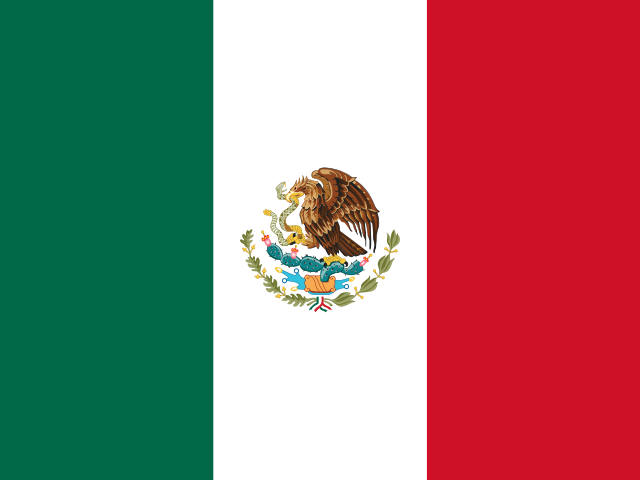
The Mexican flag has three equal vertical stripes of green, white and red, with the national coat of arms in the centre of the white stripe. The coat of arms shows a golden eagle perched on a prickly pear cactus, which grows from a rock in a lake, devouring a snake. Beneath it, a branch of oak and a branch of laurel are tied with a ribbon in the national colours.
What the colours and symbols mean
- The original meaning: when the colours were first adopted by the Army of the Three Guarantees in 1821, they stood for its three promises: white for the Catholic religion, green for independence and red for union between the peoples of Mexico.
- Later interpretations: over time, a more secular reading became popular, in which green stands for hope, white for unity and red for the blood of the nation's heroes. Mexican law does not fix an official meaning for the colours.
- The eagle and the snake recall the legend of the founding of Tenochtitlan: the Mexica god Huitzilopochtli told his people to settle where they saw an eagle perched on a cactus eating a serpent, and they found the sign on an island in Lake Texcoco, the site of today's Mexico City.
- The oak and laurel branches are traditional symbols of strength and of victory.
Where the flag came from
The first flag in Mexico's national colours was the flag of the Army of the Three Guarantees, led by Agustín de Iturbide, which had diagonal white, green and red stripes. After independence in 1821, the colours were arranged in vertical stripes with the eagle in the centre, wearing a crown during Iturbide's short-lived empire. The design of the eagle has changed many times since: Emperor Maximilian's flag, for example, added imperial ornaments. The current version, drawn to show the eagle in profile in a style inspired by Aztec art, was adopted in 1968, and the flag is regulated by a 1984 law on the national coat of arms, flag and anthem. Mexico celebrates Flag Day on 24 February.
Flag facts most people get wrong
- It is not the Italian flag with an emblem. Both use green, white and red, but the Mexican flag uses darker shades, is longer in shape, with proportions of 4:7 instead of Italy's 2:3, and carries the coat of arms.
- The first flag was diagonal. The Three Guarantees flag of 1821 had diagonal stripes and stars rather than the vertical stripes used today.
- The bird is a golden eagle, officially. Some historians have suggested that the bird in the original Aztec legend may have been a crested caracara, but the eagle on the flag is described in law as a golden eagle.
- There are rules for using it. By law the coat of arms and flag cannot be altered, and the national anthem must be performed in an official version.
The Mexican people: proud, diverse and family-centred
Mexican identity is a blend of Indigenous and European heritage, with important African and other influences. Most Mexicans describe themselves as mestizo, of mixed ancestry, while millions identify as Indigenous, and in recent censuses several million people reported speaking an Indigenous language, most commonly Nahuatl. In 2019 the constitution was amended to recognise Afro-Mexican peoples. This mixture of roots is celebrated in Mexican art, food, music and festivals, and many traditions, from Day of the Dead altars to the veneration of the Virgin of Guadalupe, bring together Indigenous and Catholic elements.
Family is at the centre of life for many Mexicans, and big gatherings for baptisms, weddings, birthdays and quinceañeras, the celebration of a girl's fifteenth birthday, are important occasions. Most Mexicans are Catholic, although the share has been falling and the country also has growing Protestant and non-religious communities. Hospitality, a warm sense of humour and pride in regional food and music are often noted by visitors, and Mexicans can be fiercely proud of their national team, their history and their flag.
Mexico's influence extends far beyond its borders. Tens of millions of people of Mexican descent live in the United States, where Mexican food, music and festivals such as Day of the Dead and Cinco de Mayo have become part of everyday culture. Spanish words of Nahuatl origin, such as chocolate, tomate and aguacate, have passed into many languages, including English. At the same time, Mexico has become a destination for people from around the world, drawn by its culture, climate and creative energy.
Frequently asked questions about Mexico
What is Mexico most famous for?
Mexico is famous for ancient sites such as Chichén Itzá, Teotihuacan and Palenque; for its food, including tacos, mole and guacamole; for tequila and mezcal; for the Day of the Dead and mariachi music; for artists such as Frida Kahlo and Diego Rivera; for Caribbean beaches in Cancún and the Riviera Maya; and for colourful colonial cities such as Guanajuato, Oaxaca and San Miguel de Allende.
What do the colours of the Mexican flag mean?
When the colours were first adopted in 1821, white represented the Catholic religion, green represented independence and red represented the union of the Mexican people. Today green is often described as standing for hope, white for unity and red for the blood of national heroes, although the law does not give them an official meaning. The eagle devouring a snake on a cactus recalls the Aztec legend of the founding of Tenochtitlan.
What is the capital of Mexico?
Mexico City is the capital and largest city of Mexico. It was built on the site of the Aztec capital, Tenochtitlan, and lies at an altitude of about 2,240 m in the Valley of Mexico.
How many states does Mexico have?
Mexico has 31 states plus Mexico City, which together make up 32 federal entities. Mexico City was formerly the Federal District and gained a status similar to that of a state in 2016.
What language is spoken in Mexico?
Spanish is spoken by the great majority of Mexicans, and Mexico has more Spanish speakers than any other country. The law also recognises 68 Indigenous languages, including Nahuatl and Yucatec Maya, as national languages alongside Spanish.
Is Mexico part of North America?
Yes. Mexico is part of North America, bordering the United States to the north and Guatemala and Belize to the south-east. It is often also considered part of Latin America, because of its language and history, and its southern regions are part of the cultural area known as Mesoamerica.
Own a square of the Mexican flag
On 195 Flags, the flag of Mexico is being rebuilt one square at a time by people in Mexico and around the world. Claim your square for $1.99 and seal a message and a photo inside it: a time capsule for your future self and the generations who come after you. And when the Mexican flag is completely filled, one square owner wins $40,000.
Claim your square of the Mexican flag →
Photo credits
- Chichén Itzá (cover): Daniel Schwen, CC BY-SA 4.0, via Wikimedia Commons
- Pyramid of the Sun, Teotihuacan: Daniel Case, CC BY-SA 3.0, via Wikimedia Commons
- Palace of Fine Arts, Mexico City: Daniel Case, CC BY-SA 3.0, via Wikimedia Commons
- Metropolitan Cathedral and Zócalo, Mexico City: Jeff Kramer, CC BY 2.0, via Wikimedia Commons
- Temple of the Inscriptions, Palenque: Jan Harenburg, CC BY 4.0, via Wikimedia Commons
- Temple of the God of the Wind, Tulum: Martin Falbisoner, CC BY-SA 4.0, via Wikimedia Commons
- Monte Albán, Oaxaca: nsaum75, CC BY-SA 3.0, via Wikimedia Commons
- Copper Canyon, Chihuahua: Jens Uhlenbrock, Public domain, via Wikimedia Commons
- Agave fields and the Tequila volcano: Juan Carlos Fonseca Mata, CC BY-SA 4.0, via Wikimedia Commons
- Trajineras in Xochimilco, Mexico City: Wotancito, CC BY-SA 4.0, via Wikimedia Commons
- Cancún beach, Quintana Roo: Luka Peternel, CC BY-SA 4.0, via Wikimedia Commons
- Guadalajara Cathedral, Jalisco: ProtoplasmaKid, CC BY-SA 4.0, via Wikimedia Commons
- View of Guanajuato: Asenetp, CC BY-SA 3.0, via Wikimedia Commons
- Parroquia de San Miguel Arcángel, San Miguel de Allende: Adam Jones from Kelowna, BC, Canada, CC BY-SA 2.0, via Wikimedia Commons
- Puebla Cathedral: Juan Carlos Fonseca Mata, CC BY-SA 4.0, via Wikimedia Commons
- San Cristóbal de las Casas, Chiapas: Adam Jones, CC BY 2.0, via Wikimedia Commons
The Mexican flag image is from 195flags.com.


