South Korea: What It's Famous For, Iconic Landmarks, Provinces, History and the Meaning of the South Korean Flag

South Korea packs an extraordinary amount into a small, mountainous peninsula. In little more than two generations it has grown from one of the poorest countries in the world, devastated by war, into a wealthy, high-tech democracy and a global cultural force, the home of K-pop, K-dramas, Samsung and kimchi. Yet alongside the neon of Seoul and the glass towers of Busan, it has preserved royal palaces, Buddhist temples in the hills, thatched folk villages and a deep respect for tradition. In this guide we explore what South Korea is famous for, its most distinctive landmarks, the most popular provinces and cities and what each one offers, a timeline of Korean history, and the meaning of the circle and four black trigrams on the South Korean flag, the Taegukgi.
South Korea at a glance
- Official name: the Republic of Korea; Koreans call their country Hanguk or Daehan Minguk
- Capital: Seoul; other major cities include Busan, Incheon, Daegu, Daejeon, Gwangju and Ulsan, while many government ministries have moved to the planned city of Sejong
- Population: around 51 million, about half of whom live in and around Seoul
- Area: about 100,000 km², covering the southern part of the Korean Peninsula and more than 3,000 islands, the largest of which is Jeju
- Language: Korean, written in the Hangul alphabet, created in the 15th century under King Sejong the Great
- Currency: the South Korean won (KRW), with the symbol ₩
- Administrative divisions: 17 top-level divisions: the special city of Seoul, six metropolitan cities, the special self-governing city of Sejong and nine provinces, including the special self-governing provinces of Jeju, Gangwon and Jeonbuk
- Government: a presidential republic; Lee Jae-myung has been president since June 2025
- National symbols: the flag (the Taegukgi), the national anthem "Aegukga" ("Patriotic Song") and the national flower, the mugunghwa or rose of Sharon, whose name suggests endurance; the tiger is a much-loved traditional symbol of Korea
- National days: March 1st Movement Day (1 March), Liberation Day (15 August), National Foundation Day (3 October) and Hangul Day (9 October)
- Highest mountain: Hallasan (about 1,950 m), a dormant volcano on Jeju Island
- Longest river: the Nakdong River, about 510 km long, which flows south to the sea near Busan; the Han River runs through the heart of Seoul
- Standout facts: South Korea has some of the fastest internet connections in the world and one of the lowest birth rates; North and South Korea are separated by the heavily fortified Demilitarized Zone, and because the Korean War ended in an armistice rather than a peace treaty, the two remain technically at war
What is South Korea famous for?
K-pop
Korean pop music, or K-pop, has become a worldwide phenomenon. Built on tightly choreographed groups, polished music videos and devoted fan communities, it reached global audiences in 2012 when Psy's "Gangnam Style" became the first video to pass one billion views on YouTube. Groups such as BTS and BLACKPINK have since topped charts and filled stadiums around the world, and BTS have even addressed the United Nations. Fans learn Korean, copy the dance routines and travel to Seoul to visit the places linked with their favourite idols. The success of K-pop is part of the wider Hallyu, or "Korean Wave", of popular culture.
Films and K-dramas
Korean television dramas, known as K-dramas, are watched all over the world for their romance, historical epics, thrillers and emotional storytelling, and Netflix's Squid Game, released in 2021, became one of the most watched series in the streaming service's history. Korean cinema is just as admired: Bong Joon-ho's Parasite won the Palme d'Or at Cannes and, in 2020, became the first film not in English to win the Academy Award for Best Picture. Directors such as Park Chan-wook are celebrated internationally, and in 2024 the novelist Han Kang became the first South Korean writer to win the Nobel Prize in Literature.
Korean food
Korean food is bold, colourful and made for sharing. Almost every meal comes with kimchi, spicy fermented cabbage or other vegetables, and an array of small side dishes called banchan. The tradition of kimjang, when families and neighbours gather in late autumn to make kimchi for the winter, is recognised by UNESCO. Other favourites include Korean barbecue, where diners grill pork belly (samgyeopsal) or marinated beef (bulgogi) at the table, bibimbap, rice topped with vegetables, meat, egg and chilli paste, tteokbokki (spicy rice cakes), japchae noodles, hearty stews and soups, and Korean fried chicken, often eaten with beer as chimaek. Soju is the best-known Korean drink.
Technology and industry
South Korea's rapid rise from poverty to prosperity after the Korean War is often called the "Miracle on the Han River". Today, it is a world leader in electronics and semiconductors, home to companies such as Samsung, LG and SK Hynix, and it is one of the world's largest shipbuilders and carmakers, through Hyundai and Kia. Koreans are among the most connected people on Earth, with very fast broadband, widespread mobile payments and a passion for online gaming; competitive video gaming, or e-sports, became popular in Korea early on and is followed like a traditional sport.
Hangul, the Korean alphabet
Korea has its own writing system, Hangul, created under King Sejong the Great and announced in 1446 in a document called the Hunminjeongeum, "the correct sounds for the instruction of the people". Before then, Korean was written mainly with Chinese characters, which few ordinary people could learn. Hangul's letters are designed to reflect the shape of the mouth and tongue when making each sound, and they are grouped into syllable blocks. It is admired by linguists for its logic and is said to be learnable in a matter of hours. Koreans celebrate Hangul Day every year on 9 October, and the original Hunminjeongeum document is on UNESCO's Memory of the World Register.
Taekwondo and sport
Taekwondo, a Korean martial art known for its high, fast kicks, is practised by millions of people around the world and has been an Olympic sport since 2000. Korea's traditional wrestling, ssireum, is recognised by UNESCO, and archery is a national strength: South Korean archers have dominated Olympic competitions for decades. Football, baseball and golf are hugely popular, and South Korea has hosted the 1988 Summer Olympics in Seoul, the 2002 FIFA World Cup, jointly with Japan, when the national team reached the semi-finals, and the 2018 Winter Olympics in PyeongChang.
Beauty, fashion and hanbok
Korean skincare and cosmetics, known as K-beauty, are famous for innovations such as sheet masks, BB creams and multi-step skincare routines, and Seoul is one of Asia's fashion capitals. Koreans also take pride in the hanbok, the traditional dress, with its flowing skirts and short jackets for women and loose trousers and jackets for men, worn today at weddings, festivals and holidays such as Seollal (Lunar New Year) and Chuseok, the autumn harvest festival. Visitors who rent a hanbok can often enter Seoul's royal palaces free of charge.
South Korea's most distinctive landmarks
Gyeongbokgung Palace, Seoul

Built in 1395, three years after the founding of the Joseon dynasty, Gyeongbokgung, the "Palace Greatly Blessed by Heaven", was the main royal palace of Joseon and the largest of Seoul's five grand palaces. It was burned down during the Japanese invasions of the 1590s and lay in ruins for more than 250 years until it was rebuilt in the 1860s; much of it was demolished again during Japanese colonial rule, and restoration has continued since the 1990s. Highlights include the Geunjeongjeon throne hall and Gyeonghoeru, the royal banquet pavilion standing on stone pillars in a lotus pond, pictured at the top of this guide. Visitors enter through Gwanghwamun Gate, where a colourful changing of the royal guard ceremony takes place, and the palace grounds also contain the National Folk Museum of Korea. Behind the palace stands the Blue House (Cheong Wa Dae), for decades the seat of South Korea's presidents.
Changdeokgung Palace and its Secret Garden, Seoul

Built in 1405 as a secondary palace, Changdeokgung became the favourite residence of many Joseon kings because its buildings were designed to blend into the natural landscape of the hills behind it. Behind the palace lies the Huwon, or Secret Garden, a royal garden of ponds, pavilions and centuries-old trees that can be visited on guided tours. Changdeokgung is a UNESCO World Heritage Site and is often described as the most beautiful of Seoul's palaces, especially in autumn when the leaves turn red and gold.
Bulguksa Temple and Seokguram Grotto, Gyeongju

On the slopes of Mount Toham near Gyeongju, Bulguksa is one of the most celebrated Buddhist temples in Korea. It was completed in the 8th century, during the Silla kingdom, and is known for its elegant stone terraces, double staircases representing the path to the Buddha's land, and two stone pagodas, Dabotap and Seokgatap, which are national treasures. The wooden buildings were burned during the Japanese invasions of the 1590s and later rebuilt. Higher up the mountain, the Seokguram Grotto is an artificial cave temple housing a serene granite Buddha that faces east towards the sea, a masterpiece of Buddhist sculpture. Together they became a UNESCO World Heritage Site in 1995.
Hwaseong Fortress, Suwon

The fortress of Hwaseong in Suwon, south of Seoul, was built between 1794 and 1796 by King Jeongjo, who moved the tomb of his father, Crown Prince Sado, to the area and hoped to make the city a new centre of power. Its walls run for more than 5 km around the old city, with gates, watchtowers, command posts and the graceful Banghwasuryujeong pavilion. Built with innovative techniques for its time, the fortress was badly damaged in the 20th century, but it could be faithfully restored thanks to a detailed record of its construction published in 1801. It is a UNESCO World Heritage Site, and visitors can walk the entire circuit of the walls.
Haedong Yonggungsa Temple, Busan

Most Korean Buddhist temples are hidden in the mountains, but Haedong Yonggungsa sits right on the rocky seashore on the north-eastern edge of Busan. According to the temple's tradition, it was founded in 1376, and its present buildings were largely rebuilt in the 20th century. Visitors descend a stairway lined with stone statues of the zodiac animals and cross an arched bridge to reach the main halls, where waves crash on the rocks below. It is especially popular at sunrise and on Buddha's Birthday, when the temple is hung with colourful lanterns.
Seongsan Ilchulbong, Jeju

Rising from the sea at the eastern tip of Jeju Island, Seongsan Ilchulbong, or "Sunrise Peak", is a tuff cone formed by an underwater volcanic eruption, thought to be about 5,000 years ago. Its bowl-shaped crater, about 600 m across, is ringed by jagged rocky peaks, and the summit, at around 180 m, can be reached by a steep 20 to 30 minute climb. As its name suggests, it is a famous place to watch the sunrise, especially on New Year's Day. It is part of the Jeju Volcanic Island and Lava Tubes UNESCO World Heritage Site, and at its foot the haenyeo, Jeju's famous women free-divers, sometimes give demonstrations.
Gamcheon Culture Village, Busan

Clinging to a hillside above the port of Busan, Gamcheon Culture Village is a maze of brightly painted houses, steep stairways and narrow alleys. The area grew up in the 1950s, when refugees fleeing the Korean War settled on the slopes, and for decades it was one of the poorest parts of the city. From 2009, an art project brought in artists to paint murals and create installations, transforming it into one of Busan's most popular sights. It is still a residential neighbourhood, so visitors are asked to keep their voices down.
Bukchon Hanok Village, Seoul

Between Gyeongbokgung and Changdeokgung palaces, Bukchon is a hillside neighbourhood of hundreds of hanok, traditional Korean houses with tiled roofs, wooden frames and inner courtyards, many dating from the early 20th century. Its winding alleys offer views over the rooftops towards the skyscrapers of central Seoul. Many of the houses are private homes, and because of the large number of visitors, Seoul has introduced restrictions on visiting hours in parts of the area; tourists are asked to respect residents' privacy. Several hanok have been converted into tea houses, craft workshops and guesthouses.
The DMZ and Panmunjom
The Demilitarized Zone, or DMZ, runs for about 250 km across the Korean Peninsula and is about 4 km wide. It was established by the armistice that ended the fighting of the Korean War in 1953, and it is one of the most heavily fortified borders in the world. With few people entering it for decades, it has also become an unexpected haven for wildlife. Organised tours from Seoul visit observatories with views into North Korea, infiltration tunnels dug under the border, and, when it is open to visitors, the Joint Security Area at Panmunjom, where the two sides stand face to face and where the leaders of North and South Korea met in 2018. Access depends on the security situation and can change at short notice.
The most popular provinces and cities in South Korea and what they offer
South Korea is divided into provinces, metropolitan cities and special cities, each with its own landscapes, dialects and food. Here are some of the highlights.
Seoul

South Korea's capital, Seoul, has been the heart of the country for more than 600 years, since the Joseon dynasty chose it as its capital in the 1390s. It is a city of contrasts: royal palaces and ancient city gates sit among glass towers, and the Cheonggyecheon stream, uncovered from beneath a road in the 2000s, runs through the centre. Visitors shop in Myeongdong and Dongdaemun, eat at Gwangjang Market, explore the nightlife of Hongdae and Itaewon, see the trendy boutiques of Gangnam and take in the views from N Seoul Tower on Namsan mountain or the Lotte World Tower, which at 555 m is the tallest building in the country. Hikers can climb Bukhansan, a granite mountain national park on the city's northern edge.
Busan

South Korea's second city and largest port, Busan, sits on the south-east coast between mountains and the sea. It is known for its beaches, especially Haeundae, one of the most famous in the country, and Gwangalli, overlooked by the illuminated Gwangan Bridge. Seafood lovers head to Jagalchi Fish Market, the largest of its kind in Korea, and the city's signature dishes include dwaeji gukbap (pork and rice soup) and milmyeon (cold wheat noodles), a dish linked to refugees from the north during the Korean War. Busan also hosts the Busan International Film Festival, one of the most important film festivals in Asia, every autumn.
Gyeongju

For nearly a thousand years, Gyeongju in North Gyeongsang province was the capital of the Silla kingdom, which unified much of the Korean Peninsula in the 7th century. Often called "a museum without walls", the city is scattered with royal burial mounds, temples, pagodas and palace sites. Highlights include the grassy tombs of Tumuli Park, Cheomseongdae, a 7th-century stone tower believed to be one of the oldest surviving astronomical observatories in East Asia, and Donggung Palace and Wolji Pond, beautifully lit at night. Gyeongju's historic areas, as well as Bulguksa and Seokguram, are UNESCO World Heritage Sites, and the city hosted the APEC summit in 2025.
Jeju
Jeju, a volcanic island off the south coast, is South Korea's favourite holiday destination, known for its mild climate, beaches, waterfalls, tangerine orchards and black lava-stone walls. At its centre rises Hallasan, the country's highest mountain, and the island is dotted with hundreds of smaller volcanic cones called oreum. Visitors explore volcanic craters and lava caves, walk sections of the Jeju Olle Trail around the coast and see Seongsan Ilchulbong. Jeju is also famous for its haenyeo, women divers who harvest shellfish and seaweed without breathing equipment, whose culture is recognised by UNESCO, and for the dol hareubang, the island's stone grandfather statues.
Gangwon: Seoraksan and the east coast

The mountainous north-eastern province of Gangwon is South Korea's great outdoor playground. Seoraksan National Park, near the coastal city of Sokcho, is famous for its jagged granite peaks, waterfalls and Buddhist temples, and is at its most spectacular in autumn, when the hillsides blaze with colour. In winter, skiers head to resorts around PyeongChang, host of the 2018 Winter Olympics, and along the coast are beaches, seafood markets and the city of Gangneung, known for its coffee street and the Gyeongpo lake and beach. The province is also home to Chuncheon, famous for its spicy stir-fried chicken, dakgalbi.
Gyeonggi and Incheon
Surrounding Seoul, Gyeonggi province and the city of Incheon are home to roughly half of the country's population when combined with the capital. Gyeonggi's highlights include Hwaseong Fortress in Suwon, the Korean Folk Village in Yongin and the DMZ border area in the north. Incheon is the main gateway to South Korea through Incheon International Airport, and it has Korea's oldest Chinatown, where jajangmyeon, noodles in black bean sauce, is said to have been created. In 1950, Incheon was the site of a famous amphibious landing during the Korean War.
Jeonbuk: Jeonju

Jeonju, the capital of Jeonbuk province, is considered the food capital of Korea and the birthplace of bibimbap, and it has been named a UNESCO City of Gastronomy. The Jeonju Hanok Village contains several hundred traditional houses, together with the Gyeonggijeon Shrine, which holds a portrait of Taejo, the founder of the Joseon dynasty, and the nearby Jeondong Catholic Cathedral. Visitors stay in hanok guesthouses, take part in crafts such as making traditional hanji paper, and eat at the city's busy night market.
Gyeongbuk: Andong and Hahoe Folk Village

The inland province of Gyeongbuk (North Gyeongsang) is a stronghold of Korean tradition and Confucian heritage. Near the city of Andong, Hahoe Folk Village is a living village of thatched and tiled houses where members of the Ryu clan have lived for centuries, set in a bend of the Nakdong River. It is famous for its mask dance drama, Hahoe Byeolsingut Talnori, and together with the village of Yangdong it is a UNESCO World Heritage Site. Andong is also known for its Confucian academies, its strong traditional liquor, Andong soju, and the braised chicken dish jjimdak.
Jeonnam: Boseong, Suncheon and Yeosu

The south-western province of Jeonnam (South Jeolla) is known for its food, its islands and its gentle green landscapes. The tea plantations of Boseong, where neat rows of tea bushes wrap around the hillsides, are among the most photographed scenes in Korea. Suncheon Bay is a vast wetland of reed beds, home to migratory birds such as hooded cranes, and the port city of Yeosu, which hosted the 2012 World Expo, is famous for its night views over the sea. Nearby, the city of Gwangju is a centre of the arts and holds the Gwangju Biennale; it is also remembered for the May 1980 pro-democracy uprising, which is commemorated at the May 18th National Cemetery.
A timeline of Korean history
- Tens of thousands of years ago: Early humans live on the Korean Peninsula, leaving stone tools behind.
- From around 8000 BCE: Neolithic people make distinctive comb-pattern (Jeulmun) pottery.
- 2333 BCE: According to legend, Dangun founds Gojoseon, the first Korean kingdom; Koreans celebrate this on National Foundation Day.
- 108 BCE: China's Han dynasty conquers Gojoseon.
- 1st century BCE: The traditional founding dates of the Three Kingdoms: Silla (57 BCE), Goguryeo (37 BCE) and Baekje (18 BCE).
- 372: Buddhism is officially introduced to Goguryeo.
- 668: Silla, allied with Tang China, defeats Goguryeo, having already conquered Baekje, and goes on to unify most of the peninsula.
- 8th century: Bulguksa Temple and Seokguram Grotto are built in Gyeongju.
- 918: Wang Geon founds the Goryeo dynasty, from which the name "Korea" is derived.
- 13th century: The Mongols invade Goryeo repeatedly; the Tripitaka Koreana, more than 80,000 woodblocks of Buddhist scriptures, is carved and is still kept at Haeinsa Temple.
- 1377: The Jikji, a Buddhist text, is printed in Korea; it is the oldest surviving book printed with movable metal type.
- 1392: General Yi Seong-gye founds the Joseon dynasty, which rules for more than 500 years; soon afterwards, Hanyang (Seoul) becomes the capital.
- 1446: King Sejong the Great introduces Hangul, the Korean alphabet.
- 1592–1598: Japan invades Korea; Admiral Yi Sun-sin wins famous naval victories, helped by his armoured "turtle ships".
- 1627 and 1636–1637: Manchu armies invade Korea.
- 1876: The Treaty of Ganghwa forces Korea to open its ports to Japan.
- 1897: King Gojong proclaims the Korean Empire.
- 1910: Japan annexes Korea, beginning 35 years of colonial rule.
- 1 March 1919: The March 1st Movement sees mass peaceful demonstrations for independence; a Korean provisional government is formed in Shanghai.
- 15 August 1945: Korea is liberated at the end of the Second World War and divided along the 38th parallel into US and Soviet zones.
- 1948: The Republic of Korea is established in the south on 15 August, with Syngman Rhee as president; North Korea is established in September.
- 25 June 1950: North Korean forces invade the South, beginning the Korean War.
- 27 July 1953: An armistice ends the fighting and establishes the DMZ, but no peace treaty is signed.
- 1960: Student-led protests in the April Revolution force Syngman Rhee to resign.
- 1961: General Park Chung-hee takes power in a military coup; his rule brings rapid industrialisation and authoritarian government.
- 1979: Park Chung-hee is assassinated.
- May 1980: A pro-democracy uprising in Gwangju is violently suppressed by the military.
- 1987: Nationwide protests in the June Democratic Struggle win direct presidential elections and a new constitution.
- 1988: Seoul hosts the Summer Olympics.
- 1991: North and South Korea both join the United Nations.
- 1997–1998: The Asian financial crisis hits South Korea hard; millions of citizens donate gold to help the country repay its debts.
- 2000: The first inter-Korean summit is held in Pyongyang; President Kim Dae-jung is awarded the Nobel Peace Prize.
- 2002: South Korea co-hosts the FIFA World Cup with Japan and reaches the semi-finals.
- 2012: Psy's "Gangnam Style" becomes a global hit.
- 2017: President Park Geun-hye is removed from office after being impeached.
- 2018: PyeongChang hosts the Winter Olympics, and the leaders of North and South Korea meet at Panmunjom.
- 2020: Parasite wins the Academy Award for Best Picture.
- 2024: Han Kang wins the Nobel Prize in Literature; in December, President Yoon Suk Yeol briefly declares martial law, which is lifted within hours after the National Assembly votes against it, and he is impeached.
- 2025: The Constitutional Court upholds Yoon's impeachment in April; Lee Jae-myung wins the presidential election in June, and Gyeongju hosts the APEC summit.
- 2026: In February, a Seoul court sentences Yoon Suk Yeol to life imprisonment at first instance for leading an insurrection.
The South Korean flag: its history and meaning
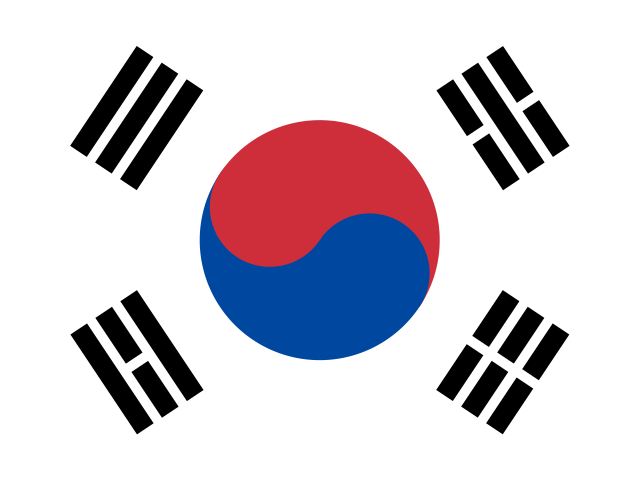
The flag of South Korea is called the Taegukgi. It has a white background with a red and blue circle, the taegeuk, in the centre, surrounded by four groups of black bars, called trigrams (gwae), one near each corner. Its width-to-height ratio is 3:2, and its design is rich in philosophical meaning drawn from East Asian thought and the ancient Chinese classic, the I Ching (Book of Changes).
What the colours and symbols mean
- The white background represents peace and purity, and is linked to the traditional love of white clothing among Koreans, who were once called "the white-clad people".
- The taegeuk in the centre represents the balance of opposing cosmic forces, yin and yang (eum and yang in Korean): the red upper half stands for yang, the positive, active force, and the blue lower half for eum, the negative, passive force. Together they express harmony and the idea that opposites complete each other.
- The four trigrams each stand for one of the elements of the universe: geon (three solid bars, upper left) for heaven, gon (three broken bars, lower right) for earth, gam (upper right) for water, and ri (lower left) for fire. Each sits opposite its counterpart, reinforcing the theme of balance.
Where the flag came from
The Taegukgi dates from 1882, when Joseon Korea was opening up to foreign countries and needed a national flag for diplomacy. Its creation is traditionally credited to the diplomat Park Yeong-hyo, who flew a version of the flag on a mission to Japan in 1882, although historians have also identified earlier designs from the same year, including one linked to the interpreter Lee Eung-jun at the signing of a treaty with the United States. In 1883, King Gojong proclaimed it the national flag. Under Japanese rule the flag was banned, and it became a powerful symbol of the independence movement, waved by crowds during the March 1st Movement of 1919. After liberation, it was adopted by the Republic of Korea in 1948, and its exact proportions and layout were standardised in 1949. The flag's colours and specifications were confirmed by law in the National Flag Act of 2007.
Flag facts most people get wrong
- It is not a Chinese yin-yang symbol. The taegeuk is related to the same philosophy, but its red and blue halves are arranged one above the other and it has no dots, unlike the familiar black and white taijitu.
- It was not created after the Korean War. The flag is more than 140 years old and predates the division of Korea.
- North Korea once used it too. The Taegukgi was the flag of the whole of Korea, and North Korea briefly used it after liberation before adopting its own flag in 1948.
- The trigrams cannot be swapped around. Each trigram has a fixed position, and the flag looks incorrect if it is flown upside down or mirrored, a mistake that is sometimes made abroad.
- The red half is on top. In the taegeuk, the red half (yang) is uppermost and the blue half (eum) below.
The Korean people: jeong, education and the Korean Wave
Korean culture places great importance on relationships, respect and community. Koreans often speak of jeong, a deep sense of affection, attachment and loyalty that grows between people over time, and of nunchi, the ability to read a room and sense how others are feeling. Confucian traditions remain influential in daily life: the Korean language has different levels of politeness depending on age and status, people bow when greeting elders, and families honour their ancestors with rituals at Seollal and Chuseok. Many Koreans follow no religion, while others are Protestant Christians, Buddhists or Catholics.
Education is taken extremely seriously. On the day of the national university entrance exam, the suneung, office hours are delayed, police escort late students to exam centres and flights are restricted during the English listening test. This hard work is often credited with helping power the country's economic rise. At the same time, modern South Korea is fast-paced, creative and highly connected, with a lively café culture, late-night restaurants, noraebang (karaoke rooms) and a deep love of food shared with friends.
Millions of people of Korean descent live outside the peninsula, especially in the United States, China, Japan, Canada and Central Asia, and Koreatowns in cities such as Los Angeles and New York are lively centres of food and culture. Thanks to the Korean Wave, interest in Korean language, food, music and films has soared around the world, and many South Koreans take pride in seeing their culture embraced so widely.
Frequently asked questions about South Korea
What is South Korea most famous for?
South Korea is famous for K-pop groups such as BTS and BLACKPINK, for K-dramas and films such as Parasite and Squid Game, and for its food, including kimchi, Korean barbecue and bibimbap. It is also known for technology companies such as Samsung and Hyundai, for taekwondo, for the Hangul alphabet, for royal palaces such as Gyeongbokgung, for Buddhist temples such as Bulguksa, and for Jeju Island.
What do the colours of the South Korean flag mean?
The white background stands for peace and purity. The red and blue circle, the taegeuk, represents the balance of yin and yang, with red for the positive force and blue for the negative force. The four black trigrams around it represent heaven, earth, water and fire, together expressing harmony and balance in the universe.
What is the capital of South Korea?
Seoul is the capital and largest city of South Korea, home to around 9 million people, with roughly half of the country's population living in the wider Seoul metropolitan area. It has been the capital since the founding of the Joseon dynasty at the end of the 14th century.
Why are North and South Korea divided?
At the end of the Second World War in 1945, Korea was freed from Japanese rule and temporarily divided along the 38th parallel, with Soviet forces in the north and US forces in the south. Two separate states were established in 1948, and the Korean War of 1950–1953 ended in an armistice rather than a peace treaty, leaving the peninsula divided along the DMZ.
How many provinces does South Korea have?
South Korea has nine provinces, three of which (Jeju, Gangwon and Jeonbuk) have special self-governing status. Together with the special city of Seoul, six metropolitan cities and the special self-governing city of Sejong, that makes 17 top-level divisions.
When is the best time to visit South Korea?
Spring, from late March to May, brings cherry blossom and mild weather, and autumn, from September to November, brings clear skies and spectacular red and gold leaves in the mountains. Summer is hot, humid and rainy, especially during the monsoon season in July, while winter is cold and dry, ideal for skiing in Gangwon.
Own a square of the South Korean flag
On 195 Flags, the flag of South Korea is being rebuilt one square at a time by people in Korea and around the world. Claim your square for $1.99 and seal a message and a photo inside it: a time capsule for your future self and the generations who come after you. And when the South Korean flag is completely filled, one square owner wins $40,000.
Claim your square of the South Korean flag →
Photo credits
- Gyeonghoeru, Gyeongbokgung Palace, Seoul (cover): Frank Schulenburg, CC BY-SA 4.0, via Wikimedia Commons
- Geunjeongjeon, Gyeongbokgung Palace, Seoul: Basile Morin, CC BY-SA 4.0, via Wikimedia Commons
- Daejojeon Hall, Changdeokgung Palace, Seoul: Basile Morin, CC BY-SA 4.0, via Wikimedia Commons
- Bulguksa Temple, Gyeongju: Basile Morin, CC BY-SA 4.0, via Wikimedia Commons
- Banghwasuryujeong, Hwaseong Fortress, Suwon: Jpbarrass, Public domain, via Wikimedia Commons
- Haedong Yonggungsa Temple, Busan: Christian Bolz, CC BY-SA 4.0, via Wikimedia Commons
- Seongsan Ilchulbong, Jeju: Korea.net / Korean Culture and Information Service, CC BY-SA 2.0, via Wikimedia Commons
- Gamcheon Culture Village, Busan: VN.NguyenDucDuy, CC BY-SA 4.0, via Wikimedia Commons
- Bukchon Hanok Village, Seoul: Basile Morin, CC BY-SA 4.0, via Wikimedia Commons
- Lotte World Tower, Seoul: kallerna, CC BY-SA 4.0, via Wikimedia Commons
- Gwangan Bridge, Busan: lumoplank, CC0, via Wikimedia Commons
- Donggung Palace and Wolji Pond, Gyeongju: Basile Morin, CC BY-SA 4.0, via Wikimedia Commons
- Seoraksan National Park, Gangwon: Taewangkorea, CC BY-SA 4.0, via Wikimedia Commons
- Jeonju Hanok Village: Bernard Gagnon, CC0, via Wikimedia Commons
- Hahoe Folk Village, Andong: Bernard Gagnon, CC0, via Wikimedia Commons
- Boseong tea plantation, Jeonnam: Jakob Reichmann, CC BY-SA 3.0, via Wikimedia Commons
The South Korean flag image is from 195flags.com.


