South Africa: What It's Famous For, Iconic Landmarks, Provinces, History and the Meaning of the South African Flag

South Africa packs a whole continent's worth of variety into one country. At the southern tip of Africa, where the Atlantic and Indian oceans meet, it is a land of flat-topped mountains and endless beaches, of lion-filled savannah, desert, vineyards and soaring peaks, with three capital cities, twelve official languages and a story that moved the world. It is the country of Nelson Mandela and Desmond Tutu, of the Springboks and Bafana Bafana, of the braai, amapiano and some of the oldest traces of humankind ever found. In this guide we explore what South Africa is famous for, its most distinctive landmarks, the most popular provinces and what each one offers, a timeline of South African history, and the meaning behind the six colours of the South African flag.
South Africa at a glance
- Official name: the Republic of South Africa
- Capitals: three: Pretoria (executive), Cape Town (legislative) and Bloemfontein (judicial); the largest city is Johannesburg, and other major cities include Durban, Gqeberha (Port Elizabeth) and East London
- Population: around 63.5 million, according to Statistics South Africa's 2026 mid-year estimate
- Area: about 1.22 million km², roughly five times the size of the United Kingdom
- Languages: twelve official languages: isiZulu, isiXhosa, Afrikaans, English, Sepedi, Setswana, Sesotho, Xitsonga, siSwati, Tshivenda, isiNdebele and South African Sign Language, added in 2023; isiZulu is the most widely spoken home language
- Currency: the South African rand (ZAR), with the symbol R
- Administrative divisions: nine provinces: Western Cape, Eastern Cape, Northern Cape, Free State, KwaZulu-Natal, North West, Gauteng, Mpumalanga and Limpopo
- Government: a parliamentary republic; the president, who is both head of state and head of government, is elected by the National Assembly
- National symbols: the springbok, the king protea, the blue crane, the real yellowwood tree and the galjoen fish; the coat of arms carries the motto !ke e: ǀxarra ǁke, in the language of the ǀXam San people, meaning "diverse people unite"
- National day: Freedom Day on 27 April, marking the first democratic election in 1994; other public holidays include Youth Day (16 June), Heritage Day (24 September) and the Day of Reconciliation (16 December)
- Highest mountain: Mafadi (about 3,450 m), in the Drakensberg on the border with Lesotho
- Longest river: the Orange (Gariep), about 2,200 km long, which flows from the highlands of Lesotho west to the Atlantic
- Standout facts: South Africa completely surrounds the kingdom of Lesotho, and its national anthem uses five of its official languages
What is South Africa famous for?
Nelson Mandela and the road to freedom
South Africa is famous around the world for its long struggle against apartheid, the system of racial segregation and white minority rule enforced from 1948, and for the peaceful transition to democracy in 1994. Its best-known figure is Nelson Mandela, who spent 27 years in prison before becoming the country's first democratically elected president, and who is remembered for his message of reconciliation. Archbishop Desmond Tutu, who won the Nobel Peace Prize in 1984 and later chaired the Truth and Reconciliation Commission, popularised the phrase "the rainbow nation" to describe the new South Africa. Mandela and the last apartheid-era president, F. W. de Klerk, shared the Nobel Peace Prize in 1993.
The Big Five and safaris
South Africa is one of the best places in the world to see wild animals. Its national parks and private reserves are home to the Big Five, lion, leopard, elephant, rhino and buffalo, as well as cheetahs, giraffes, zebras, hippos, wild dogs and hundreds of bird species. The most famous is Kruger National Park, but there are many others, from Hluhluwe-iMfolozi in KwaZulu-Natal, where white rhinos were saved from near-extinction, to the red dunes of the Kgalagadi in the Kalahari. Along the coasts, visitors can see whales, dolphins, seals and African penguins.
Braai, biltong and South African food
South African food reflects the many peoples who have made the country home. The braai, a barbecue over wood or charcoal, is a national institution, often featuring boerewors (spiced farmer's sausage) and served with pap (maize porridge) and the spicy relish chakalaka. Biltong, air-dried spiced meat, is a favourite snack. The Cape Malay community gave the country dishes such as bobotie, a mildly spiced minced-meat bake topped with egg custard, while Durban's Indian community is famous for curries and bunny chow, a hollowed-out loaf filled with curry. For dessert there is sticky malva pudding and koeksisters, plaited doughnuts soaked in syrup.
Wine
South Africa is one of the world's leading wine producers. Vines were first planted at the Cape by Dutch settlers in the 1650s, and today the Cape Winelands, around towns such as Stellenbosch, Franschhoek and Paarl, are known for their Cape Dutch farmhouses, mountain scenery and excellent wines. South Africa's signature grape is Pinotage, a cross of Pinot Noir and Cinsault created at Stellenbosch University in the 1920s, and its Chenin Blanc is also highly regarded.
Rugby, cricket and football
Sport is a national passion that has often brought South Africans together. The Springboks have won the Rugby World Cup four times, in 1995, 2007, 2019 and 2023, more than any other nation; the 1995 victory on home soil, with Nelson Mandela wearing a Springbok jersey to present the trophy, became a symbol of the new South Africa. In cricket, the Proteas won the World Test Championship at Lord's in 2025. South Africa hosted the 2010 FIFA World Cup, the first held in Africa, and the national football team, Bafana Bafana, won the Africa Cup of Nations in 1996 and reached the knockout stage of a World Cup for the first time in 2026.
Music and dance
South Africa has a rich musical tradition. Singers such as Miriam Makeba and the trumpeter Hugh Masekela carried South African music around the world, and the a cappella group Ladysmith Black Mambazo became famous after working with Paul Simon on Graceland in 1986. Township styles such as mbaqanga, kwaito and gqom have shaped the country's sound, and since the mid-2010s amapiano, a laid-back house music style with deep log-drum basslines that grew up in Gauteng's townships, has spread worldwide. Today stars such as Tyla, Black Coffee and many others perform on global stages, and choral singing remains much loved.
Cradle of Humankind
Some of the most important discoveries about human origins have been made in South Africa. The Taung Child, found in 1924, was the first known fossil of Australopithecus, and the caves of the Cradle of Humankind, north-west of Johannesburg, have produced famous finds such as "Mrs Ples", "Little Foot" and, since 2013, the remains of Homo naledi. On the southern Cape coast, Blombos Cave has yielded engraved ochre and shell beads tens of thousands of years old, among the earliest known evidence of symbolic thinking.
Plants, flowers and the Cape Floral Kingdom
The south-western tip of South Africa is home to the Cape Floral Kingdom, the smallest of the world's six floral kingdoms but one of the richest, with around 9,000 plant species, most found nowhere else. Its typical vegetation, fynbos, includes proteas, ericas and restios. In spring, usually around August and September, the dry hills of Namaqualand in the Northern Cape are carpeted with millions of wild flowers after the winter rains.
South Africa's most distinctive landmarks
Table Mountain, Cape Town
Rising more than 1,000 m above Cape Town, Table Mountain is one of the most recognisable mountains on Earth. Its famous flat summit, about 3 km long, is often covered by a "tablecloth" of cloud that pours over the edge when the south-easterly wind blows. Visitors can hike to the top or ride the Table Mountain Aerial Cableway, which has carried people up since 1929, and look out over the city, Table Bay and Robben Island. The mountain is part of Table Mountain National Park, which stretches all the way to Cape Point, and it was named one of the "New 7 Wonders of Nature" in a popular vote.
Robben Island

About 7 km off the coast in Table Bay, Robben Island was used for centuries as a place of banishment, a leper colony and a military base, and from the 1960s to 1991 as a maximum-security prison for political prisoners. Nelson Mandela spent 18 of his 27 years in prison here, breaking rocks in a lime quarry and sleeping in a tiny cell. Today the island is a museum and a UNESCO World Heritage Site, and ferries leave from the Nelson Mandela Gateway at the V&A Waterfront in Cape Town. Over the years, many tours have been led by former political prisoners sharing their own stories.
The Union Buildings, Pretoria

On Meintjieskop hill overlooking Pretoria, the Union Buildings are the seat of South Africa's government and the official offices of the president. Designed by the architect Herbert Baker and completed in 1913, the long sandstone building has two wings joined by a semicircular amphitheatre, said to symbolise the union of a once-divided people. It was here that Nelson Mandela was inaugurated as president on 10 May 1994, and a 9 m bronze statue of him, unveiled in 2013, stands in the terraced gardens with its arms outstretched. In spring, the jacaranda trees of Pretoria turn the city purple.
Blyde River Canyon, Mpumalanga

The Blyde River Canyon in Mpumalanga is one of the largest canyons on Earth and, because it is covered in subtropical forest, often described as one of the greenest. Its most famous viewpoint looks out over the Three Rondavels, three round peaks capped with grass that resemble traditional African huts. Along the Panorama Route, travellers can also visit God's Window, with its views over the Lowveld, and Bourke's Luck Potholes, where swirling water has carved deep cylindrical holes into the rock.
The Drakensberg Amphitheatre, KwaZulu-Natal

The Drakensberg ("Dragon Mountains"), known in isiZulu as uKhahlamba, "barrier of spears", form the highest mountain range in southern Africa. Its most spectacular sight is the Amphitheatre in Royal Natal National Park, a curved wall of cliffs about 5 km long, over which the Tugela Falls plunge in a series of leaps, ranked by many sources among the highest waterfalls in the world. The range is also famous for thousands of San rock paintings in its caves and rock shelters, and the Maloti-Drakensberg Park is a UNESCO World Heritage Site for both its nature and its culture.
Boulders Beach, Simon's Town

Near the naval town of Simon's Town on the Cape Peninsula, sheltered coves between giant granite boulders are home to a colony of African penguins. The colony began with just a couple of breeding pairs in the early 1980s and grew to a few thousand birds at its peak, and boardwalks let visitors watch them waddling across the sand and swimming in the clear water. The African penguin is now classed as critically endangered, so the colony is carefully protected as part of Table Mountain National Park.
The Big Hole, Kimberley

When diamonds were found on a small hill in 1871, thousands of prospectors rushed to the spot, and over the next four decades they dug the Big Hole, a vast open pit more than 400 m across, largely with picks and shovels. By the time mining stopped in 1914, it had produced almost three tonnes of diamonds. The hole is now partly filled with water, and a museum and viewing platform tell the story of the diamond rush that built the city of Kimberley and transformed South Africa's economy.
Bo-Kaap, Cape Town

On the slopes of Signal Hill above central Cape Town, the Bo-Kaap is famous for its steep cobbled streets and brightly painted houses. It is the historic heart of the Cape Malay community, descended in part from enslaved people and political exiles brought to the Cape from South-East Asia and elsewhere by the Dutch East India Company. The area has some of the oldest mosques in South Africa, and its museum, spice shops and kitchens keep Cape Malay traditions alive.
The most popular provinces in South Africa and what they offer
South Africa is divided into nine provinces, each with its own landscapes, cultures and languages. Here are some of the highlights, along with a few of the regions that visitors love most.
Western Cape
The Western Cape is South Africa's most visited province. Cape Town, the "Mother City", combines Table Mountain, beaches such as Camps Bay and Clifton, the V&A Waterfront, the Bo-Kaap and the Kirstenbosch National Botanical Garden. A drive south along Chapman's Peak leads to Cape Point and the Cape of Good Hope. Inland lie the Cape Winelands, and along the coast to the east, Hermanus is known as one of the best places in the world to watch southern right whales from the shore, usually between about June and November.
The Cape Winelands

Less than an hour from Cape Town, the Cape Winelands are a landscape of vineyards, oak-lined streets and dramatic mountains. Stellenbosch, founded in 1679, is a lively university town with whitewashed Cape Dutch buildings, while Franschhoek, settled by French Huguenot refugees in the late 17th century, is famous for its restaurants. Wine estates throughout the region offer tastings, gardens and food in beautiful settings.
The Garden Route

The Garden Route runs for roughly 200 km along the southern coast between Mossel Bay and the Storms River, a stretch of lagoons, forests, beaches and mountains. Highlights include the lagoon town of Knysna and its famous Knysna Heads, the beaches of Plettenberg Bay, and the Tsitsikamma section of the Garden Route National Park, with its suspension bridge over the Storms River mouth. Nearby is the Bloukrans Bridge, home to a famously high bungee jump, and inland, in the Klein Karoo, the town of Oudtshoorn is known for its ostrich farms and the Cango Caves.
Gauteng

The smallest province by area but the most populous, Gauteng is South Africa's economic powerhouse. Johannesburg, founded after gold was discovered on the Witwatersrand in 1886 and still known as eGoli, "the place of gold", is a fast-paced city of business, art, music and food. Visitors come for the Apartheid Museum, Constitution Hill, the creative district of Maboneng and Soweto, where Vilakazi Street is often described as the only street in the world to have been home to two Nobel Peace Prize winners, Nelson Mandela and Desmond Tutu, and where the Hector Pieterson Memorial remembers the 1976 uprising. To the north lies Pretoria, and to the north-west, the Cradle of Humankind.
KwaZulu-Natal

On the warm Indian Ocean coast, KwaZulu-Natal is the heartland of the Zulu nation and home to the subtropical city of Durban, known for its beaches, surfing, the Moses Mabhida Stadium and a large Indian community whose culture and food are woven into the city's life. To the north, iSimangaliso Wetland Park, a UNESCO World Heritage Site, protects lakes, swamps, dunes and coral reefs, and the town of St Lucia is known for the hippos and crocodiles in its estuary. Inland, Hluhluwe-iMfolozi Park is among the oldest proclaimed game reserves in Africa, and the Drakensberg offers hiking, rock art and mountain views.
Mpumalanga, Limpopo and Kruger National Park

The north-eastern provinces of Mpumalanga and Limpopo share Kruger National Park, one of Africa's largest and best-known wildlife reserves, covering nearly 20,000 km², roughly the size of Wales. Its origins go back to the Sabi Game Reserve of 1898, and it became a national park in 1926. Visitors can drive themselves on its roads or join guided safaris in search of the Big Five. Mpumalanga also has the Panorama Route and the Blyde River Canyon, while Limpopo is home to the baobab-dotted landscape of Mapungubwe, the centre of an ancient kingdom and a UNESCO World Heritage Site, where a famous small golden rhinoceros was found.
Eastern Cape

The Eastern Cape is the home of the Xhosa people and the birthplace of many of South Africa's leaders, including Nelson Mandela, who was born in the village of Mvezo in 1918 and grew up in nearby Qunu. Its Wild Coast is one of the most unspoilt shorelines in the country, with rolling green hills, traditional villages and dramatic sights such as the Hole in the Wall near Coffee Bay, a detached cliff with an arch carved through it by the sea. The province is also home to Addo Elephant National Park, near Gqeberha, which protects hundreds of elephants.
Northern Cape

The Northern Cape is South Africa's largest province but its least populated, a vast land of desert, semi-desert and huge skies. Highlights include Kimberley's Big Hole, the Augrabies Falls, where the Orange River crashes into a deep granite gorge, the spring flowers of Namaqualand, the red dunes of the Kgalagadi Transfrontier Park, shared with Botswana, and the mountain desert of the Richtersveld. Its clear, dark skies make it ideal for astronomy, and the area around Sutherland and Carnarvon hosts major telescopes, including part of the international Square Kilometre Array radio telescope project.
Free State

In the heart of the country, the Free State is a region of wide grasslands, farmland and sandstone mountains. Its capital, Bloemfontein, is the judicial capital of South Africa and, as many visitors are surprised to learn, the birthplace of J. R. R. Tolkien, author of The Lord of the Rings. In the east, Golden Gate Highlands National Park is famous for its towering sandstone cliffs, which glow gold and red in the late afternoon sun, and for its dinosaur fossils.
North West
North West province is best known for Pilanesberg National Park, set in the eroded crater of an ancient volcano and home to the Big Five within easy reach of Johannesburg, and for the resort of Sun City. Straddling the border with the Free State, the Vredefort Dome is the remains of the largest verified meteorite impact structure on Earth, formed around two billion years ago, and is a UNESCO World Heritage Site.
A timeline of South African history
- More than 2 million years ago: Early human relatives, such as Australopithecus, live in the area now known as the Cradle of Humankind.
- c. 100,000–70,000 years ago: People at Blombos Cave on the southern Cape coast make engraved ochre and shell beads.
- Thousands of years ago: San hunter-gatherers live across southern Africa and create rock paintings and engravings.
- c. 2,000 years ago: Khoekhoe herders arrive in the region with sheep and, later, cattle.
- First millennium CE: Bantu-speaking farming communities, ancestors of many of today's South Africans, settle in the east and north-east and work iron.
- c. 1075–1220: The Kingdom of Mapungubwe flourishes in the Limpopo valley, trading gold and ivory with the Indian Ocean world.
- 1488: The Portuguese navigator Bartolomeu Dias sails round the Cape.
- 1497: Vasco da Gama passes the Cape on the first sea voyage from Europe to India.
- 1652: Jan van Riebeeck establishes a supply station for the Dutch East India Company at the Cape.
- 1658: The first large groups of enslaved people are brought to the Cape.
- 1779–1879: A century of frontier wars is fought between the Xhosa and colonial forces in the Eastern Cape.
- 1795–1806: Britain takes control of the Cape, first temporarily and then permanently.
- c. 1816–1828: Shaka builds the Zulu kingdom into a major power.
- 1834: Slavery is abolished at the Cape.
- 1830s–1840s: Thousands of Afrikaner settlers leave the Cape in the Great Trek.
- 1838: The Battle of Blood River (Ncome) is fought between Voortrekkers and Zulu forces on 16 December.
- 1852–1854: The Boer republics of the Transvaal and the Orange Free State are recognised by Britain.
- 1867: Diamonds are discovered near Hopetown, followed by the rush to Kimberley in 1871.
- 1879: The Anglo-Zulu War; Zulu forces defeat the British at Isandlwana before the kingdom is conquered.
- 1886: Gold is discovered on the Witwatersrand, and Johannesburg is founded.
- 1893: Mohandas Gandhi arrives in Natal, where he develops his ideas of non-violent resistance over the next two decades.
- 1899–1902: The South African War (Second Anglo-Boer War); tens of thousands of Boer and Black civilians die in British concentration camps.
- 1910: The Union of South Africa is formed on 31 May.
- 1912: The South African Native National Congress, later the African National Congress (ANC), is founded.
- 1913: The Natives Land Act restricts Black land ownership to a small fraction of the country.
- 1948: The National Party comes to power and begins to impose apartheid.
- 1955: The Freedom Charter is adopted at Kliptown, Soweto.
- 1956: Around 20,000 women march to the Union Buildings on 9 August to protest against pass laws.
- 1960: Police kill 69 people at Sharpeville on 21 March; the ANC and the Pan Africanist Congress are banned.
- 1961: South Africa becomes a republic and leaves the Commonwealth.
- 1964: Nelson Mandela and others are sentenced to life imprisonment at the Rivonia Trial.
- 1967: Christiaan Barnard performs the world's first human-to-human heart transplant at Groote Schuur Hospital, Cape Town.
- 1976: The Soweto uprising begins on 16 June, when students protest against the use of Afrikaans in schools.
- 1977: The Black Consciousness leader Steve Biko dies in police custody.
- 1984: Desmond Tutu is awarded the Nobel Peace Prize.
- 1990: Nelson Mandela is released from prison on 11 February, and the ban on the ANC is lifted.
- 1993: Nelson Mandela and F. W. de Klerk share the Nobel Peace Prize.
- 1994: South Africa holds its first democratic election on 27 April, and Nelson Mandela becomes president.
- 1995: The Springboks win the Rugby World Cup on home soil.
- 1996: The Truth and Reconciliation Commission begins its hearings, and the new constitution is adopted.
- 2010: South Africa hosts the FIFA World Cup, the first held in Africa.
- 2013: Nelson Mandela dies on 5 December, aged 95.
- 2019: The Springboks win their third Rugby World Cup under Siya Kolisi, their first Black Test captain.
- 2023: The Springboks win a record fourth Rugby World Cup, and South African Sign Language becomes the twelfth official language.
- 2024: The ANC loses its parliamentary majority for the first time since 1994, and a Government of National Unity is formed.
- 2025: The Proteas win the World Test Championship, and Johannesburg hosts the first G20 leaders' summit held in Africa.
- 2026: Bafana Bafana reach the knockout stage of a World Cup for the first time, and local government elections are set for 4 November.
The South African flag: its history and meaning
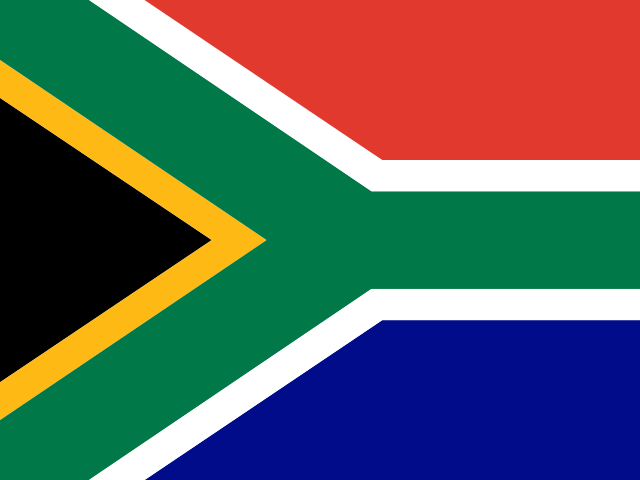
The flag of South Africa is one of the most distinctive in the world. It has a red (chilli red) band at the top and a blue band at the bottom, separated by a horizontal green "Y" or pall that runs from the hoist and joins into a single band across the flag. The green is edged with white against the red and blue, and with gold against a black triangle at the hoist. With six colours and no emblem, it was first raised on 27 April 1994, the day of the first democratic election, and its proportions are 2:3.
What the colours and symbols mean
- The Y shape is the key to the flag's meaning: it represents the convergence of diverse elements within South African society, coming together and moving forward as one along a shared road.
- No official meaning is given to the individual colours. The government states that the flag should be seen as a whole, and that no universal symbolism should be attached to any one colour.
- The colours do echo South Africa's history: black, green and gold are the colours of the ANC and other liberation movements, while red, white and blue appeared on the earlier flag and those of the Boer republics and Britain.
- Popular interpretations link red to the bloodshed of the struggle, blue to the sky and oceans, green to the land, black to the people, gold to mineral wealth and white to peace, but these are unofficial.
Where the flag came from
As the country prepared for its first democratic election, a public competition in 1993 attracted thousands of designs, but none was accepted. With little time left, the State Herald, Frederick Brownell, designed the flag; it was approved only weeks before the election and was intended as an interim flag for a trial period. It proved so popular that it was kept, and the 1996 constitution confirmed it as the national flag. It replaced the orange, white and blue flag used from 1928 to 1994, which carried small versions of the British Union Flag and the flags of the two Boer republics in its centre.
Flag facts most people get wrong
- The colours have no official individual meanings. Only the Y shape, symbolising convergence and unity, has an official interpretation.
- The flag was meant to be temporary. It was adopted as an interim flag in 1994 and only made permanent in the 1996 constitution.
- The flag has six colours, an unusually large number for a national flag without a coat of arms or emblem.
- There is a right way up. When the flag is flown horizontally, the red band must be at the top; when hung vertically, the red band should be on the viewer's left.
- The black triangle faces the flagpole, with the green Y opening out from the hoist side.
The South African people: the rainbow nation
South Africa is one of the most diverse countries on Earth. Its people include Zulu, Xhosa, Sotho, Tswana, Pedi, Venda, Tsonga, Swazi and Ndebele communities, Afrikaners and English-speaking South Africans, people of mixed heritage often described as Coloured, many of them Afrikaans-speaking, and a large community of Indian descent, as well as Khoe and San peoples whose roots in the region go back further than any other. Most South Africans are Christian, and there are also Muslim, Hindu, Jewish and traditional African communities. Many people speak several languages and switch between them in a single conversation.
A value often associated with South Africa is ubuntu, a Nguni word usually summed up as "I am because we are", the idea that a person's humanity is bound up with that of others. It finds expression in hospitality, in community life and in the country's spirit of reconciliation. South Africans are also known for their love of the outdoors, of sport and of a good braai with family and friends, and for a warm, self-deprecating humour that helps them face shared challenges such as inequality and unemployment.
Hundreds of thousands of South Africans live abroad, with large communities in the United Kingdom, Australia, New Zealand, the United States, Canada and the Netherlands, and South African musicians, actors, comedians, writers and athletes are celebrated worldwide. At home, the country's constitution, adopted in 1996 and regarded as one of the most progressive in the world, remains a proud symbol of the democratic South Africa.
Frequently asked questions about South Africa
What is South Africa most famous for?
South Africa is famous for Table Mountain and Cape Town, for safaris and the Big Five in Kruger National Park, for Nelson Mandela and the end of apartheid, for its wines and braais, for the Springboks' rugby World Cup wins, for the Drakensberg and the Garden Route, and for being one of the places where humankind began.
What do the colours of the South African flag mean?
Officially, the individual colours have no fixed meaning; the government says the flag should be seen as a whole. Its central green Y shape represents the coming together of South Africa's diverse peoples and moving forward in unity. Unofficially, many people link red to the struggle, blue to the sky and seas, green to the land, black to the people, gold to mineral wealth and white to peace.
What is the capital of South Africa?
South Africa has three capitals: Pretoria is the administrative capital and seat of the president, Cape Town is the legislative capital where Parliament sits, and Bloemfontein is the judicial capital. Johannesburg, the largest city, is not a capital.
What language do people speak in South Africa?
South Africa has twelve official languages. isiZulu is the most widely spoken home language, followed by isiXhosa and Afrikaans, and English is widely used in business, government and the media.
How many provinces does South Africa have?
South Africa has nine provinces. The Northern Cape is the largest by area, while Gauteng is the smallest by area but has the most people.
Is Cape Point the southernmost tip of Africa?
No. Although Cape Point and the Cape of Good Hope are famous, the southernmost point of Africa is Cape Agulhas, about 150 km to the south-east, which is generally regarded as the place where the Atlantic and Indian oceans officially meet.
Own a square of the South African flag
On 195 Flags, the flag of South Africa is being rebuilt one square at a time by people in South Africa and around the world. Claim your square for $1.99 and seal a message and a photo inside it: a time capsule for your future self and the generations who come after you. And when the South African flag is completely filled, one square owner wins $40,000.
Claim your square of the South African flag →
Photo credits
- Table Mountain and Cape Town's City Bowl (cover): Daniel Case, CC BY-SA 3.0, via Wikimedia Commons
- Murray's Bay Harbour, Robben Island: Daniel Case, CC BY-SA 3.0, via Wikimedia Commons
- Union Buildings, Pretoria: Fritz Joubert, CC BY-SA 4.0, via Wikimedia Commons
- Three Rondavels, Blyde River Canyon: Claidheamhmor, CC BY-SA 4.0, via Wikimedia Commons
- The Amphitheatre, Drakensberg: Anthony Webb, CC BY-SA 3.0, via Wikimedia Commons
- Penguins at Boulders Beach: Satdeep Gill, CC BY-SA 4.0, via Wikimedia Commons
- The Big Hole, Kimberley: South African Tourism, CC BY 2.0, via Wikimedia Commons
- Chiappini Street, Bo-Kaap: Moheen Reeyad, CC BY-SA 4.0, via Wikimedia Commons
- Vineyards in Stellenbosch: Matthias Bethke, CC BY-SA 4.0, via Wikimedia Commons
- Knysna Heads: Dietmar Rabich, CC BY-SA 4.0, via Wikimedia Commons
- Johannesburg skyline: Mark Hillary, CC BY 2.0, via Wikimedia Commons
- Hippos at St Lucia, iSimangaliso Wetland Park: Rialfver at Dutch Wikipedia, CC BY-SA 3.0, via Wikimedia Commons
- Elephants in Kruger National Park: Dietmar Rabich, CC BY-SA 4.0, via Wikimedia Commons
- Hole in the Wall, Wild Coast: Vincentvanoosten, CC0, via Wikimedia Commons
- Augrabies Falls: Svwmal, CC BY-SA 4.0, via Wikimedia Commons
- Golden Gate Highlands National Park: Pavel Špindler, CC BY 3.0, via Wikimedia Commons
The South African flag image is from 195flags.com.


