China: What It's Famous For, Iconic Landmarks, Provinces, History and the Meaning of the Chinese Flag

China is one of the oldest continuous civilisations on Earth and, with around 1.4 billion people, one of the two most populous countries in the world. It is the land of the Great Wall and the Forbidden City, of the Terracotta Army and the giant panda, of silk, porcelain, tea and kung fu, and of some of the most spectacular landscapes anywhere, from the misty karst peaks of Guilin to the sandstone pillars of Zhangjiajie and the high plateau of Tibet. It is also home to gleaming modern cities such as Shanghai and Shenzhen and the world's largest high-speed rail network. In this guide we explore what China is famous for, its most distinctive landmarks, the most popular provinces and regions and what each one offers, a timeline of Chinese history, and the meaning of the five gold stars on the red Chinese flag.
China at a glance
- Official name: the People's Republic of China (PRC); in Chinese, the country is called Zhongguo, usually translated as "the Middle Kingdom" or "the Central State"
- Capital: Beijing; other major cities include Shanghai, Chongqing, Guangzhou, Shenzhen, Tianjin, Chengdu, Wuhan, Xi'an and Hangzhou
- Population: around 1.4 billion; official figures put it at about 1.405 billion at the end of 2025, after four years of gradual decline, and India overtook China as the world's most populous country in 2023, according to UN estimates
- Area: about 9.6 million km², making China one of the largest countries in the world, bordering 14 other countries
- Languages: Standard Chinese (Mandarin, or Putonghua) is the official national language, written with Chinese characters; many other Chinese languages and dialects are spoken, including Cantonese, Shanghainese and Hokkien, as well as minority languages such as Tibetan, Uyghur, Mongolian and Zhuang; English and Chinese are official in Hong Kong, and Portuguese and Chinese in Macau
- Currency: the renminbi (RMB), whose unit is the yuan (CNY); Hong Kong uses the Hong Kong dollar and Macau the pataca
- Administrative divisions: 22 provinces, five autonomous regions, four directly governed municipalities (Beijing, Shanghai, Tianjin and Chongqing) and two special administrative regions (Hong Kong and Macau); the People's Republic also claims Taiwan, which has been governed separately since 1949
- Government: a one-party socialist state led by the Communist Party of China; Xi Jinping has been the party's general secretary since 2012 and president since 2013, and Li Qiang has been premier since 2023
- National symbols: the flag (the "Five-Star Red Flag"), the national emblem showing Tiananmen Gate beneath five stars, and the national anthem, "March of the Volunteers"; the giant panda is a much-loved unofficial symbol
- National day: 1 October, marking the founding of the People's Republic in 1949; the most important traditional holiday is the Spring Festival, or Chinese New Year
- Highest mountain: Mount Everest, known in Tibetan as Chomolungma and in Chinese as Qomolangma, at 8,849 m on the border with Nepal
- Longest river: the Yangtze (Chang Jiang), about 6,300 km long, the longest river in Asia; the Yellow River (Huang He) is often called the "cradle of Chinese civilisation"
- Standout facts: although China spans roughly five geographical time zones, the whole country officially runs on a single time, Beijing Time; China has more UNESCO World Heritage Sites than almost any other country; and Beijing is the only city so far to have hosted both the Summer (2008) and Winter (2022) Olympic Games
What is China famous for?
Chinese food
Chinese cooking is one of the world's great cuisines and is enormously varied. Chefs traditionally speak of "eight great cuisines", including the fiery, numbing dishes of Sichuan, flavoured with chillies and Sichuan pepper, the delicate steamed and stir-fried dishes of Cantonese cooking from Guangdong and Hong Kong, and the sweeter cooking of Jiangsu and Zhejiang. Famous dishes include Peking duck, with its crisp lacquered skin, dim sum served with tea, xiaolongbao soup dumplings from Shanghai, jiaozi dumplings eaten at New Year, hand-pulled noodles from Lanzhou, mapo tofu and the bubbling hotpot of Chongqing and Chengdu. Rice dominates in the south and wheat, in the form of noodles, buns and dumplings, in the north. Sharing many dishes from the centre of a round table is at the heart of a Chinese meal.
Tea, silk and porcelain
China is the original home of tea, which has been drunk there for well over a thousand years and was later carried along trade routes to the rest of the world. Famous varieties include green Longjing (Dragon Well) tea from Hangzhou, oolong, jasmine and fermented Pu'er from Yunnan. China also gave the world silk, whose production was a closely guarded secret for centuries and gave its name to the Silk Road, the network of trade routes linking China with Central Asia, the Middle East and Europe. Chinese porcelain, above all the blue-and-white ware of Jingdezhen, was so prized abroad that in English the word "china" came to mean fine ceramics.
Great inventions
Chinese tradition celebrates the "Four Great Inventions": paper, printing, gunpowder and the compass. Papermaking was refined during the Han dynasty around 2,000 years ago, woodblock printing was in use by the Tang dynasty, and the Diamond Sutra of 868, found in a cave near Dunhuang, is the oldest known dated printed book. Gunpowder was discovered by Chinese alchemists, and the magnetic compass was used for navigation by the Song dynasty. Other Chinese innovations include paper money, the wheelbarrow, cast iron, the seismoscope and the abacus.
Chinese New Year and festivals
The Spring Festival, or Chinese New Year, falls between late January and February according to the lunar calendar and is the most important celebration of the year. Families gather for a reunion dinner, homes are decorated with red lanterns and couplets, children receive red envelopes of money, and fireworks, dragon dances and lion dances fill the streets. Hundreds of millions of people travel home for the holiday, a period known as chunyun that is often described as the largest annual human migration on Earth. Each year is associated with one of the twelve animals of the Chinese zodiac. Other festivals include the Lantern Festival, the Dragon Boat Festival, with its races and sticky-rice zongzi, and the Mid-Autumn Festival, when families eat mooncakes and admire the full moon.
Giant pandas and wildlife

The giant panda, found in the wild only in the mountains of central China, mainly in Sichuan, Shaanxi and Gansu, is one of the most recognisable animals in the world. Pandas spend most of their day eating bamboo, and they have become a symbol of wildlife conservation. Thanks to decades of protection and the creation of reserves, wild numbers have risen, and in 2016 the International Union for Conservation of Nature downgraded the panda from "endangered" to "vulnerable". Visitors can see pandas at breeding and research centres such as the one in Chengdu. China is also home to golden snub-nosed monkeys, South China and Siberian tigers, red-crowned cranes and the Chinese giant salamander.
Philosophy, writing and the arts
The teachings of Confucius (traditionally 551–479 BCE), with their emphasis on family, respect, education and social harmony, have shaped Chinese society for more than two thousand years, alongside Daoism, associated with the sage Laozi, and Buddhism, which arrived from India. Chinese calligraphy, written with brush and ink, is regarded as one of the highest art forms, together with landscape painting and poetry, especially that of Tang dynasty poets such as Li Bai and Du Fu. Peking opera, with its painted faces, acrobatics and elaborate costumes, was recognised by UNESCO in 2010, and traditional instruments include the two-stringed erhu and the zither-like guzheng.
Kung fu, tai chi and sport
Chinese martial arts, known collectively as wushu or kung fu, are famous around the world, thanks in part to films starring Bruce Lee, Jackie Chan and Jet Li. The Shaolin Temple in Henan is legendary as a birthplace of martial arts, and in parks across China people practise slow, flowing tai chi in the early morning. In modern sport, China is a powerhouse in table tennis, badminton, diving, gymnastics and weightlifting, and it topped the gold medal table when Beijing hosted the 2008 Summer Olympics.
Modern China: cities, trains and technology
Since the late 1970s, China has transformed itself into one of the world's largest economies and a major manufacturing and trading nation. Its cities are famous for their skylines, from Shanghai's Pudong district to Shenzhen, a small border town that has grown into a technology hub of more than 17 million people. China has built the world's largest high-speed rail network, with well over 40,000 km of lines, and its space programme has placed astronauts on its own space station, Tiangong, and landed missions on the far side of the Moon. Chinese companies make a large share of the world's electronics, solar panels and electric vehicles.
China's most distinctive landmarks
The Great Wall of China
The Great Wall is not a single wall but a vast network of fortifications built and rebuilt over some two thousand years to protect the northern frontiers of Chinese states and empires. The first emperor, Qin Shi Huang, linked earlier walls in the 3rd century BCE, but most of the brick and stone sections that visitors see today were built during the Ming dynasty (1368–1644). A national survey published in 2012 measured all the walls built over the centuries at more than 21,000 km in total. Near Beijing, the restored sections at Badaling and Mutianyu are the easiest to visit, while Jinshanling, pictured at the top of this guide, offers spectacular hiking along watchtowers and ridges. The Great Wall became a UNESCO World Heritage Site in 1987.
The Forbidden City, Beijing

At the heart of Beijing, the Forbidden City was the imperial palace of 24 emperors of the Ming and Qing dynasties, from its completion in 1420 until the last emperor, Puyi, was expelled in 1924. Surrounded by a moat and a high red wall, it covers about 72 hectares and contains hundreds of halls and courtyards; legend says it has 9,999 rooms, although surveys count fewer. Its golden-yellow roof tiles were reserved for the emperor, and ordinary people were forbidden to enter without permission, hence the name. Since 1925 it has housed the Palace Museum, one of the most visited museums in the world, and it is a UNESCO World Heritage Site. To its south lies Tiananmen Gate, where Mao Zedong proclaimed the People's Republic in 1949, and the vast Tiananmen Square.
The Terracotta Army, Xi'an

In 1974, farmers digging a well near Xi'an in Shaanxi province struck fragments of clay figures, and one of the greatest archaeological discoveries of the 20th century came to light. The Terracotta Army was buried more than 2,200 years ago to guard the tomb of Qin Shi Huang, the first emperor of a unified China. Archaeologists estimate there are around 8,000 soldiers, along with horses and chariots, and no two faces appear to be exactly alike. The figures were originally painted in bright colours, most of which faded soon after excavation. Visitors can walk around the huge hall over Pit 1, where the warriors stand in battle formation. The emperor's burial mound itself has never been opened. The site is part of a UNESCO World Heritage Site.
The Temple of Heaven, Beijing

Built in the early 15th century, at the same time as the Forbidden City, the Temple of Heaven (Tiantan) is where Ming and Qing emperors performed ceremonies to pray to heaven for good harvests. Its most famous building, the Hall of Prayer for Good Harvests, is a round wooden hall with three tiers of deep blue roofs, traditionally said to have been built without nails; the present hall is a reconstruction from the 1890s after a fire. The temple's design is full of symbolism: round shapes represent heaven and square shapes the earth. Today its park is a favourite place for local people to dance, sing, play cards and practise tai chi, especially in the morning. It is a UNESCO World Heritage Site.
The Potala Palace, Lhasa

Rising above Lhasa, the capital of the Tibet Autonomous Region, at an altitude of about 3,700 m, the Potala Palace is one of the most striking buildings in Asia. A palace is said to have stood on the site since the 7th century, but the present building was largely constructed from 1645 under the Fifth Dalai Lama. Its White Palace housed living quarters and government offices, while the Red Palace contains chapels and the golden tombs of past Dalai Lamas. It served as the winter residence of the Dalai Lamas until 1959, when the 14th Dalai Lama went into exile in India, and today it is a museum. Together with the nearby Jokhang Temple, an important pilgrimage site in Tibetan Buddhism, it is a UNESCO World Heritage Site.
The Li River, Guilin and Yangshuo

The journey along the Li River between Guilin and Yangshuo in the Guangxi Zhuang Autonomous Region is one of the most celebrated landscapes in China. Hundreds of steep limestone peaks, known as karst mountains, rise from the green countryside along the river's banks, often wrapped in mist, past bamboo groves, water buffalo and small villages. The scenery has inspired Chinese painters and poets for centuries and appears on the back of the 20-yuan banknote. Visitors can take a river cruise or a bamboo raft, while Yangshuo is a base for cycling, rock climbing and evening light shows on the river.
The Leshan Giant Buddha, Sichuan

Carved into a red sandstone cliff where three rivers meet near the city of Leshan, the Leshan Giant Buddha is about 71 m tall, making it the largest stone Buddha of its kind in the world. Work began in 713 under a monk named Haitong, who, according to tradition, hoped the Buddha would calm the dangerous waters that threatened boats, and it was completed about 90 years later. Its ears alone are about 7 m long, and a hidden drainage system helps protect it from erosion. Visitors can descend a steep staircase beside the statue or view it from a boat. Together with nearby Mount Emei, one of the four sacred mountains of Chinese Buddhism, it is a UNESCO World Heritage Site.
Zhangjiajie National Forest Park, Hunan

In the mountains of north-western Hunan, the Zhangjiajie National Forest Park, established in 1982 as China's first national forest park, is famous for its thousands of tall quartz-sandstone pillars, many over 200 m high, rising from the forest like a stone army. The landscape is often said to have inspired the floating "Hallelujah Mountains" in the film Avatar, and one pillar was renamed "Avatar Hallelujah Mountain" in 2010. The park is part of the Wulingyuan UNESCO World Heritage Site. Visitors can ride the Bailong Elevator, built into a cliff face, and nearby Tianmen Mountain has a natural arch and glass skywalks clinging to its cliffs.
The Mogao Caves, Dunhuang
On the edge of the Gobi Desert in Gansu province, near the old Silk Road oasis of Dunhuang, the Mogao Caves are a complex of hundreds of Buddhist cave temples carved into a cliff between the 4th and 14th centuries. They contain thousands of square metres of wall paintings and more than 2,000 painted sculptures, a remarkable record of art, religion and life along the Silk Road. In 1900, a sealed "Library Cave" was discovered containing tens of thousands of manuscripts, including the Diamond Sutra of 868. The caves are a UNESCO World Heritage Site, and visitor numbers are limited to protect the fragile paintings.
The most popular provinces and regions in China and what they offer
China is divided into provinces, autonomous regions, municipalities and special administrative regions, which vary hugely in landscape, climate, language and food. Here are some of the highlights.
Beijing

China's capital, Beijing, has been the seat of power for most of the last 700 years. Alongside the Forbidden City, the Temple of Heaven and the Great Wall, it is home to the Summer Palace, an imperial garden of lakes, pavilions and covered walkways built around Kunming Lake and Longevity Hill; it was damaged by Anglo-French troops in 1860 and again in 1900, and later rebuilt. Visitors explore the city's hutongs, narrow lanes of traditional courtyard houses, often by bicycle or rickshaw, and the Lama Temple, a working Tibetan Buddhist monastery. Beijing is also the place to eat Peking duck, and its modern landmarks include the "Bird's Nest" National Stadium from the 2008 Olympics.
Shanghai

Shanghai, China's largest city and its financial centre, faces two eras across the Huangpu River. On the west bank, the Bund is lined with grand early 20th-century banks, hotels and trading houses built when Shanghai was a busy treaty port. Opposite, the skyscrapers of Pudong include the Oriental Pearl Tower, with its pink spheres, and the Shanghai Tower, which at 632 m is the tallest building in China. Shanghai also has the classical Yu Garden, the tree-lined streets of the former French Concession, excellent museums, Shanghai Disneyland and some of the best soup dumplings in the country. The Maglev train from Pudong airport is one of the fastest commercial trains in the world.
Hong Kong

A special administrative region of China, Hong Kong was under British rule from the 1840s until 1997, when it returned to Chinese sovereignty under the principle of "one country, two systems". Its skyline around Victoria Harbour is one of the most dramatic in the world, best seen from Victoria Peak, reached by the historic Peak Tram, or from the Star Ferry. Hong Kong is famous for its Cantonese food and dim sum, busy markets and shopping streets, the Tian Tan Buddha on Lantau Island and, perhaps surprisingly, its country parks and hiking trails, which cover a large part of its territory. Nearby Macau, a Portuguese territory until 1999, combines a UNESCO-listed historic centre with huge casino resorts.
Shaanxi: Xi'an
Under the name Chang'an, Xi'an was the capital of a number of dynasties, including the Han and the Tang, and the eastern starting point of the Silk Road; during the Tang dynasty it was one of the largest cities in the world. Today, besides the Terracotta Army, visitors can cycle along the top of its city wall, a 14th-century Ming fortification about 14 km long and one of the best preserved in China, visit the Big Wild Goose Pagoda, built to house Buddhist scriptures brought from India, and eat their way through the lively Muslim Quarter, famous for its street food, including roujiamo, sometimes called the Chinese hamburger, and biangbiang noodles.
Sichuan

Sichuan in south-western China is famous for its pandas and its spicy food. Its capital, Chengdu, is known for its relaxed teahouses, Sichuan opera with its lightning-fast "face-changing", and fiery hotpot, and it was among the first cities to be named a UNESCO City of Gastronomy. Beyond the city are the Leshan Giant Buddha, sacred Mount Emei and, in the north of the province, the valley of Jiuzhaigou, a UNESCO World Heritage Site famous for its multi-coloured lakes, waterfalls and Tibetan villages. Jiuzhaigou was damaged by an earthquake in 2017 and has since reopened after restoration. Western Sichuan rises into the high Tibetan plateau.
Guangxi: Guilin and the Longji rice terraces

The Guangxi Zhuang Autonomous Region in southern China is home to the Zhuang people, China's largest ethnic minority, as well as many other groups. Besides the karst scenery of Guilin and the Li River, it is famous for the Longji (Dragon's Backbone) rice terraces near Longsheng, carved into steep hillsides by Zhuang and Yao farmers over hundreds of years. They are at their most photogenic in spring, when flooded terraces reflect the sky, and in autumn, when the rice turns gold. Guangxi is also known for its rice noodles, especially the pungent luosifen snail noodles of Liuzhou.
Jiangsu and Zhejiang

The fertile region around the Yangtze delta, south of the river, has long been one of the richest in China, famous for silk, tea and waterways. In Jiangsu, Suzhou is celebrated for its classical gardens, carefully composed miniature landscapes of rocks, ponds, pavilions and windows framing views, nine of which are part of a UNESCO World Heritage Site, and for its canals. Nearby water towns such as Zhouzhuang and Tongli preserve old houses and stone bridges. In Zhejiang, Hangzhou is built around West Lake, with its causeways, pagodas and tea plantations, a UNESCO World Heritage Site and a classic of Chinese poetry and painting. The Grand Canal, the longest artificial waterway in the world, connects the region with Beijing far to the north.
Anhui: Huangshan

The granite peaks of Huangshan, the Yellow Mountains, in Anhui province have been called the most beautiful mountains in China. Famous for their oddly shaped rocks, twisted pine trees growing out of the cliffs, hot springs and the "sea of clouds" that often fills the valleys below, they have inspired generations of Chinese landscape painters. Visitors climb thousands of stone steps or take cable cars, and many stay overnight on the mountain to see the sunrise. Huangshan is a UNESCO World Heritage Site, and at its foot the villages of Hongcun and Xidi preserve elegant whitewashed houses from the Ming and Qing dynasties.
Yunnan
In the far south-west, Yunnan is one of China's most diverse provinces, home to 25 officially recognised ethnic minority groups and landscapes ranging from snow-capped peaks to tropical rainforest. The old town of Lijiang, with its cobbled lanes, canals and wooden houses, is a UNESCO World Heritage Site and the heartland of the Naxi people, beneath Jade Dragon Snow Mountain. Dali, on the shores of Erhai Lake, is a centre of the Bai people, and Shangri-La (Zhongdian) has a strongly Tibetan character. Near the capital, Kunming, the Stone Forest is a maze of limestone pillars, and the province is famous for its Pu'er tea, wild mushrooms and "crossing-the-bridge" rice noodles.
Tibet
The Tibet Autonomous Region occupies much of the Tibetan Plateau, often called "the Roof of the World", with an average altitude of more than 4,000 m. Its capital, Lhasa, is the site of the Potala Palace, the Jokhang Temple and the Barkhor, a circuit around the temple walked by pilgrims. Further afield are great monasteries such as Tashilhunpo in Shigatse, turquoise lakes such as Namtso, and the north face of Mount Everest. Tibetan Buddhism, with its prayer flags, prayer wheels and monasteries, shapes daily life for many people. Tibet came under the control of the People's Republic in 1950–51, and its political status remains a subject of international debate. Foreign visitors need special permits and must travel with an approved tour.
A timeline of Chinese history
- Hundreds of thousands of years ago: Early humans, including the Homo erectus known as "Peking Man", live at Zhoukoudian near Beijing.
- By around 7000 BCE: Farmers are growing rice along the Yangtze and millet along the Yellow River.
- c. 1600–1046 BCE: The Shang dynasty rules the Yellow River valley; inscriptions on "oracle bones" are the earliest known Chinese writing.
- 1046–256 BCE: The Zhou dynasty; in its later centuries, during the "Hundred Schools of Thought", Confucius and other great thinkers teach.
- 221 BCE: Qin Shi Huang unites China as its first emperor, standardising writing, coins, weights and measures, and linking earlier frontier walls.
- 206 BCE–220 CE: The Han dynasty; Silk Road trade links China with Central Asia and beyond, and papermaking is refined. The majority Han Chinese take their name from this dynasty.
- 1st century CE: Buddhism reaches China from India along the trade routes.
- 220–589: After the fall of the Han, China is divided among rival kingdoms, beginning with the Three Kingdoms period.
- 581–618: The Sui dynasty reunites China and builds much of the Grand Canal.
- 618–907: The Tang dynasty, a golden age of poetry, art and trade, with its capital at Chang'an (Xi'an).
- 690–705: Wu Zetian rules as the only woman in Chinese history to take the title of emperor in her own right.
- 868: The Diamond Sutra, the oldest known dated printed book, is produced.
- 960–1279: The Song dynasty; paper money, gunpowder weapons and the magnetic compass come into wide use.
- 1271–1368: The Yuan dynasty, founded by the Mongol ruler Kublai Khan; Marco Polo's account of his travels makes China famous in Europe.
- 1368–1644: The Ming dynasty; the Forbidden City is completed in 1420, and much of the Great Wall that survives today is built.
- 1405–1433: Admiral Zheng He leads great fleets on voyages across the Indian Ocean as far as East Africa.
- 1644–1912: The Qing dynasty, founded by the Manchus, rules China and expands its territory.
- 1839–1842: The First Opium War with Britain ends with the Treaty of Nanking, under which Hong Kong Island is ceded to Britain.
- 1850–1864: The Taiping Rebellion, one of the deadliest conflicts of the 19th century, costs millions of lives.
- 1856–1860: The Second Opium War; British and French troops burn the Old Summer Palace in Beijing.
- 1894–1895: China is defeated in the First Sino-Japanese War, and Taiwan is ceded to Japan.
- 1899–1901: The Boxer Uprising is put down by an alliance of foreign powers.
- 1911–1912: The Xinhai Revolution overthrows the Qing; the Republic of China is founded on 1 January 1912, with Sun Yat-sen as provisional president, and the last emperor, Puyi, abdicates.
- 1919: The May Fourth Movement, a wave of student protest and cultural change, begins in Beijing.
- 1921: The Communist Party of China is founded in Shanghai.
- 1934–1935: Communist forces under Mao Zedong and others make the Long March.
- 1937–1945: The Second Sino-Japanese War, which becomes part of the Second World War; millions of Chinese people are killed.
- 1945–1949: Civil war between the Nationalists and the Communists.
- 1 October 1949: Mao Zedong proclaims the People's Republic of China in Beijing; the Nationalist government of the Republic of China relocates to Taiwan.
- 1958–1962: The Great Leap Forward, an attempt at rapid industrialisation, is followed by a severe famine in which tens of millions of people die.
- 1966–1976: The Cultural Revolution brings years of political upheaval.
- 1971: The People's Republic takes China's seat at the United Nations.
- 1972: US President Richard Nixon visits China.
- 1974: The Terracotta Army is discovered near Xi'an.
- 1976: Mao Zedong dies.
- 1978: Under Deng Xiaoping, China begins the policy of "reform and opening up", leading to decades of rapid economic growth.
- 1989: Protests centred on Tiananmen Square in Beijing are ended by a military crackdown on 3–4 June, in which many people are killed.
- 1997: Hong Kong returns to Chinese sovereignty, followed by Macau in 1999.
- 2001: China joins the World Trade Organization.
- 2003: Yang Liwei becomes the first Chinese astronaut to travel into space.
- 2008: A major earthquake strikes Sichuan in May, killing around 70,000 people; in August, Beijing hosts the Summer Olympics.
- 2012–2013: Xi Jinping becomes general secretary of the Communist Party and then president.
- 2019: The Chang'e 4 mission makes the first soft landing on the far side of the Moon.
- 2019–2020: COVID-19, first identified in Wuhan, spreads around the world.
- 2022: Beijing hosts the Winter Olympics, becoming the first city to host both the Summer and Winter Games; the Tiangong space station is completed.
- 2023: India overtakes China as the world's most populous country, according to UN estimates.
- 2024: The Chang'e 6 mission returns the first samples ever collected from the far side of the Moon.
- 2026: Official figures show that China's population fell for a fourth consecutive year in 2025, to about 1.405 billion.
The Chinese flag: its history and meaning
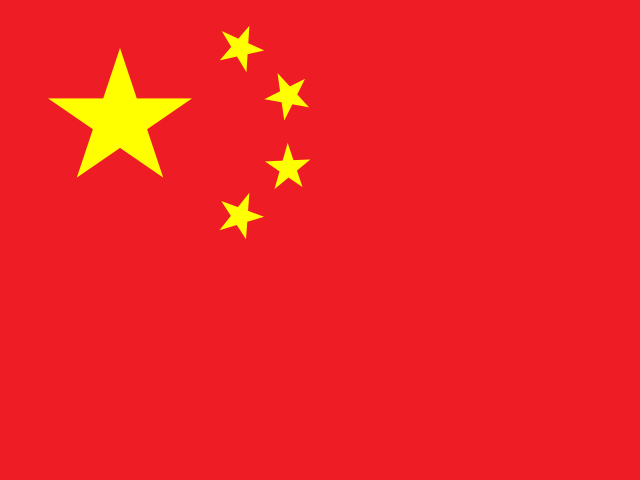
The flag of the People's Republic of China is known as the Five-Star Red Flag (Wuxing Hongqi). It consists of a red field with five gold (yellow) stars in the upper corner near the flagpole: one large star and four smaller stars arranged in an arc to its right. The flag has a width-to-height ratio of 3:2.
What the colours and symbols mean
- Red represents the communist revolution; it is also a traditional colour of good fortune and celebration in Chinese culture.
- The large star represents the leadership of the Communist Party of China.
- The four smaller stars represent the four social classes described by Mao Zedong in 1949: the working class, the peasantry, the urban petty bourgeoisie and the national bourgeoisie.
- The arrangement of the small stars around the large one represents the unity of the Chinese people under the party's leadership; each small star has one point aimed at the centre of the large star.
- Gold or yellow stands out against the red and is associated with brightness; yellow was also historically the imperial colour in China.
Where the flag came from
In July 1949, as the Communists neared victory in the civil war, a committee preparing for the new state invited the public to submit designs for a national flag, and received thousands of entries. The winning design was by Zeng Liansong, an economist from Zhejiang living in Shanghai, who was reportedly inspired by the stars of the night sky. His original version included a hammer and sickle in the large star, which was removed before the design was adopted. The flag was approved by the Chinese People's Political Consultative Conference on 27 September 1949, and it was first raised in Tiananmen Square on 1 October 1949, when Mao Zedong proclaimed the People's Republic and pressed the button that hoisted it. Today, a flag-raising ceremony takes place every day at sunrise in Tiananmen Square. The flag's design and use are set out in a national flag law, first passed in 1990.
Flag facts most people get wrong
- The five stars do not represent five ethnic groups. That was the meaning of an earlier flag: the Republic of China used a "Five Races Under One Union" flag of five horizontal stripes from 1912 to 1928.
- The stars are not all the same size or evenly spaced. The four small stars sit at precise, slightly different positions so that each points towards the centre of the large star.
- The flag is not the same as the flag used in Taiwan. The Republic of China, which governs Taiwan, uses a different flag: a red field with a blue canton containing a white sun.
- It was chosen by a public design competition. The designer was not a professional artist or politician but an ordinary citizen.
- Hong Kong and Macau have their own regional flags, featuring a bauhinia flower and a lotus flower respectively, which fly alongside the national flag.
The Chinese people: family, tradition and change
China is home to 56 officially recognised ethnic groups. The Han Chinese make up the great majority, roughly nine in ten people, while larger minority groups include the Zhuang, Hui, Manchu, Uyghur, Miao, Yi, Tujia, Tibetans and Mongols, each with their own languages, customs, dress and food. Across this diversity, many shared values run deep: the importance of family and respect for elders, often linked to Confucian ideas of filial piety; a great emphasis on education, symbolised by the gaokao, the national university entrance exam taken by more than ten million students each year; and the importance of personal relationships and hospitality, especially around the dinner table.
Modern China has changed at astonishing speed. Within a few decades, hundreds of millions of people have moved from the countryside to the cities, and daily life has become highly digital, with mobile payments, food delivery and super-apps used for almost everything. At the same time, traditions remain strong: families still travel across the country for the Spring Festival, people sweep their ancestors' graves at the Qingming Festival, and parks fill with people dancing, singing, practising calligraphy with water on the pavement or playing Chinese chess.
Chinese communities have also spread around the world over many centuries. There are tens of millions of people of Chinese descent living outside China, especially in Southeast Asia, in countries such as Indonesia, Thailand, Malaysia and Singapore, as well as in North America, Europe and Australia. Chinatowns from San Francisco to London host Lunar New Year parades every year, and Chinese food, festivals and language have become part of everyday life far beyond China's borders.
Frequently asked questions about China
What is China most famous for?
China is famous for the Great Wall, the Forbidden City and the Terracotta Army; for giant pandas; for its food, from Peking duck to dim sum and Sichuan hotpot; for tea, silk and porcelain; for the "Four Great Inventions" of paper, printing, gunpowder and the compass; for Chinese New Year, kung fu and Confucius; and for its spectacular landscapes and fast-growing modern cities.
What do the colours of the Chinese flag mean?
The red field represents the communist revolution and is also a traditional Chinese colour of good fortune. The large gold star represents the Communist Party of China, and the four smaller stars represent the four social classes of the Chinese people, arranged around the large star to symbolise unity.
What is the capital of China?
Beijing is the capital of China. The city has been the capital for most of the period since the 13th century, apart from times when the capital was moved elsewhere, notably to Nanjing. Shanghai is China's largest city and its main financial centre.
Can you see the Great Wall of China from space?
This is a popular myth. The Great Wall is very long but only a few metres wide and similar in colour to the land around it, so it is not visible to the naked eye from the Moon, and astronauts in low Earth orbit have generally reported that it is extremely difficult or impossible to see without help.
How many provinces does China have?
The People's Republic of China has 22 provinces, plus five autonomous regions (Inner Mongolia, Guangxi, Tibet, Ningxia and Xinjiang), four municipalities (Beijing, Shanghai, Tianjin and Chongqing) and two special administrative regions (Hong Kong and Macau). The People's Republic also regards Taiwan as a province, but Taiwan has been governed separately since 1949.
Where does the name "China" come from?
The English name "China" is widely thought to come from the Qin dynasty (pronounced "chin"), which first united the country in 221 BCE, via Sanskrit and Persian, although historians still debate its exact origins. In Chinese, the country is called Zhongguo, meaning "Middle Kingdom" or "Central State".
Own a square of the Chinese flag
On 195 Flags, the flag of China is being rebuilt one square at a time by people in China and around the world. Claim your square for $1.99 and seal a message and a photo inside it: a time capsule for your future self and the generations who come after you. And when the Chinese flag is completely filled, one square owner wins $40,000.
Claim your square of the Chinese flag →
Photo credits
- The Great Wall at Jinshanling (cover): Severin.stalder, CC BY-SA 3.0, via Wikimedia Commons
- Giant panda cub, Chengdu: George Lu, CC BY 2.0, via Wikimedia Commons
- Corner tower of the Forbidden City, Beijing: Kallgan, CC BY-SA 3.0, via Wikimedia Commons
- Terracotta Army, Xi'an: xiquinhosilva, CC BY 2.0, via Wikimedia Commons
- Hall of Prayer for Good Harvests, Temple of Heaven, Beijing: Lloyd Tudor, CC BY-SA 4.0, via Wikimedia Commons
- Potala Palace, Lhasa: Ondřej Žváček, CC BY 2.5, via Wikimedia Commons
- Li River near Yangshuo, Guangxi: chensiyuan, CC BY-SA 4.0, via Wikimedia Commons
- Leshan Giant Buddha, Sichuan: 王计, CC BY 2.5, via Wikimedia Commons
- Zhangjiajie National Forest Park, Hunan: Dcpeets, CC BY-SA 4.0, via Wikimedia Commons
- Summer Palace, Beijing: xiquinhosilva, CC BY 2.0, via Wikimedia Commons
- Pudong skyline from the Bund, Shanghai: DvTor8303, CC0, via Wikimedia Commons
- Victoria Harbour at night, Hong Kong: Benh LIEU SONG (Flickr), CC BY-SA 4.0, via Wikimedia Commons
- Five Flower Lake, Jiuzhaigou, Sichuan: Chensiyuan, CC BY-SA 4.0, via Wikimedia Commons
- Longji rice terraces, Guangxi: Kurinurm, CC0, via Wikimedia Commons
- Classical garden pavilion, Suzhou: Jason Zhang, CC0, via Wikimedia Commons
- Huangshan (Yellow Mountains), Anhui: 颐园居, CC BY-SA 4.0, via Wikimedia Commons
The Chinese flag image is from 195flags.com.


