Nigeria: What It's Famous For, Iconic Landmarks, States, History and the Meaning of the Nigerian Flag

Nigeria is a country that rarely does anything quietly. Africa's most populous nation is a land of giant granite domes and rainforest rivers, of ancient kingdoms and buzzing megacities, of hundreds of languages and one of the world's most exciting music scenes. It gave the world Afrobeats and Nollywood, the novels of Chinua Achebe and the plays of Wole Soyinka, the Benin Bronzes and a plate of jollof rice that whole countries argue about. In this guide we explore what Nigeria is famous for, its most distinctive landmarks, the most popular states and what each one offers, a timeline of Nigerian history, and the meaning behind the simple green and white of the Nigerian flag.
Nigeria at a glance
- Official name: the Federal Republic of Nigeria
- Capital: Abuja, a planned city that replaced Lagos as the capital in 1991; Lagos remains the largest city, and other major cities include Kano, Ibadan, Port Harcourt and Benin City
- Population: around 240 million by UN-based estimates, the largest in Africa and among the six or seven largest in the world; the last national census was held in 2006, so all current figures are projections
- Area: about 924,000 km², roughly four times the size of the United Kingdom
- Languages: English is the official language; Hausa, Yoruba and Igbo are the most widely spoken of more than 500 languages, and Nigerian Pidgin is used as a common tongue across much of the country
- Currency: the naira (NGN), with the symbol ₦, divided into 100 kobo
- Administrative divisions: 36 states and the Federal Capital Territory (FCT), which contains Abuja
- Government: a federal presidential republic; the president is both head of state and head of government, and the next general election is scheduled for early 2027
- National symbols: the coat of arms, with a black shield crossed by a white "Y" for the Niger and Benue rivers, supported by two horses and topped by an eagle; the national motto is "Unity and Faith, Peace and Progress", and the national anthem is "Nigeria, We Hail Thee", restored in 2024
- National days: Independence Day on 1 October, marking independence in 1960, and Democracy Day on 12 June
- Highest mountain: Chappal Waddi (about 2,420 m), on the Mambilla Plateau near the border with Cameroon
- Longest river: the Niger, which flows for about 4,180 km through West Africa and gives the country its name; it is joined by its great tributary, the Benue, at Lokoja
- Standout facts: Nigeria has two UNESCO World Heritage Sites, the Sukur Cultural Landscape and the Osun-Osogbo Sacred Grove, and is one of Africa's largest oil producers
What is Nigeria famous for?
Jollof rice, suya and Nigerian food
Nigerian cooking is bold, peppery and generous. Its most famous dish is jollof rice, cooked in a rich tomato and pepper sauce and served at almost every party, and the friendly rivalry with Ghana over whose jollof is best is a long-running joke across West Africa. Other favourites include pounded yam or eba eaten with soups such as egusi (made with melon seeds) and efo riro (a spinach stew), spicy suya (grilled skewered meat dusted with a peanut and chilli spice mix), moi moi (steamed bean pudding), akara (bean fritters), pepper soup, fried plantain known as dodo, and sweet puff-puff. In the north, dishes such as tuwo shinkafa and miyan kuka are popular, while the south-east is known for ofe onugbu (bitter leaf soup) and nkwobi.
Afrobeats and Nigerian music
Few countries have shaped global pop music in the 21st century like Nigeria. Afrobeats, a blend of West African rhythms, hip hop, dancehall and pop, has turned artists such as Burna Boy, Wizkid, Davido, Tems, Rema and Asake into international stars, filling stadiums from London to New York and winning Grammy Awards. It grew from older Nigerian traditions: the political Afrobeat of Fela Kuti, the guitar-led jùjú music of King Sunny Adé, highlife, fújì and apala. Music is everywhere in Nigeria, from church choirs and wedding bands to the speakers of Lagos traffic.
Nollywood
Nigeria's film industry, known as Nollywood, is one of the largest in the world by the number of films made, producing a huge number of titles every year. It began with low-budget home videos in the early 1990s, and Living in Bondage (1992) is often cited as the film that launched the boom. Today Nollywood ranges from quick-fire comedies and family dramas to big-budget productions shown in cinemas and on international streaming platforms, and its stories, actors and catchphrases are loved across Africa and the diaspora.
Literature
Nigeria has produced some of Africa's most celebrated writers. Chinua Achebe's Things Fall Apart (1958), about the impact of colonialism on an Igbo village, is one of the most widely read African novels of all time. In 1986 the playwright Wole Soyinka became the first sub-Saharan African writer to win the Nobel Prize in Literature. Later generations include Ben Okri, who won the Booker Prize in 1991, Buchi Emecheta, Chimamanda Ngozi Adichie, author of Half of a Yellow Sun and Americanah, and many more novelists and poets writing in English, Yoruba, Hausa and Igbo.
Football and sport
Football is Nigeria's great passion. The men's team, the Super Eagles, have won the Africa Cup of Nations three times (1980, 1994 and 2013) and finished third at the 2025 tournament in Morocco, while the under-23 side won Olympic gold in Atlanta in 1996, the first African country to win the men's Olympic football tournament. Nigeria's women, the Super Falcons, are the most successful team in the history of the Women's Africa Cup of Nations, having won it ten times. Nigerian athletes also shine in track and field, boxing and basketball, and many players of Nigerian heritage star in Europe's top football leagues and in the NBA.
Ancient art: Nok, Ife, Igbo-Ukwu and Benin
Long before European contact, the peoples of what is now Nigeria created extraordinary works of art. The terracotta sculptures of the Nok culture, more than 2,000 years old, are among the earliest known figurative sculptures in sub-Saharan Africa. The ancient bronzes of Igbo-Ukwu, dating from around the 9th or 10th century, show astonishing technical skill, while the lifelike brass and terracotta heads of Ife are admired as some of the finest portrait sculptures in the world. The Benin Bronzes, thousands of plaques and sculptures made for the royal court of the Kingdom of Benin, were taken by British forces in 1897 and scattered across museums worldwide; in recent years some have begun to be returned to Nigeria.
Festivals
Nigeria's festivals are spectacular. In the north, the Durbar festivals held at the end of Ramadan and at Eid al-Adha in cities such as Kano, Katsina and Zaria see hundreds of horsemen in brilliant robes and turbans parade before the emir. In Osogbo, the Osun-Osogbo Festival each August honours the river goddess Osun. The Argungu Fishing Festival in Kebbi State sees thousands of fishermen leap into the river at once, Lagos has the white-robed masquerades of the Eyo Festival, Igbo communities celebrate the New Yam Festival after the harvest, and the Calabar Carnival fills the streets of Calabar every December.

Rivers, rainforests and wildlife
Nigeria stretches from the mangrove swamps of the Niger Delta, one of the largest river deltas in the world, through rainforest and savannah to the dry Sahel on the edge of the Sahara. Its national parks include Yankari in Bauchi State, known for its elephants and the crystal-clear Wikki Warm Spring, Cross River National Park, a refuge for rare primates such as the Cross River gorilla, and Gashaka-Gumti, the country's largest national park. Highlands such as the Jos Plateau, the Obudu Plateau and the Mambilla Plateau offer a cooler climate and sweeping views.

Nigeria's most distinctive landmarks
Zuma Rock, Niger State
Rising abruptly from the plains beside the main road from Abuja to Kaduna, near the town of Madalla, Zuma Rock is Nigeria's most recognisable natural landmark. This enormous granite monolith rises around 700 m above its surroundings, and its streaked grey sides are said by many to show the shape of a human face. It is often called the "Gateway to Abuja", it appears on the ₦100 banknote, and it has long held spiritual importance for the local Gbagyi (Gwari) people, who once used it as a place of refuge.
Aso Rock, Abuja

The capital city of Abuja was built at the foot of Aso Rock, a massive granite outcrop rising about 400 m above the city on its north-eastern edge. At its base lie the Three Arms Zone, home to the Presidential Villa, the National Assembly and the Supreme Court, which is why "Aso Rock" has become shorthand in Nigerian newspapers for the presidency itself. The name is often translated as "victorious" in the language of the local Asokoro people.
The National Mosque and National Christian Centre, Abuja

Two of Abuja's most striking buildings stand on opposite sides of the same central avenue. The Abuja National Mosque, completed in 1984, is crowned by a shining golden dome and four slender minarets, and is used for Friday prayers and major religious occasions. Not far away stands the National Christian Centre, a modern cathedral-like church with a soaring central spire, opened in the 2000s. Together they reflect a country whose population is roughly divided between Muslims and Christians.
Olumo Rock, Abeokuta

The city of Abeokuta, whose name means "under the rock", grew up around Olumo Rock, a granite outcrop that offered shelter to the Egba people during the wars that swept Yorubaland in the early 19th century. Today visitors climb its carved steps or take a lift to the summit, passing shrines, old hiding places and caves along the way, and are rewarded with a wide view over the rooftops of Abeokuta and the Ogun River. The rock remains a symbol of Egba identity and pride.
The Osun-Osogbo Sacred Grove, Osun State

On the edge of the city of Osogbo, a dense forest along the Osun River is home to the Osun-Osogbo Sacred Grove, one of the last remnants of primary high forest in southern Nigeria and a sacred place for followers of the Yoruba religion. It is dedicated to Osun, the goddess of fertility and the river. From the 1950s, the Austrian-born artist Susanne Wenger, who made Osogbo her home, worked with local artists to restore its shrines and fill the grove with dramatic sculptures. The grove was listed as a UNESCO World Heritage Site in 2005, and every August it hosts the Osun-Osogbo Festival, which draws worshippers and visitors from Nigeria and abroad.
The Wole Soyinka Centre (National Arts Theatre), Lagos

With its sweeping circular shape, often compared to a military cap, the National Arts Theatre in the Iganmu district of Lagos is one of the city's best-known buildings. It was completed in 1976 to host FESTAC '77, the Second World Black and African Festival of Arts and Culture, which brought together artists from across Africa and the diaspora. After years of decline, it was extensively renovated and reopened on 1 October 2025 as the Wole Soyinka Centre for Culture and Creative Arts, named in honour of Nigeria's Nobel laureate.
Idanre Hills, Ondo State

The Idanre Hills (Oke Idanre) are a dramatic cluster of granite domes rising high above the forests of Ondo State. For centuries the people of Idanre lived on the hilltop for safety, and the remains of their old town, including the former palace of the Owa (king), shrines and a court, can still be visited. Reaching them means climbing more than 600 steps, with rest points along the way and spectacular views over the surrounding landscape. The site is on Nigeria's tentative list for UNESCO World Heritage status.
The ancient city walls of Kano

Kano, one of the oldest cities in West Africa, was once ringed by massive earthen walls, the ganuwa, begun in the early centuries of the Hausa kingdom and extended over hundreds of years. Long stretches have crumbled, but sections and some of the old gates survive, and parts have been restored. Inside the old city are the Emir's Palace (Gidan Rumfa), the Gidan Makama Museum, the vast Kurmi Market, which has traded for centuries, and the Kofar Mata dye pits, where indigo cloth is still dyed by hand in pits that tradition says date back to the 15th century.
The most popular states in Nigeria and what they offer
Nigeria is a federation of 36 states and the Federal Capital Territory, each with its own landscapes, languages and traditions. Broadly speaking, the north is home mainly to the Hausa-Fulani and Kanuri peoples, the south-west to the Yoruba and the south-east to the Igbo, with hundreds of other ethnic groups across the Middle Belt and the Niger Delta. Here are some of the highlights.
Lagos State

Lagos is Nigeria's commercial capital and one of the largest and fastest-growing cities in Africa, with a population usually estimated at well over 15 million. It sprawls across islands, lagoons and mainland districts linked by long bridges such as the Third Mainland Bridge. Lagos Island has the old business district and markets, Ikoyi and Victoria Island are known for restaurants, galleries and nightlife, and Lekki has beaches, the Lekki Conservation Centre with its long canopy walkway and the huge Nike Art Gallery. The city is the heart of Nigeria's music, fashion, film and tech scenes, and its energy, traffic jams and creativity are legendary.
The Federal Capital Territory (Abuja)
Chosen in 1976 as a new, centrally located capital, Abuja was built from scratch and became the seat of government in 1991. It is greener, calmer and more orderly than Lagos, with wide avenues, modern government buildings and landmarks such as Aso Rock, the National Mosque, the National Christian Centre, the Millennium Park and Jabi Lake. The city is surrounded by hills and rock formations, and Zuma Rock lies just outside the territory on the road north.
Kano State
Kano has been a great trading city for centuries, a terminus of the trans-Saharan caravan routes, where goods such as leather, cloth and kola nuts were exchanged. Today it is the largest city in northern Nigeria and a centre of Hausa culture and Islamic learning. Visitors come for the old walled city, the Emir's Palace, the indigo dye pits and the bustling markets, and above all for the Kano Durbar, when horsemen in dazzling costume ride in procession to salute the emir during the Eid festivals.
Cross River State

In the south-east, close to the border with Cameroon, Cross River State is one of Nigeria's greenest and most visitor-friendly regions. Its capital, Calabar, is known for its clean streets, its colonial-era buildings and the month-long festivities of the Calabar Carnival in December. Inland, the Obudu Mountain Resort, once a cattle ranch, sits at about 1,500 m on the Obudu Plateau and is reached by a famously winding road, offering cool air, hiking and wide mountain views. The state is also home to Cross River National Park and the Drill Ranch, which protects endangered drill monkeys.

In Calabar itself, the Old Residency, a prefabricated colonial building from the late 19th century, now houses a branch of the National Museum, with exhibits on the region's history, including the slave trade, the palm oil trade and the colonial era.
Osun State

In the heart of Yorubaland, Osun State combines spiritual heritage with beautiful scenery. Its capital, Osogbo, is home to the Sacred Grove and a lively art scene, while the ancient city of Ile-Ife is regarded by the Yoruba as the place where humanity was created and is the seat of the Ooni of Ife, one of the most important traditional rulers in Nigeria. Near the town of Erin-Ijesha, the Olumirin (Erin Ijesha) Waterfalls tumble down a series of rocky levels through the forest, and adventurous visitors climb from one level to the next.
Ogun and Oyo States
North of Lagos, Ogun State is home to Abeokuta and Olumo Rock, and to the birthplaces of many famous Nigerians, including Wole Soyinka and Fela Kuti, both born in Abeokuta. Neighbouring Oyo State has Ibadan, one of the largest cities in Nigeria, with Nigeria's oldest university, the University of Ibadan, founded in 1948, the hilltop Bower's Tower and the historic town of Oyo, once the capital of the powerful Oyo Empire. Further north lies Old Oyo National Park, where the ruins of the empire's ancient capital lie in the savannah.
Edo State
Edo State is the heartland of the historic Kingdom of Benin, one of the great states of West Africa, which should not be confused with the modern Republic of Benin next door. In Benin City, the Oba (king) still holds court at his palace, and on Igun Street guilds of bronze casters continue the craft that produced the famous Benin Bronzes. The remains of the vast earthworks known as the Benin Walls and Moats, built over several centuries, once stretched for thousands of kilometres across the kingdom.
Plateau State
Set on the Jos Plateau, at an average height of about 1,200 m, Plateau State has a noticeably cooler climate than most of Nigeria, which earned its capital, Jos, a reputation as a holiday destination. The landscape of rolling grassland and striking rock formations is ideal for hiking, and the Jos Museum holds important collections, including Nok terracottas. The area has a long history of tin mining, which left behind lakes and ponds across the plateau.
Niger State

Nigeria's largest state by area, Niger State lies along the Niger River north-west of Abuja. As well as Zuma Rock, it is home to the Gurara Falls, where the Gurara River spreads across broad rock shelves and plunges into a gorge, at its most powerful in the rainy season. Part of Kainji Lake National Park, created around the reservoir of the Kainji Dam, lies in the state, along with the historic town of Bida, famous for its glass beads, brass work and colourful Durbar.
Taraba State and the Mambilla Plateau

In the far east, on the border with Cameroon, Taraba State contains some of Nigeria's most spectacular and least-visited scenery. The Mambilla Plateau, much of it more than 1,500 m above sea level, is a land of green hills, cattle herds and tea plantations with a mild, almost temperate climate. Nearby rises Chappal Waddi, Nigeria's highest mountain, and the vast Gashaka-Gumti National Park, which is home to chimpanzees, elephants and many rare birds.
Bauchi State
Bauchi State in the north-east is best known for Yankari National Park, one of the most popular wildlife destinations in Nigeria. Its savannah and woodland are home to elephants, baboons, hippos, antelopes and many bird species, and visitors can swim in the clear, warm water of the Wikki Warm Spring, which stays at around 31°C all year round.
Rivers State and the Niger Delta
The Niger Delta in the south is a vast network of creeks, mangroves and islands, home to many peoples, including the Ijaw, Ogoni, Itsekiri, Urhobo and Efik. It is also the centre of Nigeria's oil and gas industry, which has brought wealth to the country but also pollution and tension in the region. Port Harcourt, the capital of Rivers State, nicknamed the "Garden City", is the region's main city, and the delta's waterside communities have their own rich traditions of masquerade, music, fishing and boat-building.
Enugu and the South-East
The south-east is the heartland of the Igbo people, known for their enterprise, love of education and lively festivals. Enugu, once a coal-mining centre and still nicknamed the "Coal City", is a green city surrounded by hills, while the commercial city of Onitsha on the Niger is home to one of the largest markets in West Africa, and Aba is famous for its craftsmen and manufacturers. In Anambra State, the Ogbunike Caves, a network of caves and tunnels in the forest, are linked to local traditions and an annual festival.
A timeline of Nigerian history
- Tens of thousands of years ago: Stone Age hunter-gatherers live in the region; human remains found at the Iwo Eleru rock shelter in Ondo State are more than 11,000 years old.
- c. 1500 BCE–1 CE: The Nok culture flourishes in central Nigeria, creating terracotta sculptures and, in its later centuries, smelting iron.
- c. 9th–10th centuries CE: Bronze objects of remarkable skill are made at Igbo-Ukwu in the south-east.
- c. 11th century: Islam spreads to the Kanem-Bornu Empire around Lake Chad, and Hausa city-states such as Kano and Katsina begin to grow.
- c. 12th–15th centuries: Ife becomes a major Yoruba religious and artistic centre, producing its famous naturalistic heads.
- 15th century: The Kingdom of Benin expands under Oba Ewuare; Kano grows into a great walled trading city.
- Late 15th century: Portuguese traders reach the Kingdom of Benin.
- 16th–19th centuries: The Atlantic slave trade forcibly takes huge numbers of people from the Bights of Benin and Biafra to the Americas.
- 17th–18th centuries: The Oyo Empire becomes the dominant power in Yorubaland.
- 1804–1809: Usman dan Fodio leads a jihad across Hausaland and founds the Sokoto Caliphate.
- 1807: Britain abolishes its slave trade and later sends naval patrols to West Africa.
- 1861: Britain annexes Lagos as a colony.
- 1884–1885: Britain claims the Oil Rivers Protectorate on the coast during the "Scramble for Africa".
- 1897: British forces attack Benin City and take thousands of artworks, including the Benin Bronzes.
- 1900: The protectorates of Northern and Southern Nigeria are established under British rule.
- 1903: British forces capture Kano and Sokoto.
- 1914: Northern and Southern Nigeria are amalgamated into a single colony on 1 January under Frederick Lugard.
- 1929: Igbo and Ibibio women lead the Aba Women's War, protesting against colonial rule and taxation.
- 1948: University College Ibadan, Nigeria's first university, is founded.
- 1958: Chinua Achebe publishes Things Fall Apart.
- 1960: Nigeria becomes independent on 1 October, with Abubakar Tafawa Balewa as prime minister.
- 1963: Nigeria becomes a republic, with Nnamdi Azikiwe as president.
- 1966: Two military coups overthrow the civilian government and bring violence to the north.
- 1967–1970: The Nigerian Civil War, also known as the Biafran War, follows the secession of the south-east as Biafra; it causes enormous loss of life, much of it through famine, before ending in January 1970.
- 1971: Nigeria joins OPEC as oil becomes the heart of the economy.
- 1976: A new capital at Abuja is chosen; the National Arts Theatre is completed in Lagos.
- 1977: Lagos hosts FESTAC '77, a festival of Black and African arts and culture.
- 1979: Civilian rule returns under the Second Republic, ending with another military coup in 1983.
- 1986: Wole Soyinka wins the Nobel Prize in Literature.
- 1991: Abuja officially becomes the capital, replacing Lagos.
- 1993: The presidential election of 12 June, widely believed to have been won by Moshood Abiola, is annulled.
- 1995: The writer and activist Ken Saro-Wiwa and eight other Ogoni leaders are executed, and Nigeria is suspended from the Commonwealth.
- 1996: Nigeria wins Olympic football gold in Atlanta.
- 1999: Civilian rule returns with the Fourth Republic, and Olusegun Obasanjo becomes president.
- 2006: Nigeria holds its most recent national census.
- 2009: The Boko Haram insurgency escalates in the north-east, beginning years of conflict and displacement.
- 2014: Boko Haram abducts 276 schoolgirls from Chibok, prompting the worldwide #BringBackOurGirls campaign; Nigeria contains an Ebola outbreak.
- 2015: Muhammadu Buhari becomes the first opposition candidate to defeat a sitting president at the ballot box.
- 2019: 12 June is made Democracy Day in recognition of the 1993 election.
- 2020: Young Nigerians lead the #EndSARS protests against police brutality.
- 2023: Bola Ahmed Tinubu is inaugurated as president on 29 May.
- 2024: "Nigeria, We Hail Thee", the anthem used at independence, is restored as the national anthem.
- 2025: The Super Falcons win a record tenth Women's Africa Cup of Nations, and the National Arts Theatre reopens as the Wole Soyinka Centre.
- 2026: The Super Eagles finish third at the Africa Cup of Nations, and preparations begin for the general election scheduled for early 2027.
The Nigerian flag: its history and meaning
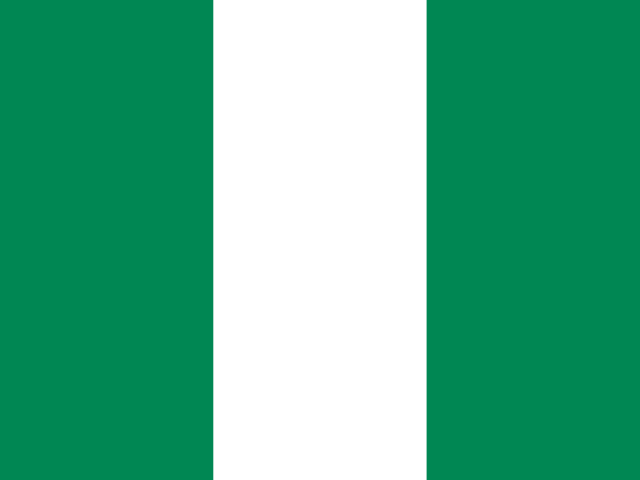
The flag of Nigeria is one of the simplest in the world: three equal vertical bands of green, white and green, with no emblem or symbol. Its proportions are 1:2, and it has been the national flag since 1 October 1960, the day Nigeria became independent. Nigerians often call it the "green-white-green".
What the colours mean
- Green represents Nigeria's land, forests and natural wealth, and agriculture, which has always been at the heart of the country's economy.
- White stands for peace and unity, the hope that Nigeria's many peoples can live together in harmony.
- The flag carries no religious or ethnic symbols, a deliberate choice for a country of many faiths and peoples.
Where the flag came from
As independence approached, a competition was held in 1958 to design a national flag. Among almost 3,000 entries, the winning design came from Michael Taiwo Akinkunmi, a young Nigerian student from Ibadan who was studying in London at the time. His original design included a red sun with rays in the centre of the white band, but the judges removed it, leaving the plain green-white-green that was raised at independence on 1 October 1960. Akinkunmi, honoured as "Mr Flag Man", lived to see his design become one of Nigeria's most cherished symbols, and he was given national honours before his death in 2023.
Flag facts most people get wrong
- The bands are vertical, not horizontal. A horizontal green-white-green flag is not the Nigerian flag.
- The flag has no coat of arms. The eagle and shield appear on the coat of arms and on presidential flags, not on the national flag.
- The green does not represent a religion. It stands for the land and agriculture.
- The designer's original version had a red sun in the white band, which was removed before adoption.
- The flag is twice as wide as it is tall, with a ratio of 1:2, not the 2:3 used by many other countries.
The Nigerian people: many nations, one country
Nigeria is home to more than 250 ethnic groups. The largest are the Hausa and Fulani in the north, the Yoruba in the south-west and the Igbo in the south-east, alongside the Ijaw, Kanuri, Ibibio, Tiv, Edo, Nupe and many others, each with its own language, history and traditions. Faith is important to many people: roughly half of Nigerians are Muslim and most of the rest are Christian, and traditional beliefs continue to shape culture and festivals. Nigerians are often proud of their own community and of their country at the same time, and many speak several languages, switching easily between English, Pidgin and their mother tongue.
Family, respect for elders and hospitality are widely valued, and greetings matter: taking time to greet people properly is a sign of good manners across many Nigerian cultures. Weddings, naming ceremonies and parties, known as "owambe" in Yoruba areas, can be large, joyful celebrations with music, dancing and matching outfits called aso ebi. Nigeria is also a very young country, with a median age of under 20, and its young people are driving booms in music, fashion, film, comedy and technology, with Lagos often named one of Africa's leading start-up hubs.
Millions of Nigerians live abroad, especially in the United Kingdom, the United States, Canada, Ireland and other African countries, and the Nigerian diaspora is known for its achievements in medicine, academia, business, sport and the arts. Remittances sent home are an important part of the economy, and Nigerian food, music, films and style have become part of the cultural life of cities around the world.
Frequently asked questions about Nigeria
What is Nigeria most famous for?
Nigeria is famous for being Africa's most populous country, for Afrobeats stars such as Burna Boy and Wizkid, for Nollywood films, for jollof rice and suya, for the novels of Chinua Achebe and the plays of Wole Soyinka, for its football teams, for ancient art such as the Benin Bronzes and Nok terracottas, and for landmarks such as Zuma Rock and the Osun-Osogbo Sacred Grove.
What do the colours of the Nigerian flag mean?
The two green bands represent Nigeria's land, forests, natural wealth and agriculture, and the white band in the middle stands for peace and unity. The flag has no emblem and was designed by the student Michael Taiwo Akinkunmi.
What is the capital of Nigeria?
Abuja has been the capital of Nigeria since 1991. It was built as a planned city in the centre of the country, replacing Lagos, which remains the largest city and the main commercial centre.
What language do people speak in Nigeria?
English is the official language, used in government, education and business. More than 500 languages are spoken in Nigeria, the most widely spoken being Hausa, Yoruba and Igbo, and Nigerian Pidgin is understood by a very large share of the population.
How many states does Nigeria have?
Nigeria has 36 states plus the Federal Capital Territory, Abuja. The most populous state is usually estimated to be Kano or Lagos, and the largest by area is Niger State.
Is Nigeria the same as Niger?
No. Niger is a separate country that borders Nigeria to the north. Both are named after the Niger River, which flows through both countries; Nigeria's name was coined in the 1890s by the British journalist Flora Shaw, who later married Frederick Lugard.
Own a square of the Nigerian flag
On 195 Flags, the flag of Nigeria is being rebuilt one square at a time by people in Nigeria and around the world. Claim your square for $1.99 and seal a message and a photo inside it: a time capsule for your future self and the generations who come after you. And when the Nigerian flag is completely filled, one square owner wins $40,000.
Claim your square of the Nigerian flag →
Photo credits
- Zuma Rock, Niger State (cover): Nzenwa Chinomso, CC BY-SA 4.0, via Wikimedia Commons
- Durbar festival, northern Nigeria: Adamu galadima lifestyle, CC BY-SA 4.0, via Wikimedia Commons
- The Niger River at Jebba: Adeyinka Ekundayo, CC BY-SA 4.0, via Wikimedia Commons
- Aso Rock, Abuja: Mark Fischer, CC BY-SA 2.0, via Wikimedia Commons
- Abuja National Mosque: Mark Fischer, CC BY-SA 2.0, via Wikimedia Commons
- Olumo Rock, Abeokuta: AdeolaStudio, CC BY-SA 4.0, via Wikimedia Commons
- Flying tortoise sculpture, Osun-Osogbo Sacred Grove: Tunde Akangbe, CC BY-SA 4.0, via Wikimedia Commons
- National Arts Theatre, Lagos: Omoeko Media, CC BY-SA 4.0, via Wikimedia Commons
- Idanre Hills, Ondo State: Agbebiyi Adekunle (Tadek Photography), CC BY-SA 4.0, via Wikimedia Commons
- Kano city wall: Suleiman Umar, Aminu Abdullahi, Abubakar Yusuf, www.kanostreetsonosm.org.ng, CC BY-SA 4.0, via Wikimedia Commons
- Ikoyi, Lagos: Reginald Bassey, CC BY-SA 4.0, via Wikimedia Commons
- Obudu Plateau, Cross River State: Laminartosin, CC BY-SA 4.0, via Wikimedia Commons
- Old Residency, Calabar: Ei'eke, CC BY-SA 4.0, via Wikimedia Commons
- Erin Ijesha Waterfalls, Osun State: Baaadmus, CC BY-SA 4.0, via Wikimedia Commons
- Gurara Falls, Niger State: Ayobami Macaulay, CC BY-SA 4.0, via Wikimedia Commons
- Tea plantation, Mambilla Plateau: Ebere Jude Ekemezie, CC BY-SA 4.0, via Wikimedia Commons
The Nigerian flag image is from 195flags.com.


