India: What It's Famous For, Iconic Landmarks, States, History and the Meaning of the Indian Flag

India is less a single country than a whole world in one place: a subcontinent of snow-capped Himalayan peaks, scorching deserts, tropical backwaters and sacred rivers, home to more people than any other nation on Earth. It is the land of the Taj Mahal and the Golden Temple, of Diwali and Holi, of cricket, Bollywood, yoga and some of the most celebrated cooking in the world, and the birthplace of four major religions. In this guide we explore what India is famous for, its most distinctive landmarks, the most popular states and what each one offers, a timeline of Indian history, and the meaning behind the saffron, white and green of the Indian flag, with the navy blue wheel at its heart.
India at a glance
- Official name: the Republic of India (Bharat Ganarajya); the constitution names the country as "India, that is Bharat"
- Capital: New Delhi; the largest cities include Mumbai, Delhi, Bengaluru, Kolkata, Chennai and Hyderabad
- Population: around 1.45 billion, the largest of any country; India overtook China as the world's most populous nation in 2023, according to United Nations estimates, and a new national census began in 2026
- Area: about 3.3 million km², the seventh-largest country in the world
- Languages: Hindi and English are the official languages of the central government, and the constitution recognises 22 scheduled languages, including Bengali, Marathi, Telugu, Tamil, Gujarati, Urdu, Kannada, Malayalam and Punjabi; hundreds more languages and dialects are spoken
- Currency: the Indian rupee (INR), with the symbol ₹
- Administrative divisions: 28 states and 8 union territories, including the National Capital Territory of Delhi
- Government: a federal parliamentary republic; the president is head of state and the prime minister leads the government; India is often described as the world's largest democracy
- National symbols: the Lion Capital of Ashoka (the state emblem), the Bengal tiger, the Indian peafowl (peacock), the lotus, the banyan tree and the mango; the national anthem is "Jana Gana Mana" and the national song "Vande Mataram"
- National days: Independence Day on 15 August, marking independence in 1947, and Republic Day on 26 January, marking the constitution of 1950
- Highest mountain: Kangchenjunga (about 8,586 m), on the border between Sikkim and Nepal, the third-highest mountain in the world
- Longest river: the Ganges (Ganga), about 2,500 km long, which flows from the Himalayas to the Bay of Bengal and is sacred to Hindus
- Standout facts: India is home to around three-quarters of the world's wild tigers, and it is the birthplace of Hinduism, Buddhism, Jainism and Sikhism
What is India famous for?
Indian food and spices
Indian cooking is not one cuisine but dozens. In the north, people eat wheat breads such as naan, roti and paratha with rich dishes like dal makhani, butter chicken and tandoori meats from the clay oven, while the south is the land of rice, coconut and the crisp fermented pancake called dosa, served with sambar and chutneys. Biryani, a fragrant layered rice dish, has famous versions in Hyderabad, Lucknow and Kolkata, and the west coast is known for seafood curries. India has traded spices for thousands of years, and cardamom, black pepper, turmeric, cumin and chilli are at the heart of its kitchens. Many Indians are vegetarian, and almost everyone drinks chai, sweet milky tea brewed with spices, sold by chaiwalas on street corners everywhere.
Religion and spirituality
India is a land of faith. Around four in five Indians are Hindu, and the country also has one of the world's largest Muslim populations, as well as Christians, Sikhs, Buddhists, Jains, Parsis and others. Hinduism, Buddhism, Jainism and Sikhism were all born here, and pilgrims travel from around the world to sacred places such as Varanasi, Bodh Gaya, where the Buddha is said to have attained enlightenment, and the Golden Temple in Amritsar. The Kumbh Mela, a Hindu pilgrimage held in rotation at four riverside cities, is among the largest religious gatherings on Earth.
Festivals
India's calendar is crowded with festivals. Diwali, the festival of lights, celebrates the victory of light over darkness with oil lamps, fireworks, sweets and family gatherings. Holi, the spring festival of colours, sees people throwing coloured powder and water at one another in the streets. Other great celebrations include Eid, Christmas, the Sikh festival of Vaisakhi, Durga Puja in Bengal, Ganesh Chaturthi in Mumbai, Onam in Kerala and Pongal in Tamil Nadu. Durga Puja in Kolkata and the Kumbh Mela are both recognised by UNESCO as intangible cultural heritage.
Cricket
Cricket is India's great passion, followed with an intensity that can bring the country to a standstill. India won the men's Cricket World Cup in 1983 and 2011, and the men's T20 World Cup in 2007, 2024 and again in 2026, when it beat New Zealand in the final in Ahmedabad on home soil. In 2025, India's women won their first Cricket World Cup. Players such as Sachin Tendulkar, MS Dhoni and Virat Kohli are national heroes, and the Indian Premier League, launched in 2008, is one of the richest and most watched cricket competitions in the world. Field hockey has a proud history too: India won eight Olympic gold medals in the sport.
Bollywood and Indian cinema
India produces more films than any other country, in many different languages. Bollywood, the Hindi-language film industry based in Mumbai, is famous for its colourful song-and-dance numbers, romance and drama, and stars such as Amitabh Bachchan and Shah Rukh Khan are known far beyond India. There are also huge film industries in Tamil, Telugu, Malayalam, Bengali and other languages. The Bengali director Satyajit Ray is regarded as one of the great film-makers of the 20th century, and the song "Naatu Naatu" from the Telugu film RRR won an Oscar for Best Original Song in 2023.
Yoga, Ayurveda and ideas
Yoga, which combines postures, breathing and meditation, has its roots in ancient India and is now practised by millions of people worldwide; since 2015, 21 June has been marked as the International Day of Yoga. Ayurveda, a traditional system of medicine, is still widely practised. India also has a long tradition of science and mathematics: the decimal place-value system with a symbol for zero was developed here, and astronomer-mathematicians such as Aryabhata worked on astronomy and mathematics more than 1,500 years ago. Today the Indian Space Research Organisation is a leading space agency, and in 2023 Chandrayaan-3 made India the first country to land a spacecraft near the Moon's south pole.
Textiles, crafts and colour
India is famous for its textiles: silk saris from Varanasi and Kanchipuram, block-printed cottons from Rajasthan, Kashmiri shawls and the hand-spun cloth called khadi, which became a symbol of the independence movement. Each region has its own crafts, from blue pottery and miniature painting to brass work, carpets and embroidery, and markets across the country are a riot of colour.
Tigers, elephants and wildlife
India has some of the richest wildlife in Asia. It is home to around three-quarters of the world's wild tigers, protected in reserves such as Ranthambore, Bandhavgarh, Kanha and Jim Corbett, as well as Asian elephants, one-horned rhinos, leopards, snow leopards and the last wild Asiatic lions, which live only in and around Gir National Park in Gujarat. The peacock, India's national bird, can be seen in villages and parks across the country.
India's most distinctive landmarks
The Taj Mahal, Agra
Few buildings in the world are as famous as the Taj Mahal. Standing on the bank of the Yamuna River in Agra, this white marble mausoleum was built by the Mughal emperor Shah Jahan in memory of his wife Mumtaz Mahal, who died in 1631. Work began around 1632 and the whole complex took about twenty years to finish, employing thousands of craftsmen. Its great onion dome, four slender minarets and walls inlaid with semi-precious stones in floral patterns are reflected in long water channels running through formal Mughal gardens. The marble seems to change colour with the light, from soft pink at dawn to dazzling white at noon and gold at sunset. The Taj Mahal is a UNESCO World Heritage Site and was named one of the "New Seven Wonders of the World" in a popular vote in 2007.
The Red Fort, Delhi

When Shah Jahan moved the Mughal capital from Agra to Delhi, he built a new walled city, Shahjahanabad, and at its heart the massive Red Fort (Lal Qila), completed in 1648. Its walls of red sandstone stretch for more than 2 km and enclose palaces, audience halls and gardens. The fort has a special place in modern India: on Independence Day every year, the prime minister raises the national flag above the Lahori Gate and addresses the nation from its ramparts, a tradition begun by Jawaharlal Nehru in 1947. The Red Fort is a UNESCO World Heritage Site.
Qutb Minar, Delhi

Rising about 73 m above south Delhi, the Qutb Minar is one of the tallest minarets in the world. It was begun around 1199 by Qutb ud-Din Aibak, the first ruler of the Delhi Sultanate, and completed by his successors. Its five storeys of red and buff sandstone are carved with bands of Arabic calligraphy and ringed by projecting balconies. The surrounding complex includes the ruins of one of India's earliest mosques and a famous iron pillar, around 1,600 years old, which has resisted rust remarkably well. The site is a UNESCO World Heritage Site.
The Golden Temple, Amritsar

The Harmandir Sahib, known around the world as the Golden Temple, is the holiest shrine of Sikhism. It stands in the middle of a sacred pool, the Amrit Sarovar, in the city of Amritsar in Punjab. The temple was built under the fifth Sikh Guru, Guru Arjan, and the Sikh scripture was installed there in 1604; its upper floors were covered in gilded copper in the early 19th century under Maharaja Ranjit Singh. The temple has four entrances, a symbol of openness to people from every direction and background, and its community kitchen, the langar, serves free vegetarian meals to tens of thousands of visitors every day, all prepared and served by volunteers.
The ghats of Varanasi, Uttar Pradesh

Often described as one of the oldest continuously inhabited cities in the world, Varanasi is the holiest city of Hinduism. Along the western bank of the Ganges, more than 80 ghats, stone steps leading down to the water, are lined with temples, palaces and shrines. At dawn, pilgrims bathe in the sacred river and boats glide past in the mist; every evening at Dashashwamedh Ghat, priests perform the Ganga Aarti, a ceremony of fire, bells and chanting. Many Hindus believe that being cremated here brings liberation from the cycle of rebirth, and the funeral pyres of Manikarnika Ghat burn day and night. Just outside the city, at Sarnath, the Buddha is said to have given his first sermon.
The Gateway of India, Mumbai

Overlooking the Arabian Sea on Mumbai's waterfront, the Gateway of India is a triumphal arch built to commemorate the visit of King George V and Queen Mary in 1911. Designed by the architect George Wittet in the Indo-Saracenic style, which blends Indian and European influences, it was completed in 1924. In a twist of history, it was through this arch that the last British troops left India in 1948. Today the waterfront is one of Mumbai's favourite gathering places, and boats leave from here for the rock-cut caves of Elephanta Island. Across the road stands the grand Taj Mahal Palace hotel, which opened in 1903.
Hampi, Karnataka

In a surreal landscape of giant granite boulders beside the Tungabhadra River lie the ruins of Hampi, once the capital of the Vijayanagara Empire, one of the greatest Hindu kingdoms of southern India. At its height in the 15th and 16th centuries it was a vast and wealthy city, admired by foreign visitors, until it was sacked in 1565 and abandoned. Today its ruins cover a huge area, including palaces, bazaars, elephant stables and temples such as the Virupaksha Temple, still a place of worship, and the Vittala Temple, famous for its stone chariot. Hampi is a UNESCO World Heritage Site.
The Konark Sun Temple, Odisha

Near the coast of the Bay of Bengal, the Konark Sun Temple was built in the 13th century by King Narasimhadeva I of the Eastern Ganga dynasty. It was conceived as a colossal stone chariot for Surya, the sun god, with 24 elaborately carved wheels and teams of stone horses pulling it towards the sunrise. Every surface is covered with sculptures of gods, dancers, musicians, animals and scenes of daily life. Much of the main tower has collapsed, but what remains is one of the masterpieces of Indian architecture, and a UNESCO World Heritage Site. One of its wheels appears on the Indian ten-rupee note.
The Meenakshi Temple, Madurai
In the ancient city of Madurai in Tamil Nadu, the Meenakshi Amman Temple is one of the greatest temple complexes in southern India. It is dedicated to the goddess Meenakshi, a form of Parvati, and her consort Sundareswarar, a form of Shiva. The temple has 14 towering gopurams, or gateway towers, the tallest about 50 m high, each covered from top to bottom with thousands of brightly painted figures of gods, demons and animals. Much of the present complex dates from the 16th and 17th centuries, and it draws thousands of worshippers every day, especially during the spring festival celebrating the divine wedding of Meenakshi and Sundareswarar.
The most popular states in India and what they offer
India is a union of 28 states and 8 union territories, many of them as large and populous as entire countries, each with its own language, food and traditions. Here are some of the highlights.
Rajasthan

Rajasthan, "the land of kings", is India's largest state by area and its most romantic, a land of desert forts, maharajas' palaces and vivid colour. Its capital, Jaipur, the "Pink City", is famous for the honeycombed façade of the Hawa Mahal, the "Palace of Winds", and for the hilltop Amber Fort, one of the Hill Forts of Rajasthan listed by UNESCO. Udaipur is known for its lakes and the white Lake Palace, Jodhpur for its blue-painted old town below the mighty Mehrangarh Fort, and Jaisalmer for its golden sandstone fort rising out of the Thar Desert, where visitors ride camels among the dunes.
Delhi
India's capital territory combines the old and the new. Old Delhi is a maze of bazaars around the Red Fort and the great Jama Masjid mosque, while New Delhi, designed by the British architects Edwin Lutyens and Herbert Baker and inaugurated in 1931, is a city of wide avenues and grand government buildings around India Gate, a memorial to Indian soldiers who died in the First World War. Delhi also has three UNESCO World Heritage Sites, the Red Fort, Qutb Minar and Humayun's Tomb, a forerunner of the Taj Mahal, as well as the lotus-shaped Bahá'í House of Worship and some of the best street food in India.
Uttar Pradesh
The most populous state in India, Uttar Pradesh lies on the fertile plains of the Ganges and is home to many of the country's best-known sights. Agra has the Taj Mahal, the Agra Fort and, nearby, the abandoned Mughal city of Fatehpur Sikri. Varanasi is the holiest city of Hinduism, and Prayagraj, where the Ganges and Yamuna meet, hosts the largest Kumbh Mela gatherings, the most recent great one in 2025. The state capital, Lucknow, is known for its refined manners, its Mughal-era buildings and its kebabs and biryani.
Kerala

Promoted as "God's Own Country", Kerala is a lush strip of land on the south-west coast between the Arabian Sea and the Western Ghats mountains. Its famous backwaters, a network of lagoons, lakes and canals around Alappuzha and Kumarakom, are best explored on a kettuvallam, a traditional houseboat. Inland, the hill station of Munnar is surrounded by tea plantations, and the coast has beaches such as Varkala and Kovalam. Kerala is known for its spices, Ayurvedic treatments, coconut-rich cooking, the dramatic dance-drama Kathakali and its high literacy rate, and the port of Kochi shows the influence of centuries of trade with Arab, Chinese, Portuguese, Dutch and British merchants.
Goa

India's smallest state by area, Goa is famous for its palm-fringed beaches, relaxed atmosphere and unique culture. It was ruled by Portugal for more than 450 years, from 1510 until 1961, and the Portuguese legacy can still be seen in its whitewashed churches, colourful Latin-style houses and food, such as spicy vindaloo and xacuti. The churches and convents of Old Goa, including the Basilica of Bom Jesus, which holds the remains of St Francis Xavier, are a UNESCO World Heritage Site. Beaches such as Palolem, Agonda and Anjuna draw visitors from around the world, especially between November and March.
Ladakh

High in the Himalayas, Ladakh, a union territory since 2019, is a high-altitude desert of stark mountains, turquoise lakes and Tibetan Buddhist monasteries perched on hilltops, such as Thiksey and Hemis. Its main town, Leh, lies at about 3,500 m above sea level, so visitors need time to adjust to the thin air. The long, brackish lake of Pangong Tso, which stretches across the Line of Actual Control into Tibet, changes colour from blue to green with the light. The wider Kashmir and Ladakh region includes areas whose borders are disputed between India, Pakistan and China.
Karnataka

Karnataka in southern India combines the high-tech and the historic. Its capital, Bengaluru (Bangalore), is the centre of India's technology industry and is often called the "Silicon Valley of India". The city of Mysuru (Mysore) is famous for the Mysore Palace, the seat of the Wodeyar kings, rebuilt in the early 20th century in the Indo-Saracenic style and lit by tens of thousands of bulbs on festival nights, especially during the Dasara festival. The state is also home to the ruins of Hampi, the finely carved Hoysala temples of Belur and Halebidu and the coffee-growing hills of Kodagu (Coorg).
Tamil Nadu
At the south-eastern tip of India, Tamil Nadu is the heartland of Tamil culture, one of the world's oldest living classical languages. It is a land of great temples, including the Meenakshi Temple in Madurai and the Brihadisvara Temple in Thanjavur, completed in 1010 under the Chola king Rajaraja I and part of the UNESCO-listed Great Living Chola Temples. At Mahabalipuram, the Shore Temple and rock-cut monuments date from the 7th and 8th centuries. Tamil Nadu is the home of the classical dance Bharatanatyam, of the harvest festival Pongal and of hearty South Indian breakfasts, and its capital, Chennai, has one of the longest urban beaches in the world.
Maharashtra

Maharashtra is home to Mumbai, India's financial capital and largest city, the heart of Bollywood and a place of contrasts, from the Art Deco and Victorian Gothic buildings of the south, recognised by UNESCO, to the busy suburban trains and the famous dabbawalas, who deliver huge numbers of home-cooked lunches across the city every day. Inland, the Ajanta Caves contain Buddhist paintings and sculptures over 1,500 years old, and at Ellora, Buddhist, Hindu and Jain temples were carved into the rock; the most astonishing, the Kailasa Temple, was cut downwards from a single mass of rock in the 8th century. Both sites are UNESCO World Heritage Sites.
West Bengal

West Bengal stretches from the Himalayas to the Bay of Bengal. Its capital, Kolkata (Calcutta), was the capital of British India until 1911 and is known as a city of poets, writers, film-makers and great conversation; it was the home of the Nobel laureate Rabindranath Tagore, who wrote India's national anthem. Its landmarks include the white marble Victoria Memorial and the Howrah Bridge over the Hooghly River, and every autumn the city is transformed by Durga Puja. In the north, Darjeeling is famous for its tea and the Darjeeling Himalayan Railway, a UNESCO-listed "toy train", while in the south, the mangrove forests of the Sundarbans are home to Bengal tigers.
Assam and the North-East

Connected to the rest of India by a narrow strip of land, the North-East is made up of eight states, including Assam, Meghalaya, Arunachal Pradesh, Nagaland and Sikkim, with a rich mix of peoples, languages and cultures. Assam, crossed by the mighty Brahmaputra River, is famous for its strong black tea and for Kaziranga National Park, home to the majority of the world's greater one-horned rhinos. Meghalaya is known for its living root bridges, grown from the roots of rubber trees, and for being one of the wettest places on Earth, while Sikkim offers views of Kangchenjunga, and Nagaland's Hornbill Festival celebrates the traditions of the Naga peoples.
A timeline of Indian history
- Tens of thousands of years ago: Early humans live across the subcontinent; the rock shelters of Bhimbetka in Madhya Pradesh contain some of the oldest rock paintings in India.
- c. 7000 BCE: Farming villages develop at sites such as Mehrgarh, in present-day Pakistan.
- c. 2600–1900 BCE: The Indus Valley (Harappan) Civilisation flourishes, with planned cities such as Harappa, Mohenjo-daro and Dholavira.
- c. 1500–500 BCE: The Vedic period; the Vedas, the oldest Hindu scriptures, are composed.
- c. 5th century BCE: The Buddha and Mahavira, founder figures of Buddhism and Jainism, teach in northern India.
- c. 322 BCE: Chandragupta Maurya founds the Maurya Empire.
- c. 268–232 BCE: Emperor Ashoka rules most of the subcontinent, embraces Buddhism and has his edicts carved on rocks and pillars.
- c. 320–550 CE: The Gupta Empire presides over a golden age of art, science and literature.
- c. 499 CE: The mathematician and astronomer Aryabhata writes the Aryabhatiya.
- 9th–13th centuries: The Chola dynasty rules much of southern India and builds great temples and a powerful navy.
- 1206: The Delhi Sultanate is established.
- 1336: The Vijayanagara Empire is founded in southern India, with its capital at Hampi.
- 1469: Guru Nanak, the founder of Sikhism, is born.
- 1498: The Portuguese navigator Vasco da Gama reaches Calicut on the Malabar Coast.
- 1526: Babur wins the First Battle of Panipat and founds the Mughal Empire.
- 1556–1605: The reign of the Mughal emperor Akbar.
- 1600: The English East India Company receives its royal charter.
- c. 1632–1653: The Taj Mahal is built in Agra.
- 1757: The East India Company's victory at the Battle of Plassey begins British dominance in Bengal.
- 1857–1858: A major uprising against Company rule is suppressed, and the British Crown takes direct control of India.
- 1885: The Indian National Congress is founded.
- 1913: Rabindranath Tagore becomes the first non-European to win the Nobel Prize in Literature.
- 1919: British troops fire on a crowd at Jallianwala Bagh in Amritsar, killing hundreds of people.
- 1930: Mahatma Gandhi leads the Salt March in protest against the British salt tax.
- 1942: The Quit India Movement demands an end to British rule.
- 1947: India becomes independent on 15 August; the partition of British India creates India and Pakistan, accompanied by mass migration and terrible violence.
- 1948: Mahatma Gandhi is assassinated in Delhi on 30 January.
- 1950: The constitution comes into force on 26 January, and India becomes a republic.
- 1951–1952: India holds its first general election.
- 1961: Goa, ruled by Portugal since 1510, becomes part of India.
- 1966: Indira Gandhi becomes India's first woman prime minister.
- 1971: India and Pakistan go to war, and Bangladesh becomes independent.
- 1983: India wins the Cricket World Cup for the first time.
- 1991: Major economic reforms open up India's economy.
- 2008: Coordinated terrorist attacks hit Mumbai in November.
- 2011: India wins the Cricket World Cup on home soil.
- 2014: India's Mars Orbiter Mission reaches Mars orbit at its first attempt.
- 2017: A nationwide Goods and Services Tax (GST) is introduced.
- 2019: Ladakh becomes a separate union territory.
- 2023: India becomes the world's most populous country by UN estimates, Chandrayaan-3 lands near the Moon's south pole, and New Delhi hosts the G20 summit.
- 2024: India holds the largest democratic election in history, and wins the men's T20 World Cup.
- 2025: Shubhanshu Shukla becomes the first Indian astronaut to visit the International Space Station, and India's women win the Cricket World Cup.
- 2026: India begins its first national census since 2011 and wins the men's T20 World Cup on home soil.
The Indian flag: its history and meaning
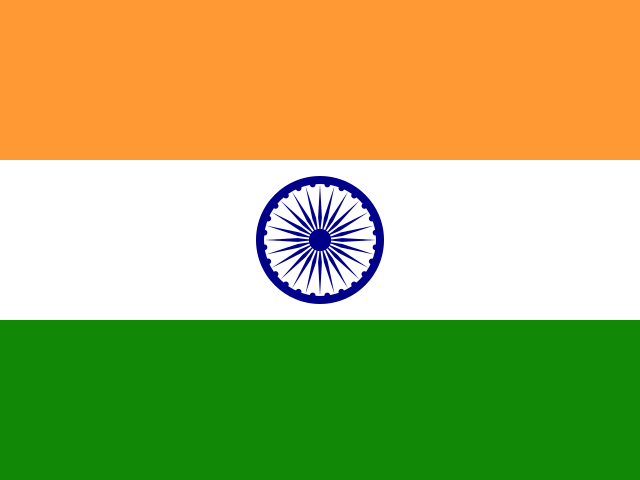
The flag of India, known as the Tiranga, or "tricolour", has three equal horizontal bands of saffron at the top, white in the middle and green at the bottom. In the centre of the white band is a navy blue wheel with 24 spokes, the Ashoka Chakra. The flag's proportions are 2:3, and it was adopted on 22 July 1947, a few weeks before independence.
What the colours and symbols mean
- Saffron stands for courage, sacrifice and the spirit of renunciation.
- White stands for peace and truth, lighting the path of the nation.
- Green represents faith, fertility, growth and the land.
- The Ashoka Chakra is the "wheel of law" (dharma), taken from the Lion Capital of Ashoka at Sarnath, carved in the 3rd century BCE. It symbolises righteousness and progress, and its 24 spokes are often associated with the 24 hours of the day, a reminder that the nation should keep moving forward.
- When the flag was adopted, the philosopher Sarvepalli Radhakrishnan, later India's president, explained the colours in this spirit: saffron for renunciation, white for light and truth, and green for our relation to the soil and to plant life.
Where the flag came from
Several flags were used during the independence movement. In 1921, Pingali Venkayya, a freedom fighter from Andhra Pradesh who is generally credited as the flag's original designer, presented Mahatma Gandhi with a design in red and green, to which white was added, with a charkha, or spinning wheel, in the centre as a symbol of self-reliance. In 1931, the Indian National Congress adopted a tricolour of saffron, white and green with the charkha. When independence approached, the Constituent Assembly adopted this design as the national flag on 22 July 1947, replacing the charkha with the Ashoka Chakra. Its use is governed by the Flag Code of India. In 2002, the code was revised to allow ordinary citizens to fly the flag with respect on any day of the year, and in 2022 it was amended again to allow flags made by machine and from polyester, and to let them fly day and night, as part of the Har Ghar Tiranga ("a tricolour in every home") campaign.
Flag facts most people get wrong
- The top colour is saffron, not orange. Its official name is saffron (kesariya), a deep orange-yellow linked to courage and sacrifice.
- The colours do not officially represent religions. Some early flags were linked to communities, but when the tricolour was adopted, its leaders stressed that the colours had no religious meaning.
- The wheel is not a spinning wheel. The charkha appeared on the pre-independence flag; the Ashoka Chakra replaced it in 1947.
- The wheel has 24 spokes and is navy blue, not black or light blue.
- The flag no longer has to be made of khadi. For decades the code required hand-spun cloth, but machine-made flags were allowed from 2022.
- Flying the flag upside down is disrespectful. The saffron band must always be at the top.
The Indian people: many languages, many faiths, one nation
India's people are astonishingly diverse. They speak hundreds of languages from several language families, including Indo-Aryan languages such as Hindi, Bengali and Marathi in the north and Dravidian languages such as Tamil, Telugu, Kannada and Malayalam in the south, and they follow many faiths, often living side by side. Crossing from one state to another can feel like entering a different country, with a new script, a new cuisine and new festivals. Yet many Indians share a strong sense of national identity, captured in the phrase "unity in diversity", which is often used to describe the country.
Family is at the centre of life for many Indians, and close ties between generations, respect for elders and great hospitality towards guests are widely valued. Weddings can be spectacular, multi-day celebrations, and food and festivals bring families and neighbours together. India is a young country too: a large share of its population is under 30, and its cities are full of energy, from start-up companies and tech campuses to music, fashion and film.
Indian culture has travelled far. Tens of millions of people of Indian origin live abroad, one of the largest diasporas in the world, with large communities in the United States, the United Kingdom, the Gulf states, Canada, South Africa, Malaysia, Singapore, Mauritius, Fiji and the Caribbean. Indian food, films, music, yoga and festivals such as Diwali and Holi are now celebrated in cities around the world.
Frequently asked questions about India
What is India most famous for?
India is famous for the Taj Mahal, the Golden Temple, the forts and palaces of Rajasthan and the sacred ghats of Varanasi; for its varied cuisine, spices and chai; for festivals such as Diwali and Holi; for cricket and Bollywood; for yoga; for its tigers; and for being the world's most populous country and its largest democracy.
What do the colours of the Indian flag mean?
Saffron stands for courage and sacrifice, white for peace and truth, and green for faith, fertility and growth. The navy blue Ashoka Chakra in the centre, a wheel with 24 spokes, is the "wheel of law", representing righteousness and constant progress.
What is the capital of India?
New Delhi is the capital of India and part of the National Capital Territory of Delhi. The capital of British India moved from Kolkata (Calcutta) to Delhi in 1911, and the newly built New Delhi was inaugurated in 1931.
What language do people speak in India?
There is no single national language. Hindi and English are the official languages of the central government, and the constitution recognises 22 scheduled languages. Many Indians speak two or three languages, and each state has its own main language.
How many states does India have?
India has 28 states and 8 union territories. The largest state by area is Rajasthan, and the most populous is Uttar Pradesh.
Why is India also called Bharat?
Bharat is an ancient name for the land, found in Sanskrit texts and linked to the legendary king Bharata. The constitution uses both names, beginning "India, that is Bharat, shall be a Union of States", and Bharat is widely used in Hindi and other Indian languages.
Own a square of the Indian flag
On 195 Flags, the flag of India is being rebuilt one square at a time by people in India and around the world. Claim your square for $1.99 and seal a message and a photo inside it: a time capsule for your future self and the generations who come after you. And when the Indian flag is completely filled, one square owner wins $40,000.
Claim your square of the Indian flag →
Photo credits
- Taj Mahal, Agra (cover): Yann; edited by King of Hearts, CC BY-SA 4.0, via Wikimedia Commons
- Lahori Gate, Red Fort, Delhi: Lucky181993, CC BY-SA 4.0, via Wikimedia Commons
- Qutb Minar, Delhi: Athulvis, CC BY-SA 4.0, via Wikimedia Commons
- Golden Temple, Amritsar: Jasleen Kaur, CC BY-SA 2.0, via Wikimedia Commons
- Munshi Ghat, Varanasi: Marcin Białek, CC BY-SA 3.0, via Wikimedia Commons
- Gateway of India, Mumbai: SriSriChinmaya, CC BY-SA 4.0, via Wikimedia Commons
- Virupaksha Temple, Hampi: iMahesh, CC BY-SA 4.0, via Wikimedia Commons
- Wheel of the Konark Sun Temple: Joydeep, CC BY-SA 4.0, via Wikimedia Commons
- Amber Fort, Jaipur: Diego Delso, CC BY-SA 4.0, via Wikimedia Commons
- Houseboat on the Kerala backwaters: Vyacheslav Argenberg, CC BY 4.0, via Wikimedia Commons
- Palolem Beach, Goa: Vachary, CC BY-SA 4.0, via Wikimedia Commons
- Pangong Tso, Ladakh: Geet Arts, CC BY-SA 4.0, via Wikimedia Commons
- Mysore Palace: Whistleraja, CC BY-SA 4.0, via Wikimedia Commons
- Kailasa Temple, Ellora: Shishirdasika, CC BY-SA 4.0, via Wikimedia Commons
- Victoria Memorial, Kolkata: Subhrajyoti07, CC BY-SA 4.0, via Wikimedia Commons
- Rhinos in Kaziranga National Park: Soumil Mukhopadhyay, CC BY 4.0, via Wikimedia Commons
The Indian flag image is from 195flags.com.


