Ireland: What It's Famous For, Iconic Landmarks, Counties, History and the Meaning of the Irish Flag

Ireland is a small island with an outsized reputation. Its landscapes are so green it earned the nickname the Emerald Isle, its stories have shaped world literature, and its people have carried Irish music, humour and hospitality to every corner of the globe. In this guide you will find what Ireland is famous for, its most distinctive landmarks, the most popular counties and what each one offers, a timeline of Irish history, and the meaning behind the green, white and orange of the Irish flag.
Ireland at a glance
- Capital: Dublin
- Population: around 5.4 million in the Republic of Ireland, and roughly 7 million across the whole island including Northern Ireland
- Official languages: Irish (Gaeilge) and English
- Currency: the euro (€) in the Republic; the pound sterling (£) in Northern Ireland
- Counties: 32 on the island, 26 in the Republic and 6 in Northern Ireland, grouped into four provinces: Leinster, Munster, Connacht and Ulster
- National symbols: the harp (the official state emblem), the shamrock and the tricolour flag
- National day: St Patrick's Day, 17 March
- Highest mountain: Carrauntoohil, Co. Kerry (1,038 m)
- Longest river: the River Shannon (about 360 km)
What is Ireland famous for?
Hospitality and "the craic"
Ask anyone who has visited and they will tell you about the welcome. The traditional Irish greeting céad míle fáilte means "a hundred thousand welcomes", and it sums up a culture built on conversation, humour and making strangers feel at home. "The craic" (pronounced crack) is the Irish word for good fun, lively chat and a great atmosphere, usually found in a pub with music playing in the corner.
St Patrick's Day
Every 17 March, Ireland celebrates its patron saint, St Patrick, who is credited with bringing Christianity to the island in the 5th century. Today it is a global celebration of all things Irish: parades take over cities from Dublin to New York, and landmarks around the world are lit up in green.
Guinness and Irish whiskey
In 1759, Arthur Guinness signed a famous 9,000-year lease on a brewery at St James's Gate in Dublin. The dark stout he made there became one of the most recognisable drinks on earth, and the Guinness Storehouse is now one of Ireland's most visited attractions. Ireland also has a long whiskey tradition: the Old Bushmills Distillery in Co. Antrim traces its licence to distil back to 1608, and names such as Jameson (founded in 1780) are known worldwide.
Literary giants
For a small country, Ireland has produced an astonishing number of great writers. Four Irish writers have won the Nobel Prize in Literature: W. B. Yeats (1923), George Bernard Shaw (1925), Samuel Beckett (1969) and Seamus Heaney (1995). Add James Joyce, Oscar Wilde, Bram Stoker (the creator of Dracula) and Jonathan Swift (Gulliver's Travels), and it is easy to see why Dublin was named a UNESCO City of Literature in 2010.
Music and dance
Traditional Irish music, played on the fiddle, tin whistle, uilleann pipes and bodhrán drum, still fills pubs every night of the week. Ireland has also given the world artists such as U2, The Cranberries, Enya, Sinéad O'Connor and Hozier. Riverdance, which began as a seven-minute interval act at the 1994 Eurovision Song Contest, turned Irish dancing into a worldwide phenomenon. Ireland has also won the Eurovision Song Contest seven times, more than almost any other country.
Gaelic games
Hurling and Gaelic football are Ireland's own national sports, organised by the Gaelic Athletic Association (GAA), founded in 1884. Hurling is often described as one of the oldest and fastest field sports in the world. Players are amateurs who represent their home parish and county, which is why the All-Ireland championships inspire such fierce local pride. The GAA's headquarters, Croke Park in Dublin, holds over 80,000 people.
The Irish language
Irish (Gaeilge) is a Celtic language with a written history stretching back more than 1,500 years. It is the first official language of the Republic and an official language of the European Union. It is spoken daily in Gaeltacht regions along the west coast, and you will see it on every road sign in the country.
The birthplace of Halloween
Halloween has its roots in Samhain, the ancient Celtic festival that marked the end of the harvest and the start of winter. People believed the boundary between the living and the dead grew thin at this time of year, so they lit bonfires and wore disguises. Irish emigrants carried these customs to America, where the carved turnip lantern became the pumpkin jack-o'-lantern.
Ireland's most distinctive landmarks
The Cliffs of Moher, Co. Clare

Stretching for around 14 km along the Atlantic coast of Co. Clare and rising to 214 m at their highest point, the Cliffs of Moher are Ireland's most famous natural wonder. On a clear day you can see the Aran Islands and the mountains of Connemara. The cliffs are home to thousands of seabirds, including puffins in early summer, and have appeared in films including Harry Potter and the Half-Blood Prince and The Princess Bride.
The Giant's Causeway, Co. Antrim (Northern Ireland)

Around 40,000 interlocking basalt columns, most of them hexagonal, step down into the sea on the north Antrim coast. Geologists explain them as the result of volcanic activity some 50 to 60 million years ago. Irish legend has a better story: the giant Fionn mac Cumhaill (Finn McCool) built the causeway to cross the sea and fight a Scottish rival. It became a UNESCO World Heritage Site in 1986. Note that the Giant's Causeway is in Northern Ireland, which is part of the United Kingdom, but it is on the island of Ireland and easily reached on any tour of the island.
Newgrange and Brú na Bóinne, Co. Meath

Built around 3200 BC, Newgrange is older than both Stonehenge and the Great Pyramid of Giza. This huge passage tomb was designed with astonishing precision: at dawn on the winter solstice, around 21 December, a beam of sunlight enters a "roof box" above the entrance and lights up the inner chamber for about 17 minutes. Together with the nearby tombs of Knowth and Dowth, it forms the Brú na Bóinne UNESCO World Heritage Site.
Skellig Michael, Co. Kerry

About 12 km off the Kerry coast, this jagged rock rises straight out of the Atlantic. Sometime between the 6th and 8th centuries, early Christian monks built a monastery near its summit: beehive-shaped stone huts reached by more than 600 steep stone steps. It is a UNESCO World Heritage Site, and it reached a new audience as Luke Skywalker's hideaway in Star Wars: The Force Awakens and The Last Jedi.
The Rock of Cashel, Co. Tipperary

Rising from the plains of Tipperary, the Rock of Cashel was the seat of the kings of Munster for centuries. Legend says St Patrick converted the local king here in the 5th century. In 1101 the site was given to the Church, and the buildings you see today include a round tower, the Romanesque Cormac's Chapel (consecrated in 1134) and a 13th-century Gothic cathedral.
Kylemore Abbey, Co. Galway

Set beside a lake in the mountains of Connemara, Kylemore Abbey began life as Kylemore Castle, built between 1867 and 1871 by the businessman and politician Mitchell Henry for his wife, Margaret. Since 1920 it has been home to a community of Benedictine nuns. Visitors can explore the castle rooms, a miniature Gothic church and a beautifully restored Victorian walled garden.
Trinity College and the Book of Kells, Dublin

Trinity College Dublin was founded in 1592 by Queen Elizabeth I, and its Old Library holds Ireland's greatest treasure: the Book of Kells, a richly illustrated copy of the four Gospels created by monks around the year 800. Above it is the breathtaking Long Room, built in the early 1700s, whose towering oak shelves have held around 200,000 of the library's oldest books. The Old Library is undergoing a major conservation project, so check visiting arrangements before you go.
Blarney Castle, Co. Cork

Built in the 15th century by the MacCarthy clan, Blarney Castle is home to the legendary Blarney Stone. Lean backwards over the battlements to kiss it, and tradition says you will be rewarded with "the gift of the gab", the talent for eloquent, persuasive speech. The castle grounds include extensive gardens and a fascinating poison garden.
The Wild Atlantic Way
Not a single landmark but a whole coastline, the Wild Atlantic Way is one of the longest defined coastal touring routes in the world. It runs for about 2,500 km from the Inishowen Peninsula in Co. Donegal to Kinsale in Co. Cork, linking cliffs, beaches, islands and fishing villages along Ireland's entire west coast.
The most popular counties in Ireland and what they offer
Ireland's 32 counties each have their own character, nicknames and fierce local pride. These are the counties visitors love most.
Dublin

Ireland's capital began as a Viking settlement in the 9th century; its name comes from the Irish Dubh Linn, meaning "black pool". Today it is a lively, walkable city of Georgian squares, historic pubs and world-class museums. Highlights include Trinity College and the Book of Kells, the Guinness Storehouse, Kilmainham Gaol, the buzzing Temple Bar area and the elegant Ha'penny Bridge, opened in 1816 and named after the halfpenny toll once charged to cross it.
Cork
Known as the Rebel County for its independent spirit, Cork is Ireland's largest county. Cork city is famous for its food scene and the historic English Market. Nearby you will find Blarney Castle, the colourful harbour town of Kinsale, and Cobh, the last port of call of the Titanic in 1912 and the departure point for millions of Irish emigrants.
Kerry

Nicknamed the Kingdom, Kerry is home to some of Ireland's most spectacular scenery. The 179 km Ring of Kerry loops around the Iveragh Peninsula, while Killarney National Park, Ireland's first national park, offers lakes, waterfalls and mountains, with Carrauntoohil, the country's highest peak, rising nearby. Don't miss the Dingle Peninsula and its lively fishing town, or the boat trips from Portmagee out to Skellig Michael.
Galway

Galway, the "City of the Tribes", is Ireland's cultural heart in the west and was named a European Capital of Culture in 2020. Its streets are full of buskers, traditional music sessions and festivals, including the Galway International Arts Festival and the famous Galway Races. Beyond the city lie the wild landscapes of Connemara, Kylemore Abbey and the Irish-speaking Aran Islands.
Clare
Clare is home to the Cliffs of Moher and the Burren, a remarkable lunar-like limestone landscape where Arctic, Mediterranean and alpine flowers grow side by side. The village of Doolin is renowned for traditional music, and the county hosts some of the best surfing beaches on the west coast.
Kilkenny

Known as the Marble City, Kilkenny is Ireland's best-preserved medieval city. Its Medieval Mile links Kilkenny Castle, for centuries the seat of the powerful Butler family, with St Canice's Cathedral and its climbable round tower. The city is also known for its craft and design scene and for Smithwick's ale, first brewed here in 1710 (the Smithwick's Experience tells its story).
Wicklow
Just south of Dublin, Wicklow is called the Garden of Ireland. The Wicklow Mountains National Park is perfect for hiking, and the valley of Glendalough holds a 6th-century monastic settlement founded by St Kevin, with a round tower in a valley of two glacial lakes. The grand Powerscourt Estate and its gardens are another favourite.
Donegal
Ireland's rugged north-west corner is wild, remote and unforgettable. Donegal is home to the Slieve League cliffs, among the highest sea cliffs in Europe at around 600 m, Glenveagh National Park and its castle, and Malin Head, the most northerly point on the island of Ireland.
Mayo
Mayo is a place of pilgrimage and big landscapes. Thousands climb Croagh Patrick, Ireland's holy mountain, every year. Achill Island, the largest island off the Irish coast, has spectacular beaches and cliffs, while the Céide Fields preserve stone-walled farm fields around 5,500 years old, among the oldest known field systems in the world.
Waterford
Founded by the Vikings in 914, Waterford is Ireland's oldest city. It is world famous for Waterford Crystal, and its Viking Triangle quarter brings more than a thousand years of history to life. The Waterford Greenway, a 46 km walking and cycling trail along an old railway line, is one of the best in the country. Waterford is also where the Irish tricolour was first flown, in 1848.
Sligo
Sligo is Yeats Country: the poet W. B. Yeats is buried beneath the distinctive flat-topped mountain of Benbulben, which inspired much of his work. Sligo's Atlantic beaches at Strandhill and Mullaghmore are among the best surfing spots in Europe.
Antrim (Northern Ireland)
Antrim's Causeway Coastal Route is one of the great drives of the world, taking in the Giant's Causeway, the Carrick-a-Rede rope bridge, the beech-tree tunnel of the Dark Hedges and the Bushmills distillery. The city of Belfast, which straddles Antrim and Down, is home to Titanic Belfast, built beside the shipyard where the Titanic was constructed.
A timeline of Irish history
- c. 10,500 BC: The earliest evidence of people in Ireland: a butchered brown bear bone found in a cave in Co. Clare.
- c. 8000–7000 BC: The first settlers, Mesolithic hunter-gatherers, establish camps such as Mount Sandel in Co. Derry.
- c. 4000 BC: Farming arrives. Neolithic communities clear forests and build field systems like the Céide Fields in Co. Mayo.
- c. 3200 BC: Newgrange is built in the Boyne Valley, centuries before Stonehenge and the pyramids of Giza.
- c. 2500 BC: The Bronze Age begins, and Irish craftsmen produce some of the finest gold work in prehistoric Europe.
- c. 500 BC onwards: During the Iron Age, Celtic culture, art and the Irish language take hold across the island.
- 432 AD: The traditional date for St Patrick's mission to bring Christianity to Ireland.
- c. 500–800: Ireland's "Golden Age" as the "Island of Saints and Scholars". Monasteries become centres of learning, and the Book of Kells is created around 800.
- 795: The first recorded Viking raids on Ireland.
- 841: The Vikings establish a settlement at Dublin. Waterford follows in 914.
- 1014: The Battle of Clontarf. The High King Brian Boru defeats a Viking and Leinster alliance but is killed in the battle.
- 1169: The Anglo-Normans land in Co. Wexford; King Henry II of England arrives in 1171, beginning more than 750 years of English and then British involvement in Ireland.
- 1541: Henry VIII is declared King of Ireland by the Irish Parliament.
- 1601: The Battle of Kinsale ends the Nine Years' War with defeat for the Gaelic lords.
- 1607: The Flight of the Earls: the leading Gaelic chieftains of Ulster leave for Europe.
- 1609: The Plantation of Ulster begins, settling English and Scottish Protestants on confiscated land.
- 1649–1653: Oliver Cromwell's conquest of Ireland.
- 1690: The Battle of the Boyne. The Protestant King William of Orange defeats the Catholic King James II, a victory that gives "Orange" its political meaning in Ireland.
- 1798: The United Irishmen, led by Theobald Wolfe Tone, rise in rebellion, inspired by the American and French revolutions.
- 1801: The Act of Union joins Ireland with Great Britain to form the United Kingdom of Great Britain and Ireland.
- 1829: Catholic Emancipation, won through the campaign of Daniel O'Connell, "the Liberator".
- 1845–1852: The Great Famine. Potato blight causes the deaths of around one million people, and at least another million emigrate.
- 1848: Thomas Francis Meagher flies the green, white and orange tricolour for the first time, in Waterford.
- 1884: The Gaelic Athletic Association is founded, followed by the Gaelic League in 1893 to revive the Irish language.
- 1916: The Easter Rising. Rebels seize the General Post Office in Dublin and read the Proclamation of the Irish Republic. The executions of its leaders that followed turned public opinion towards independence.
- 1919–1921: The Irish War of Independence.
- 1921: The Anglo-Irish Treaty is signed. Ireland has been partitioned: Northern Ireland, created earlier that year, remains part of the United Kingdom.
- 1922: The Irish Free State is established, followed by a civil war between supporters and opponents of the Treaty (1922–1923).
- 1937: A new Constitution, Bunreacht na hÉireann, names the state Éire, or Ireland, and confirms the tricolour as the national flag.
- 1949: Ireland formally becomes a republic and leaves the Commonwealth.
- 1955: Ireland joins the United Nations.
- 1973: Ireland joins the European Economic Community, now the European Union.
- Late 1960s–1998: The Troubles, a period of conflict in Northern Ireland.
- 1990s–2007: The "Celtic Tiger" years of rapid economic growth transform the country.
- 1998: The Good Friday Agreement brings peace to Northern Ireland.
- 2002: Euro notes and coins replace the Irish pound.
- 2015: Ireland becomes the first country in the world to legalise same-sex marriage by popular vote.
- 2016: The centenary of the Easter Rising is commemorated across the country.
The Irish flag: its history and meaning
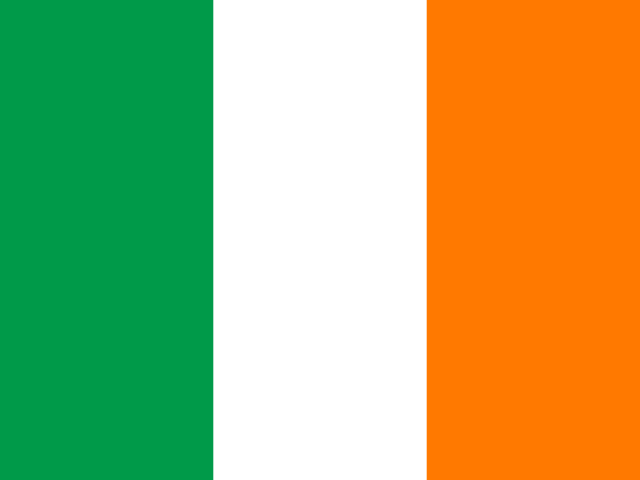
The flag of Ireland is a vertical tricolour of green, white and orange, with the green at the flagpole side. It is twice as long as it is tall, and in the Irish language it is known simply as an bhratach náisiúnta, the national flag.
What the colours mean
- Green represents the Gaelic tradition of Ireland and the older Irish nationalist movement, whose flags were green, often with a golden harp.
- Orange represents the supporters of William of Orange, the Protestant king who won the Battle of the Boyne in 1690, and the Protestant tradition in Ireland.
- White, in the centre, represents a lasting peace between the two.
The flag's message, then, is one of unity: two traditions on one island, joined by peace.
Where the flag came from
The tricolour was introduced by Thomas Francis Meagher, a leader of the Young Ireland movement, in 1848, a year of revolutions across Europe. Inspired by the French tricolour, he first flew it publicly in his home city of Waterford on 7 March 1848 and presented it in Dublin weeks later, describing the white as "a lasting truce between the 'Orange' and the 'Green'".
For decades the tricolour was a symbol of the independence movement. It was raised over the General Post Office during the 1916 Easter Rising, was adopted by the Irish Free State, and was confirmed as the national flag in Article 7 of the 1937 Constitution, which states simply that the national flag is "the tricolour of green, white and orange".
Flag facts most people get wrong
- It's orange, not gold. The official colours are green, white and orange. Describing the third band as gold is incorrect.
- Green always goes at the flagpole. Flown the other way round, it looks very like the flag of Côte d'Ivoire (Ivory Coast), which is orange, white and green with the orange at the hoist.
- The harp is a separate symbol. The golden harp on a blue background is the official emblem of the Irish state and appears on Irish euro coins and passports, while the shamrock is an unofficial national symbol linked to St Patrick.
The Irish people: identity, diaspora and spirit
Irish identity is shaped by a deep sense of place, family and community, and by a long history of hardship and resilience. The Great Famine and the waves of emigration that followed scattered Irish families across the world. Today an estimated 70 million people worldwide claim Irish ancestry, including more than 30 million in the United States, and many American presidents, from John F. Kennedy to Joe Biden, have traced their roots to Ireland.
Wherever they settled, the Irish brought their culture with them: their music, their sports, their faith, their love of storytelling and their gift for turning strangers into friends. The old Irish idea of meitheal, neighbours coming together to help one another with work, still captures the community spirit that runs through Irish life.
That spirit is also what the tricolour stands for. Green, white and orange are a reminder that people from different traditions can share one island, and one future, in peace.
Frequently asked questions about Ireland
What is Ireland most famous for?
Ireland is famous for its green landscapes, its warm hospitality, St Patrick's Day, Guinness and Irish whiskey, its writers and musicians, its traditional sports of hurling and Gaelic football, and landmarks such as the Cliffs of Moher, Newgrange and the Book of Kells.
What do the colours of the Irish flag mean?
Green represents the Gaelic and Irish nationalist tradition, orange represents the Protestant tradition and the supporters of William of Orange, and white in the middle represents a lasting peace between them.
When was the Irish flag first flown?
The tricolour was first flown publicly by Thomas Francis Meagher in Waterford on 7 March 1848. It became the national flag of the independent Irish state and was confirmed in the 1937 Constitution.
How many counties are there in Ireland?
There are 32 counties on the island of Ireland: 26 in the Republic of Ireland and 6 in Northern Ireland.
Is the Giant's Causeway in Ireland?
The Giant's Causeway is on the island of Ireland, in Co. Antrim, but Co. Antrim is in Northern Ireland, which is part of the United Kingdom rather than the Republic of Ireland.
What is the oldest landmark in Ireland?
Among the oldest is Newgrange in Co. Meath, a passage tomb built around 3200 BC, making it older than Stonehenge and the Great Pyramid of Giza.
Own a square of the Irish flag
On 195 Flags, the Irish tricolour is being rebuilt one square at a time by people from Ireland and the global Irish family. Claim your square for $1.99 and seal a message and a photo inside it: a time capsule for your future self and the generations who come after you. And when the Irish flag is completely filled, one square owner wins $40,000.
Claim your square of the Irish flag →
Photo credits
- Cliffs of Moher (cover): Giuseppe Milo, CC BY 3.0, via Wikimedia Commons
- Cliffs of Moher: Joseph Mischyshyn, CC BY-SA 2.0, via Wikimedia Commons
- Giant's Causeway: Chmee2, CC BY 3.0, via Wikimedia Commons
- Newgrange: Stanley Howe, CC BY-SA 2.0, via Wikimedia Commons
- Skellig Michael: Jerzy Strzelecki, CC BY-SA 3.0, via Wikimedia Commons
- Rock of Cashel: Berthold Werner, CC BY-SA 4.0, via Wikimedia Commons
- Kylemore Abbey: Alvesgaspar, CC BY-SA 4.0, via Wikimedia Commons
- The Long Room, Trinity College Dublin: Diliff, CC BY-SA 4.0, via Wikimedia Commons
- Blarney Castle: Gerd Eichmann, CC BY-SA 4.0, via Wikimedia Commons
- Ha'penny Bridge, Dublin: The wub, CC BY-SA 4.0, via Wikimedia Commons
- Ladies View, Ring of Kerry: Marco Ober, CC BY-SA 4.0, via Wikimedia Commons
- Quay Street, Galway: Ian Hawfinch, CC BY-SA 2.0, via Wikimedia Commons
- Kilkenny Castle: Berthold Werner, CC BY-SA 4.0, via Wikimedia Commons
.jpeg)

.JPG)

.jpg)


The Irish flag image is from 195flags.com.