Germany: What It's Famous For, Iconic Landmarks, States, History and the Meaning of the German Flag

Germany is a country of fairy-tale castles and cutting-edge cities, of deep forests, vine-covered river valleys and Alpine peaks, and of a history that has shaped Europe for more than a thousand years. It gave the world the printing press, the motor car and some of its greatest music, and today it is the most populous country in the European Union. In this guide we explore what Germany is famous for, its most distinctive landmarks, the most popular states and what each one offers, a timeline of German history, and the meaning behind the black, red and gold of the German flag.
Germany at a glance
- Official name: the Federal Republic of Germany (Bundesrepublik Deutschland)
- Capital: Berlin, also the largest city; other major cities include Hamburg, Munich, Cologne and Frankfurt
- Population: around 83.5 million, the largest of any country in the European Union
- Area: about 357,600 km²
- Language: German; Danish, Frisian, Sorbian and Romani are recognised minority languages
- Currency: the euro (€), which replaced the Deutsche Mark
- States: 16 states, or Länder, including the three city-states of Berlin, Hamburg and Bremen
- Government: a federal parliamentary republic; the federal president is head of state, and the chancellor leads the government
- National symbols: the black, red and gold flag, the federal eagle and the national anthem, the third verse of the "Song of the Germans", set to a melody by Joseph Haydn
- National day: the Day of German Unity, 3 October, marking reunification in 1990
- Highest mountain: the Zugspitze (2,962 m), on the border with Austria
- Longest river: the Rhine, which flows for about 865 km through Germany; the Danube is longer overall but has a shorter stretch inside the country
- Standout facts: Germany borders nine countries, more than any other member of the European Union, and large stretches of its motorways, the Autobahn, have no general speed limit
What is Germany famous for?
Beer and Oktoberfest
Germany is home to around 1,500 breweries, and many still follow the spirit of the Reinheitsgebot, the Bavarian purity law of 1516, which allowed beer to be brewed only from water, barley and hops. Every region has its own styles, from Kölsch in Cologne and Altbier in Düsseldorf to wheat beers in Bavaria. Munich's Oktoberfest, first held in 1810 to celebrate a royal wedding, is the world's largest beer festival, attracting millions of visitors to its giant tents.
Food
German cooking is hearty and regional. Bratwurst and hundreds of other sausages, pretzels, sauerkraut, schnitzel, potato salad and dumplings are classics, and Berlin's favourite snack, currywurst, is usually dated to 1949. Germany's bread culture, with hundreds of varieties of loaves and rolls, is recognised on the country's national list of intangible cultural heritage. Sweet treats include Black Forest gateau, apple strudel, Lebkuchen gingerbread and the Christmas stollen of Dresden.
Cars and engineering
Germany is widely seen as the home of the motor car. In 1886 Carl Benz patented the three-wheeled motor car he had built in Mannheim, and in the same decade Gottlieb Daimler and Wilhelm Maybach built their own engines and vehicles in Cannstatt, near Stuttgart. Rudolf Diesel gave his name to the diesel engine. Today Mercedes-Benz, BMW, Audi, Porsche and Volkswagen are household names, and German engineering has a worldwide reputation for precision and quality.
Classical music and beyond
Few countries have contributed as much to classical music. Johann Sebastian Bach, Ludwig van Beethoven, Johannes Brahms, George Frideric Handel, Felix Mendelssohn, Robert Schumann and Richard Wagner were all born in Germany, and the Berlin Philharmonic is one of the world's most celebrated orchestras. In the 20th century, the Düsseldorf band Kraftwerk pioneered electronic music, and Berlin's techno clubs, many born in empty buildings after the fall of the Wall, became famous around the world.
Inventions and discoveries
Around 1450 in Mainz, Johannes Gutenberg developed printing with movable metal type, one of the most important inventions in history. Germans also gave the world X-rays, discovered by Wilhelm Röntgen in 1895, aspirin, first produced in a stable form by Bayer in 1897, the first jet aircraft flight in 1939, and the MP3 audio format, developed largely at Germany's Fraunhofer institutes. Albert Einstein was born in Ulm in 1879, and the gummy bear was invented in Bonn by Haribo in 1922.
Literature, philosophy and fairy tales
German is the language of Johann Wolfgang von Goethe, Friedrich Schiller and Thomas Mann, and of philosophers such as Immanuel Kant, Georg Hegel, Karl Marx and Friedrich Nietzsche. Martin Luther's translation of the Bible in the 16th century helped shape the modern German language. The Brothers Grimm collected the fairy tales that made Snow White, Hansel and Gretel, Cinderella and Little Red Riding Hood known around the world, and published their first collection in 1812.
Sport
Football is the national passion. The men's team has won the World Cup four times (1954, 1974, 1990 and 2014), the women's team has won it twice, and the Bundesliga, led for many years by Bayern Munich, is one of the best-attended football leagues in the world. Germany hosted the men's World Cup in 2006 and the European Championship in 2024. Michael Schumacher won seven Formula One world titles, and tennis stars Steffi Graf and Boris Becker were global icons.
Christmas markets and festivals
Germany is famous for its Christmas markets, where wooden stalls sell mulled wine, roasted almonds, gingerbread and handmade decorations. Dresden's Striezelmarkt dates back to 1434, and the markets of Nuremberg and Cologne draw visitors from around the world. The tradition of the decorated Christmas tree is also closely associated with Germany. Other highlights of the year include Carnival in Cologne, Düsseldorf and Mainz, the Berlinale film festival and the Wagner festival at Bayreuth.
Germany's most distinctive landmarks
The Brandenburg Gate, Berlin
Built between 1788 and 1791 and designed by Carl Gotthard Langhans, the Brandenburg Gate is crowned by the Quadriga, a chariot drawn by four horses and driven by the goddess of victory. Napoleon took the Quadriga to Paris in 1806, but it was brought back in 1814. During the Cold War the gate stood in a restricted zone right beside the Berlin Wall, cut off from both sides, and when it reopened in December 1989 it became the defining symbol of a reunited Germany. Today it is the setting for New Year's Eve celebrations and major public events.
Neuschwanstein Castle, Bavaria

Perched on a crag above the village of Hohenschwangau, Neuschwanstein was commissioned by King Ludwig II of Bavaria, a shy and romantic ruler inspired by medieval legends and the operas of Richard Wagner. Building began in 1869, but the castle was never completed, and it opened to visitors in 1886, only weeks after the king's mysterious death. It is often said to have inspired Disney's Sleeping Beauty Castle. In 2025, Neuschwanstein and three other palaces built by Ludwig II were added to the UNESCO World Heritage List.
Cologne Cathedral, North Rhine-Westphalia

Work on Cologne Cathedral began in 1248, but it was not finished until 1880, more than six centuries later, and for a few years it was the tallest building in the world. Its twin spires rise about 157 m above the Rhine, and inside, a golden shrine is said to hold relics of the Three Kings. The cathedral was hit many times by bombs during the Second World War but remained standing, and it has been a UNESCO World Heritage Site since 1996. Next door, the Hohenzollern Bridge is covered with thousands of padlocks left by couples.
The Reichstag Building, Berlin

Completed in 1894, the Reichstag has witnessed much of Germany's turbulent modern history. The inscription Dem Deutschen Volke, "To the German People", was added in 1916. The building was badly damaged by fire in 1933 and in the fighting of 1945, and stood near the Berlin Wall during the Cold War. After reunification it was rebuilt by the British architect Norman Foster, and since 1999 it has been home to the Bundestag, Germany's parliament. Its glass dome, which visitors can climb after registering in advance, symbolises the transparency of democracy.
The Berlin Wall and the East Side Gallery

From 13 August 1961 until 9 November 1989, the Berlin Wall divided the city and became the most powerful symbol of the Cold War. At least 140 people died at the Wall, most while trying to escape from East to West Berlin. Today little of it remains. The East Side Gallery, a stretch of about 1.3 km beside the River Spree, was painted in 1990 by artists from around the world, and its best-known mural, by Dmitri Vrubel, shows the Soviet leader Leonid Brezhnev kissing the East German leader Erich Honecker. The Berlin Wall Memorial on Bernauer Strasse and Checkpoint Charlie also tell the story of the divided city.
Heidelberg Castle, Baden-Württemberg

Rising above the old town and the River Neckar, the red sandstone ruins of Heidelberg Castle are among the most romantic sights in Germany. Once the residence of the Electors Palatine, the castle was badly damaged by French troops in the late 17th century and later struck by lightning, and it was never fully rebuilt. Its ruins inspired poets and painters of the Romantic movement, and its cellar holds a giant wine barrel. Heidelberg is also home to Germany's oldest university, founded in 1386.
The Rhine Valley and the Loreley

Between Bingen and Koblenz, the Rhine flows through a steep gorge lined with vineyards, half-timbered villages and dozens of castles. This stretch, the Upper Middle Rhine Valley, has been a UNESCO World Heritage Site since 2002, and a river cruise is one of the best ways to see it. Its most famous spot is the Loreley, a slate rock rising about 130 m above a narrow bend in the river. Legend tells of a beautiful maiden whose singing lured boatmen to their doom, a story made famous by Heinrich Heine's 1824 poem.
Sanssouci Palace, Potsdam

Just outside Berlin, Sanssouci was the summer palace of Frederick the Great, King of Prussia, built in the 1740s on top of terraced vineyards. Its name is French for "without worries", and Frederick wished to be buried there; his wish was finally fulfilled in 1991. The palace sits in a vast park of gardens, temples and further palaces, which together with other palaces and parks of Potsdam and Berlin form a UNESCO World Heritage Site.
The most popular states in Germany and what they offer
Germany is a federal country of 16 states, each with its own government, traditions and dialects. Here are the highlights.
Bavaria

Germany's largest state by area is many visitors' picture of Germany: Alpine meadows, onion-domed churches, beer gardens and lederhosen. Its capital, Munich, is known for Marienplatz and the Glockenspiel of the New Town Hall, the vast English Garden, world-class museums and Oktoberfest. Nuremberg has a medieval castle and one of the most famous Christmas markets, and the Romantic Road links towns such as Rothenburg ob der Tauber, with its walls and half-timbered houses, to Neuschwanstein. In the far south-east, the emerald lake of Königssee lies among the mountains of Berchtesgaden.
Berlin and Brandenburg
The capital, home to about 3.8 million people, is famous for its history, creativity and nightlife. Visitors come for the Brandenburg Gate, the Reichstag and the remains of the Wall, the five museums of Museum Island, a UNESCO World Heritage Site, and the Memorial to the Murdered Jews of Europe, a field of 2,711 concrete slabs near the Brandenburg Gate. Each neighbourhood, from Kreuzberg to Prenzlauer Berg, has its own character. The surrounding state of Brandenburg offers Potsdam's palaces and the canals and forests of the Spreewald.
Hamburg

Germany's second-largest city is a proud port on the River Elbe, and its harbour is one of the busiest in Europe. The red-brick warehouses of the Speicherstadt, built on oak piles along canals, form part of a UNESCO World Heritage Site, and next to them rises the Elbphilharmonie, a spectacular concert hall with a wave-shaped glass roof, opened in 2017. Hamburg also has the lively Reeperbahn, where the Beatles played before they were famous, and a Sunday morning fish market that has been held since 1703.
Saxony

Dresden, nicknamed "Florence on the Elbe", is known for its baroque skyline, the Zwinger palace and the Semperoper opera house. Its Frauenkirche collapsed after the bombing of February 1945 and lay in ruins for decades; it was rebuilt using many of its original stones, with donations from around the world, and reconsecrated in 2005. Leipzig, where Bach worked for 27 years at St Thomas Church, was a centre of the peaceful protests of 1989. Nearby, the sandstone pillars of Saxon Switzerland and the porcelain town of Meissen are favourite day trips.
Baden-Württemberg

In the south-west, the Black Forest is a region of dark fir forests, waterfalls, cuckoo clocks and the gateau that bears its name; the Danube rises here, near Donaueschingen. The state also includes the university town of Heidelberg, the spa town of Baden-Baden, the sunny city of Freiburg and Stuttgart, home to the Mercedes-Benz and Porsche museums. To the south, Lake Constance, shared with Austria and Switzerland, is a favourite for sailing, cycling and island hopping.
North Rhine-Westphalia
Germany's most populous state, with around 18 million people, is home to Cologne and its cathedral, the fashion and art city of Düsseldorf, and Bonn, Beethoven's birthplace and the capital of West Germany from 1949 to 1990. The Ruhr, once the industrial heartland of coal and steel, has turned old mines and steelworks into museums and venues, including the Zollverein coal mine in Essen, a UNESCO site. Aachen's cathedral, where Charlemagne is buried, was one of the first places in Germany to be listed by UNESCO.
Rhineland-Palatinate

This is wine country, where the Rhine and the Moselle wind past steep vineyards that produce some of the world's finest Riesling. Towns such as Cochem, with its hilltop Reichsburg, and the hidden medieval castle of Burg Eltz look as if they belong in a storybook. Trier, founded by the Romans, is often described as Germany's oldest city and has the Porta Nigra, a huge Roman gate, as well as the house where Karl Marx was born. Mainz, the state capital, is the city of Gutenberg and a stronghold of Carnival.
Hesse

Frankfurt is Germany's financial capital, home to the European Central Bank and a skyline of skyscrapers that earned it the nickname "Mainhattan". Beside the modern towers, the Römerberg square and the rebuilt old town recall the medieval city, and Goethe was born here in 1749. Frankfurt hosts one of the world's largest book fairs every autumn, and its taverns serve the local apple wine. Elsewhere in Hesse, the Brothers Grimm lived and worked in Kassel, a highlight of the German Fairy Tale Route, which runs from their birthplace, Hanau, to Bremen.
Schleswig-Holstein
Germany's northernmost state lies between the North Sea and the Baltic. Lübeck, once the leading city of the Hanseatic League, has a UNESCO-listed old town entered through the twin-towered Holstentor gate, and is famous for its marzipan. On the North Sea, the island of Sylt is known for its dunes and beaches, and the mudflats of the Wadden Sea, a UNESCO site shared with the Netherlands and Denmark, can be explored on foot at low tide. Each June, the city of Kiel hosts Kiel Week, one of the world's largest sailing events.
Mecklenburg-Western Pomerania

Stretching along the Baltic coast, this is a land of beaches, lakes and seaside resorts with elegant white villas. On the island of Rügen, the white chalk cliffs of Jasmund National Park, crowned by ancient beech forests, inspired one of Caspar David Friedrich's most famous paintings. The Hanseatic towns of Stralsund and Wismar share a UNESCO listing for their brick Gothic architecture, the fairy-tale palace of Schwerin sits on an island in a lake, and the Mecklenburg Lake District has hundreds of lakes, perfect for canoeing.
Thuringia and Saxony-Anhalt

At the heart of Germany, these two states are rich in history. In Thuringia, the Wartburg castle above Eisenach is where Martin Luther translated the New Testament into German in 1521–1522, and Weimar was home to Goethe and Schiller and the birthplace of the Bauhaus design school in 1919. Near Weimar, the Buchenwald memorial remembers the victims of the Nazi concentration camp. In Saxony-Anhalt, Wittenberg is where Luther published his 95 Theses in 1517, Dessau has the iconic Bauhaus building, and the half-timbered town of Quedlinburg is a UNESCO World Heritage Site.
Lower Saxony and Bremen
Lower Saxony stretches from the North Sea and the East Frisian Islands to the Harz mountains, where the Brocken is wrapped in legends of witches, and the old mining town of Goslar is a UNESCO World Heritage Site. Its capital, Hanover, is known for its baroque Herrenhausen Gardens, and Wolfsburg is the home of Volkswagen. The small city-state of Bremen has a magnificent market square with a UNESCO-listed town hall and Roland statue, and a bronze statue of the Town Musicians of Bremen from the Grimm fairy tale.
A timeline of German history
- c. 600,000 years ago: Early humans live near Heidelberg, where a jawbone of Homo heidelbergensis was found at Mauer in 1907.
- Several hundred thousand years ago: Hunters at Schöningen in Lower Saxony make wooden spears, among the oldest hunting weapons ever found.
- c. 40,000 years ago: Modern humans carve figurines and make flutes in the caves of the Swabian Jura, some of the oldest known art and musical instruments in the world.
- 9 AD: Germanic tribes led by Arminius destroy three Roman legions in the Battle of the Teutoburg Forest.
- 1st–5th centuries: The Romans hold the Rhine and Danube frontier, founding cities such as Trier, Cologne and Mainz.
- 800: Charlemagne, King of the Franks, is crowned emperor; his favourite residence is Aachen.
- 962: Otto I is crowned emperor, an event often seen as the beginning of the Holy Roman Empire.
- 1248: Construction of Cologne Cathedral begins.
- 13th–15th centuries: The Hanseatic League, led by Lübeck, dominates trade across the North Sea and the Baltic.
- 1386: Heidelberg University is founded.
- c. 1450: Johannes Gutenberg develops printing with movable type in Mainz; his Bible follows in the mid-1450s.
- 1517: Martin Luther publishes his 95 Theses in Wittenberg, launching the Protestant Reformation.
- 1618–1648: The Thirty Years' War devastates the German lands and ends with the Peace of Westphalia.
- 1685: Johann Sebastian Bach is born in Eisenach.
- 1740–1786: Frederick the Great rules Prussia and makes it a major European power.
- 1806: The Holy Roman Empire is dissolved during the Napoleonic Wars.
- 1813: Napoleon is defeated at the Battle of Leipzig, the "Battle of the Nations".
- 1832: Tens of thousands gather at the Hambach Festival to call for unity and freedom under black, red and gold flags.
- 1848–1849: Revolutions sweep the German states, and the first elected national parliament meets in Frankfurt's St Paul's Church.
- 1871: After victory over France, the German Empire is proclaimed at Versailles, with Wilhelm I as emperor and Otto von Bismarck as chancellor.
- 1886: Carl Benz patents his motor car.
- 1914–1918: Germany fights and loses the First World War; the emperor abdicates in November 1918.
- 1919: The Weimar Republic is founded, and women vote in a national election for the first time.
- 1933: Adolf Hitler and the Nazi Party take power and establish a dictatorship.
- 1938: Jewish homes, shops and synagogues are attacked across Germany in the November pogroms.
- 1939–1945: Germany invades Poland, starting the Second World War in Europe; the Nazi regime murders six million Jews in the Holocaust, along with millions of others.
- 1945: Germany surrenders unconditionally on 8 May and is divided into four occupation zones.
- 1948–1949: The Western Allies supply West Berlin by air during the Soviet blockade.
- 1949: The Federal Republic of Germany (West Germany) and the German Democratic Republic (East Germany) are founded.
- 1953: A workers' uprising in East Germany is crushed by Soviet tanks on 17 June.
- 1954: West Germany wins the football World Cup, the "Miracle of Bern".
- 1957: West Germany is a founding member of the European Economic Community.
- 1961: East Germany builds the Berlin Wall.
- 1963: US President John F. Kennedy declares "Ich bin ein Berliner" in West Berlin.
- 1970: Chancellor Willy Brandt kneels at the memorial to the Warsaw Ghetto Uprising, a powerful gesture of reconciliation.
- 1972: Munich hosts the Summer Olympics, which are overshadowed by a terrorist attack that kills 11 members of the Israeli team.
- 1989: Peaceful protests sweep East Germany, and the Berlin Wall falls on 9 November.
- 1990: Germany is reunified on 3 October.
- 1999: The Bundestag moves into the rebuilt Reichstag as government returns to Berlin.
- 2002: Euro notes and coins replace the Deutsche Mark.
- 2005: Angela Merkel becomes Germany's first female chancellor, serving until 2021; Dresden's rebuilt Frauenkirche is reconsecrated.
- 2014: Germany wins its fourth men's football World Cup.
- 2015: Germany takes in around a million asylum seekers, many fleeing the war in Syria.
- 2023: Germany shuts down its last three nuclear power stations.
- 2024: Germany hosts the UEFA European Football Championship.
- 2025: Friedrich Merz becomes chancellor after an early federal election, and the palaces of King Ludwig II, including Neuschwanstein, join the UNESCO World Heritage List.
The German flag: its history and meaning
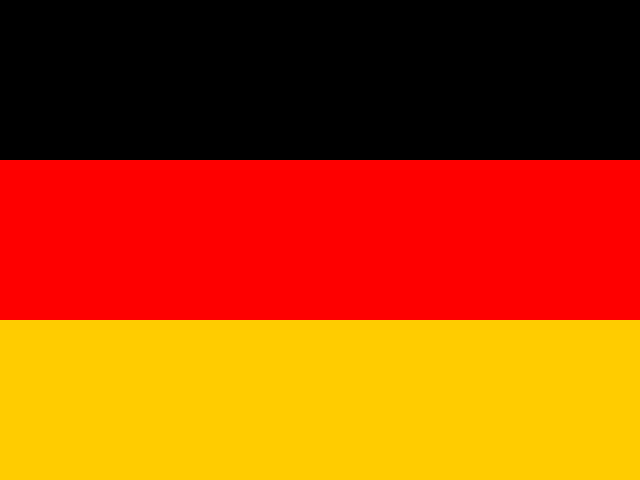
The German flag has three equal horizontal stripes of black, red and gold. Article 22 of Germany's Basic Law, its constitution, states simply that the federal flag is black, red and gold.
What the colours mean
- There is no official meaning for each colour, but together black, red and gold have stood for German unity, freedom and democracy since the 19th century.
- The uniform theory: the colours are often traced to the Lützow Free Corps, volunteers who fought against Napoleon in 1813 wearing black uniforms with red trim and gold-coloured buttons.
- The imperial theory: some also link the colours to the Holy Roman Empire, whose arms showed a black eagle with red claws on a gold background.
- A popular saying interprets the stripes as "out of darkness, through bloody battles, into the golden light of freedom", although this is a later interpretation rather than an official one.
Where the flag came from
Black, red and gold became the colours of the movement for a united and democratic Germany in the early 19th century. Student fraternities adopted them, and at the Hambach Festival of 1832, crowds marched beneath black, red and gold flags. During the revolutions of 1848, the Frankfurt Parliament adopted the colours for a united Germany, but its plans failed.
When the German Empire was founded in 1871, it chose black, white and red instead, combining the colours of Prussia and the Hanseatic cities. The democratic Weimar Republic restored black, red and gold in 1919, but the Nazi regime abolished the flag in 1933. In 1949, both new German states adopted black, red and gold. In 1959 East Germany added its state emblem of a hammer and compass inside a ring of rye, so the two flags became different, and since reunification in 1990 the plain black, red and gold flag has flown over the whole country.
Flag facts most people get wrong
- The third colour is gold, not yellow. Officially the colours are black, red and gold, reflecting the colours of 1848, even though the gold is printed as a deep yellow.
- It is not the Belgian flag turned sideways. Belgium's flag has vertical stripes of black, yellow and red, in a different order and shape.
- There is a second version. The federal service flag, with the eagle on a shield in the centre, is reserved for federal authorities; ordinary citizens use the plain tricolour.
- For decades it was rarely waved. After the Second World War many Germans were cautious about flag-waving, and many people say it was only during the 2006 World Cup, held in Germany, that flying the flag became a relaxed, everyday sight.
The German people: unity in diversity
German identity is strongly regional. People often feel as much Bavarian, Swabian, Saxon, Rhinelander, Berliner or Frisian as German, with their own dialects, foods and festivals, and the federal system gives each state real powers over areas such as education and culture. Community life is rich: Germany has hundreds of thousands of clubs and associations, or Vereine, for everything from football and choirs to gardening and volunteer firefighting.
Modern Germany is also shaped by how it remembers its past. The country has confronted the crimes of the Nazi era openly, through memorials, museums, education and small brass "stumbling stones" set into pavements outside the former homes of victims. Germany is also a country of immigration: more than a quarter of the population has a migrant background, including large communities with roots in Turkey, Poland, Russia, Italy, Syria and Ukraine. Germans have also long emigrated, and tens of millions of people in the United States, Brazil, Canada, Argentina and Australia have German ancestry.
Values that many Germans hold dear include reliability, honesty, environmental awareness, a love of nature and the outdoors, and a clear line between work and free time, from the evening Feierabend to quiet Sundays when most shops are closed.
Frequently asked questions about Germany
What is Germany most famous for?
Germany is famous for the Brandenburg Gate, Neuschwanstein Castle and Cologne Cathedral, the history of the Berlin Wall, its beer and Oktoberfest, sausages, pretzels and bread, cars such as Mercedes-Benz, BMW and Volkswagen, classical composers such as Bach and Beethoven, its Christmas markets, football, and landscapes ranging from the Black Forest to the Rhine Valley and the Alps.
What do the colours of the German flag mean?
The black, red and gold colours have no official individual meanings, but they have stood for German unity, freedom and democracy since the early 19th century. They are often traced to the uniforms of the Lützow Free Corps, who fought against Napoleon, and they were carried by democrats at the Hambach Festival in 1832 and during the revolutions of 1848.
What is the capital of Germany?
The capital is Berlin. During the division of Germany, Bonn served as the capital of West Germany, while East Berlin was the capital of East Germany. After reunification, Berlin became the capital of the whole country, and the parliament and most of the government moved there in 1999.
How many states does Germany have?
Germany has 16 states: Baden-Württemberg, Bavaria, Berlin, Brandenburg, Bremen, Hamburg, Hesse, Lower Saxony, Mecklenburg-Western Pomerania, North Rhine-Westphalia, Rhineland-Palatinate, Saarland, Saxony, Saxony-Anhalt, Schleswig-Holstein and Thuringia.
What is Germany's national day?
Germany's national day is the Day of German Unity on 3 October, which celebrates the reunification of East and West Germany in 1990. It is a public holiday across the whole country.
Is Oktoberfest really in October?
Mostly not. Munich's Oktoberfest usually begins in mid to late September and ends on the first Sunday in October, or on 3 October if that falls later. The festival was moved earlier to enjoy warmer weather.
Own a square of the German flag
On 195 Flags, the flag of Germany is being rebuilt one square at a time by people in Germany and around the world. Claim your square for $1.99 and seal a message and a photo inside it: a time capsule for your future self and the generations who come after you. And when the German flag is completely filled, one square owner wins $40,000.
Claim your square of the German flag →
Photo credits
- Brandenburg Gate (cover): Thomas Wolf, www.foto-tw.de, CC BY-SA 3.0, via Wikimedia Commons
- Neuschwanstein Castle: Wilfredor, CC0, via Wikimedia Commons
- Cologne Cathedral and Hohenzollern Bridge: Jiuguang Wang, CC BY-SA 2.0, via Wikimedia Commons
- Reichstag Building: Christian David, CC BY-SA 4.0, via Wikimedia Commons
- East Side Gallery: Gzen92, CC BY-SA 4.0, via Wikimedia Commons
- Heidelberg Castle: Eugene Alvin Villar (seav), CC BY-SA 4.0, via Wikimedia Commons
- Upper Middle Rhine Valley: Carsten Steger, CC BY-SA 4.0, via Wikimedia Commons
- Sanssouci Palace: W. Bulach, CC BY-SA 4.0, via Wikimedia Commons
- Frauenkirche and New Town Hall, Munich: Martin Falbisoner, CC BY-SA 3.0, via Wikimedia Commons
- Speicherstadt, Hamburg: Dietmar Rabich, CC BY-SA 4.0, via Wikimedia Commons
- Frauenkirche, Dresden: Dietmar Rabich, CC BY-SA 4.0, via Wikimedia Commons
- Black Forest: pictures Jettcom, CC BY 3.0, via Wikimedia Commons
- Reichsburg, Cochem: Dietmar Rabich, CC BY-SA 4.0, via Wikimedia Commons
- Frankfurt skyline: Christian Wolf (www.c-w-design.de), CC BY-SA 3.0 DE, via Wikimedia Commons
- Jasmund National Park, Rügen: Moahim, CC BY-SA 4.0, via Wikimedia Commons
- Wartburg Castle: Krzysztof Golik, CC BY-SA 4.0, via Wikimedia Commons
The German flag image is from 195flags.com.


.jpg)


.jpg)